What is JKSSB? The Definitive Guide to Jammu & Kashmir's Public Sector Recruitment
For hundreds of thousands of educated youth in Jammu and Kashmir, public sector employment represents far more than a simple career choice; it serves as a critical socioeconomic anchor in a region historically characterised by complex geopolitical realities and a developing private sector. At the absolute centre of this employment ecosystem sits a single, highly influential administrative institution responsible for evaluating, shortlisting, and allocating human capital across the entire governmental machinery.
Understanding the operational framework of this recruiting body is the foundational step for any aspirant looking to secure a government position. This exhaustive report systematically deconstructs the Jammu and Kashmir Services Selection Board, investigating its constitutional origins, digital infrastructure, rigorous evaluation metrics, and the profound policy shifts defining the 2026 recruitment landscape.
The Constitutional and Historical Genesis of the JKSSB
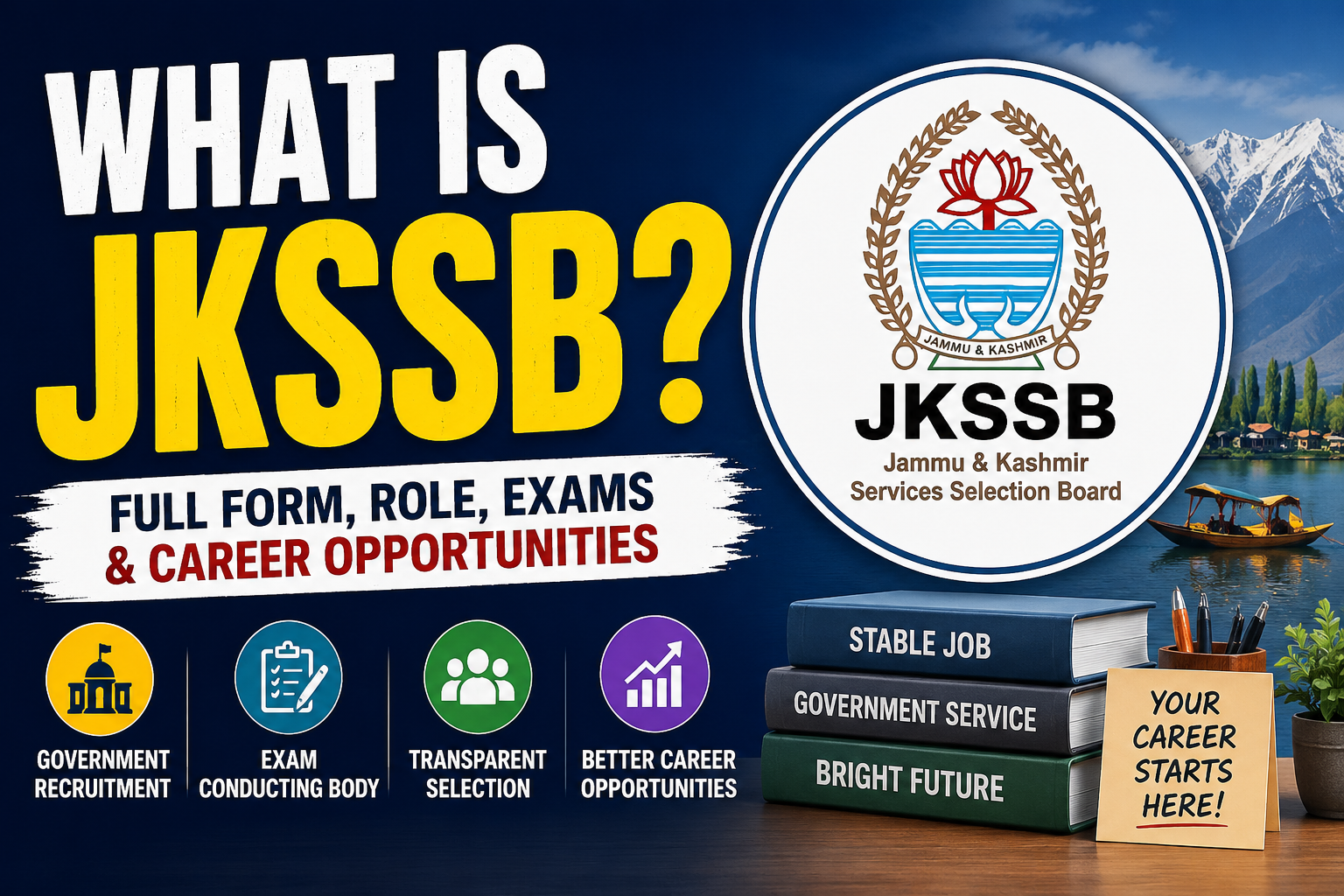
The acronym JKSSB stands for the Jammu and Kashmir Services Selection Board. Established in 1992, the board operates as the premier constitutional recruiting agency mandated to conduct examinations, interviews, and background verifications for all non-gazetted departmental services across the Union Territory.
Historically, the structural authority of the JKSSB was derived from Section 124 of the Constitution of Jammu and Kashmir. While the overarching constitutional framework of the region underwent a seismic transformation in August 2019 following the abrogation of Article 370 and the subsequent implementation of the Reorganisation Act, the JKSSB's fundamental operational mandate remains anchored in the Jammu and Kashmir Civil Services Decentralization and Recruitment Act, 2010.
This specific piece of legislation, formally known as Act No. XVI of 2010, was designed with a very distinct socio-economic purpose: to ensure equitable opportunities of employment across a region plagued by severe topographical, linguistic, and developmental disparities. The legislation acknowledged that a fully centralised recruitment process naturally favoured candidates from urban hubs with better access to educational resources, thereby disenfranchising candidates from remote, border, or economically backward districts.
To administer these complex mandates, the agency is structured with its headquarters located in the Ram Bagh area of Srinagar. The board is led by a Chairman (a senior administrative officer) and supported by a consortium of board members, all appointed directly by the Lieutenant Governor of the Union Territory. This leadership council is directly responsible for recruitment policy formulation, syllabus standardisation, and the execution of transparent examination cycles.
The Architecture of Opportunity: Understanding the Cadre System
The most distinctive feature of the JKSSB's operational model—and one that separates it from many other state-level public service commissions in India—is its rigid adherence to a decentralised cadre system. Under the 2010 Decentralisation Rules, recruitment is strictly compartmentalised to protect local employment rights while maintaining administrative efficiency.
The system classifies non-gazetted recruitment into three distinct administrative tiers.
| Cadre Classification | Administrative Scope | Pay Scale Limitation |
| District Cadre | Restricted to the boundaries of a specific district. | Basic pay does not exceed that of a Senior Assistant. |
| Divisional Cadre | Spans either the Jammu Division or the Kashmir Division. | Basic pay exceeds a Senior Assistant but remains below a Sectional Officer. |
| UT Cadre (formerly State Cadre) | Spans the entire Union Territory. | High-level non-gazetted posts spanning multiple departments. |
Data sourced from the J&K Civil Services Decentralization and Recruitment Act, 2010.
The implications of this cadre system are profound for applicants. A candidate successfully applying for a District Cadre post must possess a domicile certificate linking them to that specific geography. Furthermore, the rules actively prohibit inter-cadre transfers. An employee recruited under a specific District Cadre cannot be arbitrarily transferred to another District Cadre or elevated to a Divisional Cadre post outside of heavily regulated promotional pathways. Promotional movement from District to Divisional cadres, or Divisional to UT cadres, is calculated strictly on a proportional ratio based on the total cadre strength, ensuring that vertical mobility remains meritocratic and mathematically balanced.
Decoding the Eligibility Matrix: The 2026 Guidelines
To participate in any JKSSB recruitment drive, candidates must navigate a rigorous labyrinth of eligibility requirements. These parameters are strictly enforced by the digital application portal, and failure to present valid, original documentation during the final physical verification stage results in immediate, non-negotiable disqualification.
The Domicile Requirement: A Post-2019 Reality
Prior to 2019, JKSSB recruitment was restricted under Article 35A to 'Permanent Residents' of the state. Today, the system requires a valid Domicile Certificate issued by a competent revenue authority.
The transition to the domicile system introduced specific criteria for eligibility. Under Section 3A of the amended decentralisation rules, a domicile is defined as anyone who has resided in the Union Territory for a continuous period of fifteen years, or an individual who has studied within the region for seven years and appeared for either their Class 10th or Class 12th examinations in a local educational institution. Furthermore, children of Central Government officials, public sector bank employees, or members of statutory bodies who have served in Jammu and Kashmir for a total period of ten years are also granted domicile status for the purpose of employment. The certificate must be actively valid on or before the final cut-off date of the online application submission; retroactive certifications are routinely rejected by the board.
Demographic Baselines: Age Limit Regulations
Age limits are universally applied across JKSSB notifications, calculated typically as of January 1 of the recruiting year (for example, January 1, 2026, for the current recruitment cycle). The board provides standardised age relaxations for reserved categories, balancing the need for a dynamic workforce with the constitutional mandate for inclusive representation.
| Social Category | Maximum Age Limit | Birth Date Threshold (For 2026 Cycle) |
| Open Merit (OM) | 40 Years | Not born before 01.01.1986 |
| SC / ST / RBA / ALC-IB | 43 Years | Not born before 01.01.1983 |
| EWS / OBC / Social Caste | 43 Years | Not born before 01.01.1983 |
| Physically Challenged (PwBD) | 42 Years | Not born before 01.01.1984 |
| Ex-Servicemen | 48 Years | Not born before 01.01.1978 |
| Govt. Service / Contractual | 40 Years | Not born before 01.01.1986 |
Data accurately reflects standard age limit frameworks published in recent JKSSB notifications.
Educational Baselines and Functional Specialisations
The JKSSB caters to a remarkably broad spectrum of educational backgrounds, effectively functioning as the employment gateway for everyone from middle-school leavers to postgraduates.
For grassroots administrative and maintenance roles—such as Class IV attendants, Junior Graders, or Wildlife Guards—the baseline requirement is a Matriculation (10th standard) certificate. Interestingly, for certain Class IV positions, the board enforces a maximum educational limit of 10+2, actively preventing overqualified graduates from monopolising entry-level labour positions intended for less educated demographics.
Mid-level technical roles demand specific vocational training. For instance, an Electrician in the Animal Husbandry department requires an ITI certification in the electrical trade, while a Refrigerator Mechanic must hold a Diploma in Mechanical or Electrical Engineering with a documented specialisation.
At the upper echelons of the non-gazetted hierarchy, positions like Sub-Inspectors, Finance Account Assistants, Patwaris, and General Line Teachers mandate recognised university degrees. Certain roles blend academic achievement with practical skill requirements; a Junior Assistant, for example, must possess a graduation degree alongside a certified typing speed of 35 words per minute. All academic credentials must be definitively completed by the application deadline, meaning candidates awaiting final semester university results are ineligible to apply.
The Digital Transition: Navigating the JKSSB Portal
Over the past decade, the JKSSB has aggressively modernised its application infrastructure, completely eliminating paper-based submissions in favour of a centralised digital portal (jkssb.nic.in). This transition to e-governance aims to reduce administrative friction and eliminate the manual handling errors that previously plagued the recruitment pipeline. [Internal Link: The Impact of E-Governance on Public Sector Hiring]
For candidates, interacting with this portal requires strict adherence to digital protocols. The process begins with Candidate Registration, establishing a Single Sign-On (SSO) profile. This step demands an active mobile number and email address, both verified via a One Time Password (OTP) gateway. The system design enforces immutability on core identity fields; once a candidate registers their First Name, Last Name, and Gender, these data points are locked into the database and cannot be altered through the user interface.
Upon logging in, applicants navigate to the "Latest Openings" interface to select their desired advertisement. The UX of the application form requires the upload of heavily compressed digital assets. Both the recent passport-sized photograph and the digital signature must conform strictly to a maximum file size of 1 MB, structured within a 4.5 x 3.5 cm dimension parameter.
Once an application is populated, the platform routes the user to a digital payment gateway. Application fees vary based on the post and the applicant's social category. For example, recent technical and administrative notifications set the standard fee at ₹600 for General/Open Merit candidates, with a discounted rate of ₹500 for SC, ST, EWS, and PwBD categories. For lower-tier Class IV positions, the fee is adjusted downwards to ₹350.
A critical functional aspect of the JKSSB portal is its strict submission finality. Once the fee is successfully remitted and the Application ID is generated, the form is locked. Candidates cannot edit their submissions unless the board explicitly enables a temporary "Edit Option" window post-deadline. If a severe error is detected by the applicant before the deadline, their only recourse is to completely cancel the application—forfeiting the initial fee—and submit a fresh form with a new payment.
Examination Architecture and Evaluation Metrics
The modern JKSSB selection process heavily favours objective, standardised testing, having largely phased out subjective personal interviews for lower and middle-tier posts. This policy shift was engineered to drastically reduce allegations of nepotism and inject a higher degree of empirical transparency into the evaluation matrix.
The Standardised Testing Format
The cornerstone of the evaluation is an objective-type Multiple Choice Question (MCQ) examination. Depending on the volume of applicants and logistical constraints, the board deploys either traditional Optical Mark Recognition (OMR) sheets or advanced Computer-Based Tests (CBT). The examinations are conducted exclusively in the English language.
Crucially, the board enforces a strict negative marking penalty across its examinations. To deter statistical guessing, 0.25 marks are deducted from the final score for every incorrect answer. Unattempted questions carry no penalty.
Structural Variations by Post
The duration and total marks of the examination are dynamically adjusted to match the complexity of the advertised post.
For the ubiquitous Class IV examinations, candidates face a 120-minute test comprising 100 questions, divided equally across Mathematics, Reasoning, English, and a heavier weighting for General Awareness.
| JKSSB Class IV Exam Pattern | Question Count | Total Marks |
| Basic Mathematics | 20 | 20 |
| Basic Reasoning | 20 | 20 |
| Basic English | 20 | 20 |
| General Awareness & Science | 40 | 40 |
| Total Duration: 120 Minutes | 100 | 100 |
Structure based on official JKSSB Class IV syllabi.
Conversely, the Junior Assistant examination operates on an 80-mark framework over 80 minutes. This reduction in written testing scope accommodates the mandatory typing skill test. The typing evaluation, requiring a baseline speed of 35 words per minute, accounts for the remaining 20 points of the candidate's final merit calculation.
For more specialised roles, such as the Supervisor posts, the exam expands to a rigorous 120-minute, 120-mark evaluation. This includes 60 marks dedicated purely to domain-specific specialisations like sociology, child development, and home science, combined with 60 marks of general aptitude testing.
Syllabic Depth and Subject Matter
The generic syllabus components demand a wide breadth of knowledge:
General English: Evaluates structural language proficiency. Key topics include reading comprehension, determiners, syntax error spotting, active/passive voice manipulation, and vocabulary retention (synonyms, antonyms, idiomatic expressions).
Numerical Aptitude: Requires rapid mental calculation. Topics range from foundational arithmetic (percentages, averages, ratios) to advanced quantitative concepts (probability, logarithms, surds and indices, heights and distances).
Logical Reasoning: Tests spatial and analytical deduction through number series, coding-decoding algorithms, blood relationship matrices, and Venn diagram interpretations.
General Awareness (J&K Centric): The highest-weighted non-technical section. It demands an exhaustive understanding of the Union Territory. Candidates must master ancient texts like Kalhana's Rajatarangini, the architectural contributions of the Karkota dynasty, the agricultural reforms of Avantivarman, and the modern constitutional timeline surrounding the Instrument of Accession and the abrogation of Article 370.
Socio-Economic Engineering: The Class IV Weightage System
While standard examinations rely purely on academic merit, the JKSSB implements a highly progressive socio-economic weightage system for its entry-level Class IV recruitment drives. Formulated under the Appointment to Class-IV (Special Recruitment) Rules, 2020, this system is a direct administrative intervention aimed at poverty alleviation and social justice.
Under this framework, the written examination accounts for 85 marks for a UT Cadre post (or 80 marks for a District Cadre post) out of a total 100. The remaining 15 to 20 marks are awarded based on documented socio-economic vulnerabilities:
| Socio-Economic Criterion | Marks Awarded | Documentation Required |
| No Government Employee in Family | 5 Marks | Affidavit confirming no family member works in Govt, PSU, or Autonomous bodies. |
| Widows, Divorced Women, Orphan Girls | 5 Marks | Legal certification issued by a Tehsildar. |
| Long-term Casual Workers | 5 Marks | Proof of wages for 5+ years, countersigned by District/Divisional Head. |
| Home District Preference | 10 Marks (District Cadre Only) | Verified Domicile Certificate linking candidate to the specific district. |
This mathematical adjustment ensures that candidates originating from historically disenfranchised backgrounds, or those lacking the financial safety net of existing government employment within their immediate family, are granted a quantifiable competitive advantage at the entry level of the public sector.
Free Mcqs for jkssb jkssbmocktests.in around 50K +
Financial Realities: Salary Structures and Career Progression
The financial stability offered by JKSSB appointments remains the primary driver behind the intense competition. Salaries are calculated based on the matrix established by the 7th Pay Commission, factoring in Basic Pay, Dearness Allowance (DA), and House Rent Allowance (HRA).
Consider the highly anticipated General Line Teacher vacancies. These positions are positioned at Pay Level 5, which features an entry Basic Pay of ₹29,200.
The gross monthly compensation fluctuates based on the geographical posting due to varying HRA rates. Teachers posted in urban centres like Jammu or Srinagar receive an HRA calculated at 20% of their basic pay, whereas postings in rural or peripheral districts receive a 10% HRA.
Assuming a current DA rate of 58% (₹16,936).
Urban Posting Gross: Basic (₹29,200) + DA (₹16,936) + HRA 20% (₹5,840) + Allowances (₹3,600) = ~₹55,576.
Rural Posting Gross: Basic (₹29,200) + DA (₹16,936) + HRA 10% (₹2,920) + Allowances (₹3,600) = ~₹52,656.
However, the take-home pay is subject to mandatory deductions. Employees are automatically enrolled in the National Pension System (NPS), which requires a 10% deduction from their Basic Pay (₹2,920), alongside nominal professional tax deductions.
Higher-tier technical roles command significantly steeper pay scales. A Staff Nurse, for instance, operates under Level 6D (₹35,800 – ₹1,13,200), while a Sub-Inspector sits at Level 6C (₹35,700 – ₹1,13,100). The predictability of these increments, combined with the comprehensive healthcare and pension benefits associated with state employment, creates a highly lucrative proposition for local graduates. [Internal Link: Analysing the 7th Pay Commission Impact on State Economies]
Bureaucratic Friction: Legal Hurdles and Recruitment Timelines
While the JKSSB has made immense strides in digitising and standardising its processes, it remains susceptible to the bureaucratic friction inherent in Indian public sector recruitment.
The timeline from the release of an advertisement notification to the issuance of a final appointment letter is rarely linear. It is frequently disrupted by legal challenges. Candidates regularly file writ petitions and original applications in the Central Administrative Tribunal (CAT) or the High Court challenging everything from syllabus discrepancies to the misinterpretation of domicile clauses.
For example, cases frequently arise where candidates attempt to exploit the decentralisation rules. In a notable tribunal case (Sukriti Sharma v. D/O Education), a candidate whose husband was domiciled in Udhampur attempted to apply for a District Cadre post in Jammu. The tribunal upheld the JKSSB's decision to cancel her selection ab initio, ruling that under Section 13 of the 2010 Act, a married woman's residence for the purpose of cadre determination is legally dependent upon her husband's domicile.
Similarly, the board has faced extensive litigation regarding the reservation of posts and the accurate compilation of waiting lists, leading to scenarios where selectees have had to wait months or even years for court-ordered clearances before assuming their roles. Aspirants preparing for JKSSB examinations must, therefore, cultivate not just academic excellence, but exceptional psychological resilience to endure these administrative delays.
Frequently Asked Questions (FAQ)
What is the foundational requirement to apply for any JKSSB post in 2026? Beyond specific educational qualifications, the absolute non-negotiable baseline is the possession of a valid Domicile Certificate of the Union Territory of Jammu and Kashmir, issued by a competent revenue authority prior to the application deadline.
How does the negative marking system affect the exam strategy? Because the JKSSB enforces a 0.25 mark penalty for every incorrect answer, blind guessing is statistically detrimental. Candidates are advised to employ calculated elimination strategies and leave questions blank if they have no contextual understanding, as unattempted questions do not attract penalties.
What is the difference between the JKSSB and the JKPSC? The Jammu and Kashmir Services Selection Board (JKSSB) is responsible solely for recruiting candidates to non-gazetted and Class IV posts. The Jammu and Kashmir Public Service Commission (JKPSC) handles the recruitment for higher-level, gazetted administrative, police, and judicial services.
Are CTET and B.Ed sufficient for JKSSB Teacher posts in 2026? No. Following the 2026 directives enforcing the RTE Act, possessing a B.Ed is no longer sufficient on its own. Candidates must clear the Jammu and Kashmir Teacher Eligibility Test (JKTET) conducted by JKBOSE to even be eligible to apply for JKSSB elementary teacher vacancies.
Can an application form be modified after the fee is paid? Under normal operating procedures, the JKSSB portal locks the application immutably upon successful fee generation. Modifications are only possible if the board officially announces a temporary "Edit Option" window after the submission deadline. Otherwise, candidates must cancel their application and reapply with a fresh fee.
Listen dear aspirants if any tools regarding form fill up need, visit proainex.com best website for free tools, like u need to edit photo or pdf maker or anything regarding fill up form of jkssb
Navigating the Future of J&K Public Sector Recruitment
The Jammu and Kashmir Services Selection Board is much more than an examination conducting body; it is the primary engine of socio-economic mobility for the region. By architecting a system that harmonises rigorous academic testing with a decentralised cadre structure and targeted socio-economic weighting, the board attempts to balance the competing demands of administrative meritocracy and regional equity.
For the 2026 aspirant, the path to a JKSSB appointment requires unprecedented preparation. The introduction of the JKTET mandate, the strict enforcement of domicile laws, and the unforgiving nature of the digital application portal demand a highly strategic approach. Success in this ecosystem requires not just a mastery of mathematics and local history, but an acute understanding of the legal and administrative rules governing the recruitment process itself. Navigating this labyrinth is challenging, but the reward—a secure, respected, and financially stable career within the state's administrative machinery—remains one of the most coveted achievements in the region.