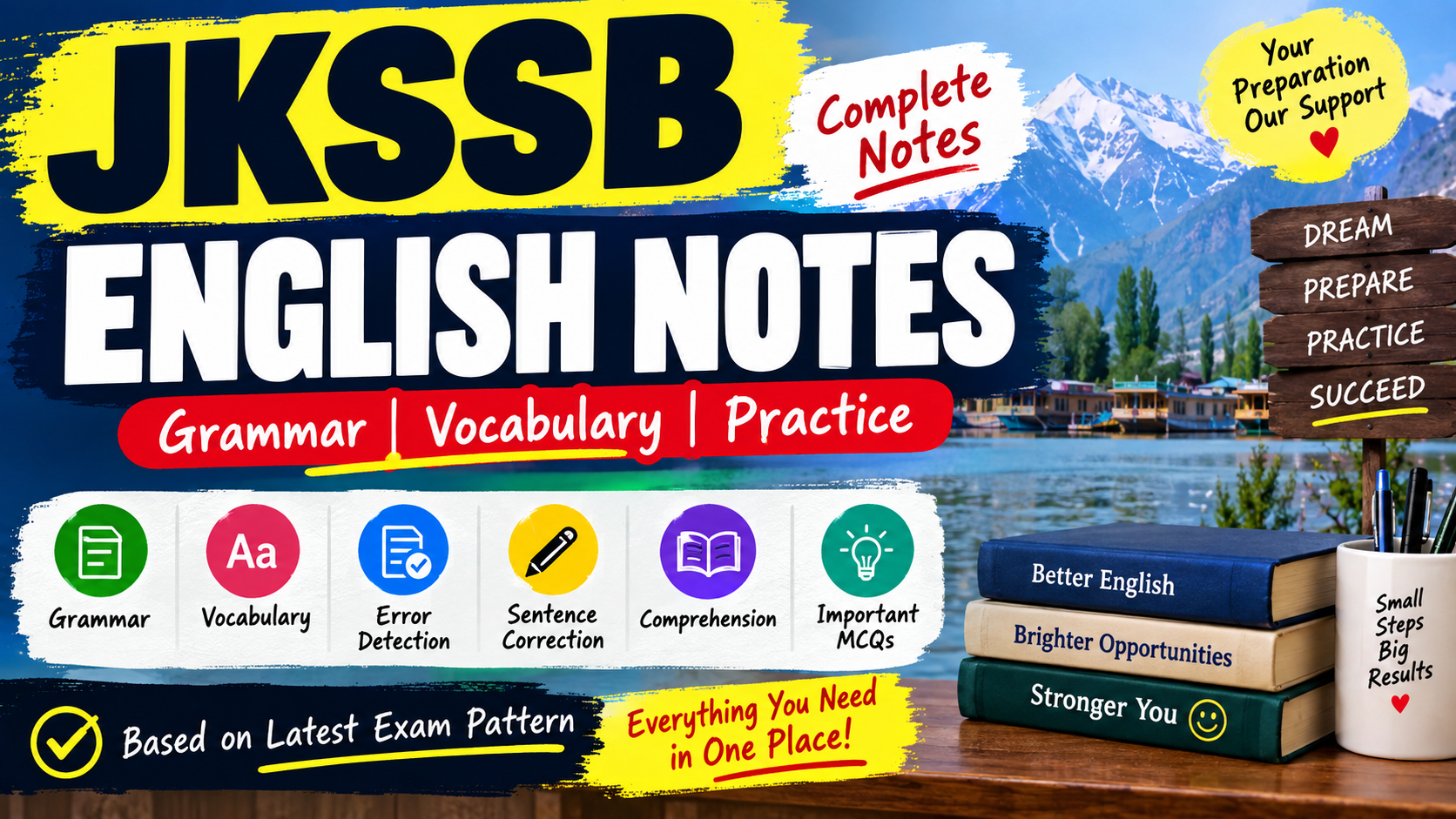
General English Articles – Complete Conceptual Notes for JKSSB Aspirants
Introduction
Articles are among the smallest words in English grammar, but they create some of the biggest mistakes in competitive examinations.
Many JKSSB aspirants know vocabulary and basic grammar, yet lose marks because of incorrect article usage.
Chck Complete Courses for all exams
Consider these sentences:
❌ He is teacher.
✅ He is a teacher.
❌ Sun rises in east.
✅ The Sun rises in the east.
❌ I saw an European.
✅ I saw a European.
Such questions are extremely common in:
- JKSSB
- JKPSC
- SSC
- Banking Exams
- Railways
- Police Recruitment Exams
- State Government Examinations
A strong understanding of Articles helps in:
- Error Detection
- Sentence Improvement
- Fill in the Blanks
- Cloze Tests
- Grammar-Based MCQs
- Descriptive English
Before learning rules, let us understand the fundamental concept.
What is an Article?
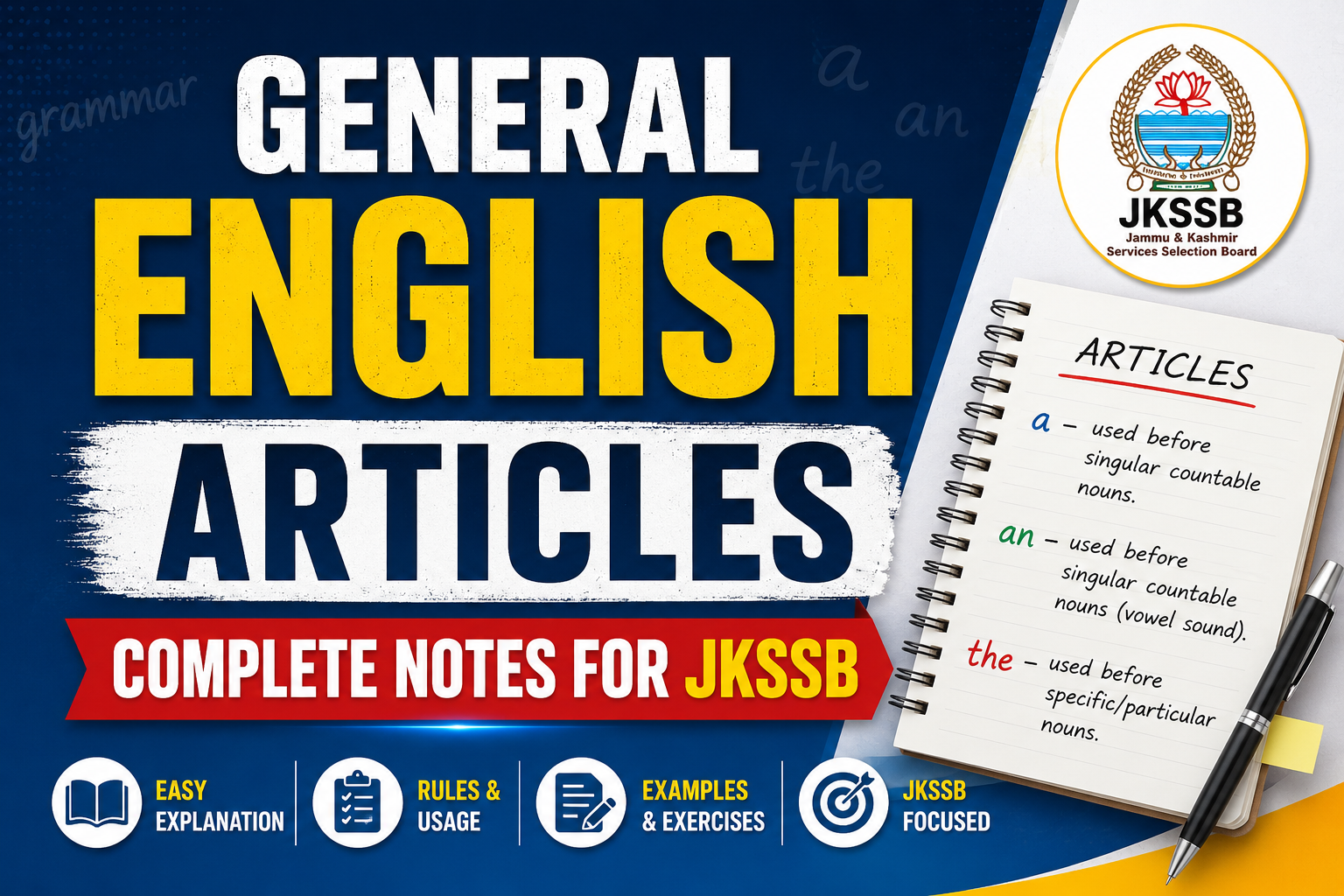
An Article is a word placed before a noun to indicate whether the noun is specific or non-specific.
English has only three articles:
| Article | Type |
|---|---|
| A | Indefinite Article |
| An | Indefinite Article |
| The | Definite Article |
Quick Definition
Indefinite Articles
"A" and "An" refer to a person, place, animal, or thing that is not specific.
Example:
- I saw a boy.
- She bought an apple.
Here we do not know which boy or which apple.
Definite Article
"The" refers to a specific person, place, animal, or thing.
Example:
- The boy who won the race is my friend.
Now the boy is specific.
Classification of Articles
| Type | Articles |
|---|---|
| Indefinite Articles | A, An |
| Definite Article | The |
Indefinite Article "A"
Basic Rule
"A" is used before words beginning with a consonant sound.
Notice carefully:
The rule is based on SOUND, not alphabet.
This is where examiners create tricky questions.
Examples
- a boy
- a girl
- a pen
- a teacher
- a university
- a European
Many students think:
University starts with U.
Therefore it should be "an university".
This is incorrect.
Why?
Because the pronunciation begins with:
"Yu"
which is a consonant sound.
Hence:
✅ a university
❌ an university
Common Examples of "A"
| Correct Usage |
|---|
| a boy |
| a cat |
| a pen |
| a doctor |
| a university |
| a union |
| a European |
| a one-rupee coin |
Why Sound Matters More Than Letter
This is among the most frequently tested concepts.
Look carefully:
| Word | Sound Starts With | Article |
|---|---|---|
| University | Yu | A |
| European | Yu | A |
| Union | Yu | A |
| One | W | A |
Examples:
✅ a university
✅ a European country
✅ a union leader
✅ a one-eyed man
JKSSB Exam Trap
Students often follow spelling instead of pronunciation.
Question:
___ European visited India.
Options:
A. A
B. An
Answer:
✅ A European visited India.
Uses of Article "A"
1. Before Singular Countable Nouns
Examples:
- a boy
- a chair
- a dog
- a book
Sentence:
- I bought a book.
2. Meaning "One"
Sometimes "A" means one.
Example:
- A hundred students attended.
Meaning:
One hundred students attended.
3. Before Professions
Examples:
- He is a doctor.
- She is a teacher.
- He is a lawyer.
4. Before Certain Numbers
Examples:
- a thousand
- a million
- a dozen
5. In Expressions of Rate
Examples:
- ₹100 a kilogram
- twice a day
- four times a month
Indefinite Article "AN"
Basic Rule
"An" is used before a vowel sound.
Again remember:
NOT vowel letter.
Vowel SOUND.
Examples
- an apple
- an orange
- an elephant
- an umbrella
Table of Common Examples
| Word | Correct Article |
|---|---|
| Apple | An |
| Elephant | An |
| Orange | An |
| Inkpot | An |
| Umbrella | An |
Special Cases of "AN"
These are favourite examination areas.
Before Silent H
Words beginning with silent H take "AN".
Examples:
- an honest man
- an hour
- an honour
- an heir
Reason:
The H is not pronounced.
Pronunciation Logic
| Word | Actual Sound |
|---|---|
| Honest | Onest |
| Hour | Our |
| Honour | Onour |
Therefore:
✅ an honest man
❌ a honest man
Important Exam Examples
| Correct Form |
|---|
| an hour |
| an honour |
| an honest officer |
| an heir |
Students Often Confuse
| Correct | Incorrect |
|---|---|
| an hour | a hour |
| an honest man | a honest man |
| a university | an university |
| a European | an European |
Difference Between A and AN
| A | AN |
|---|---|
| Used before consonant sounds | Used before vowel sounds |
| a boy | an apple |
| a university | an hour |
| a European | an honest man |
Definite Article "THE"
Now we move to the most important article in English grammar.
Questions involving "The" appear very frequently in JKSSB examinations.
What is THE?
"The" refers to a specific person, place, animal, thing, or group already known to the speaker and listener.
Example:
I saw a dog.
The dog was barking.
In the second sentence, we already know which dog is being discussed.
Major Uses of THE
1. Before Specific Nouns
Example:
- The boy standing near the gate is my brother.
Specific boy.
2. Before Unique Things
There is only one of these.
Examples:
- the Sun
- the Moon
- the Earth
- the sky
Sentence:
- The Sun rises in the east.
Quick Revision Table
| Unique Object | Usage |
|---|---|
| Sun | The Sun |
| Moon | The Moon |
| Earth | The Earth |
| Sky | The Sky |
3. Before Rivers
This is a highly important static grammar rule.
Examples:
- the Ganga
- the Yamuna
- the Chenab
- the Jhelum
- the Indus
For JKSSB students, remember especially:
- the Chenab
- the Jhelum
- the Ravi
- the Tawi
River Rule Table
| River |
|---|
| the Ganga |
| the Jhelum |
| the Chenab |
| the Ravi |
| the Indus |
4. Before Mountain Ranges
Use "The".
Examples:
- the Himalayas
- the Alps
- the Andes
Students Often Confuse
| Correct | Incorrect |
|---|---|
| the Himalayas | Himalayas |
| Mount Everest | the Mount Everest |
Important Observation
Use "The" with mountain ranges.
But not with individual peaks.
Examples:
✅ the Himalayas
✅ Mount Everest
❌ the Mount Everest
5. Before Seas, Oceans and Gulfs
Examples:
- the Arabian Sea
- the Indian Ocean
- the Pacific Ocean
- the Bay of Bengal
6. Before Newspapers
Examples:
- The Hindu
- The Tribune
- The Times of India
7. Before Holy Books
Examples:
- the Gita
- the Quran
- the Bible
8. Before Superlative Degree
Whenever a superlative adjective is used:
Use THE.
Examples:
- the best
- the tallest
- the greatest
- the richest
Sentence:
- Sachin is the greatest batsman.
9. Before Ordinal Numbers
Examples:
- the first
- the second
- the third
- the tenth
Sentence:
- He secured the first rank.
10. Before Musical Instruments
Examples:
- the flute
- the violin
- the guitar
- the piano
Sentence:
- She plays the guitar.
Zero Article (No Article)
This topic is often ignored by students but regularly appears in exams.
Zero Article means no article is used.
Before Proper Nouns
Examples:
- India
- Jammu
- Kashmir
- Delhi
- Srinagar
Correct:
- India is a democratic country.
Incorrect:
- The India is a democratic country.
Before Languages
Examples:
- English
- Hindi
- Urdu
- Kashmiri
Correct:
- She speaks English.
Before Subjects
Examples:
- History
- Geography
- Mathematics
- Science
Correct:
- Geography is my favourite subject.
Before Meals
Examples:
- breakfast
- lunch
- dinner
Sentence:
- We had lunch together.
Quick Revision Block
| No Article Used Before |
|---|
| Languages |
| Subjects |
| Meals |
| Proper Names |
| Days |
| Months |
Important Competitive Exam Exceptions
The Punjab, The Netherlands, The United States
Some countries take "The".
Examples:
- the United States
- the Netherlands
- the UAE
The Rich, The Poor
"The" + Adjective = Whole Class
Examples:
- the rich
- the poor
- the blind
Meaning:
Entire group.
Memory Trick for Articles
A = Consonant Sound
Think:
A → Before Boy
AN = Vowel Sound
Think:
AN → Before Apple
THE = Specific
Think:
THE → Particular Person or Thing
One-Look Revision Table
| Rule | Example |
|---|---|
| A before consonant sound | a university |
| An before vowel sound | an apple |
| An before silent H | an hour |
| The before rivers | the Chenab |
| The before oceans | the Indian Ocean |
| The before superlatives | the best |
| No article before languages | English |
| No article before subjects | Geography |
JKSSB Most Asked Facts
- Articles depend on pronunciation.
- "University" takes A.
- "Hour" takes AN.
- Rivers take THE.
- Mountain ranges take THE.
- Individual peaks usually do not take THE.
- Languages generally take no article.
- Superlative degrees require THE.
Practice MCQs for JKSSB
1. Choose the correct article.
He is ___ honest man.
A. A
B. An
C. The
D. No Article
Answer: B
Solution: Honest begins with a vowel sound because H is silent.
2. She studies ___ English.
A. A
B. An
C. The
D. No Article
Answer: D
Solution: Languages generally do not take articles.
3. ___ Sun rises in the east.
A. A
B. An
C. The
D. No Article
Answer: C
Solution: Sun is unique.
4. He bought ___ umbrella.
A. A
B. An
C. The
D. No Article
Answer: B
Solution: Umbrella begins with a vowel sound.
5. Mount Everest is in ___ Himalayas.
A. A
B. An
C. The
D. No Article
Answer: C
Solution: Mountain ranges take "The".
6. She is ___ university student.
A. A
B. An
C. The
D. No Article
Answer: A
Solution: University starts with "Yu" sound.
7. He waited for ___ hour.
A. A
B. An
C. The
D. No Article
Answer: B
Solution: Hour has silent H.
8. Ravi is ___ best player in the team.
A. A
B. An
C. The
D. No Article
Answer: C
Solution: Superlative degree requires "The".
Frequently Asked Questions (FAQs)
What are Articles in English Grammar?
Articles are determiners used before nouns to indicate whether the noun is specific or non-specific. The three articles are A, An, and The.
What is the difference between A and An?
A is used before consonant sounds, while An is used before vowel sounds.
Example:
- a university
- an umbrella
Why do we say "an hour" but "a university"?
Because article usage depends on pronunciation, not spelling.
- hour → vowel sound → an
- university → consonant sound (yu) → a
Where is "The" used?
"The" is used before:
- Specific nouns
- Rivers
- Oceans
- Mountain ranges
- Superlatives
- Ordinal numbers
- Unique objects
Are Articles important for JKSSB?
Yes. Articles are regularly asked in:
- Error Detection
- Fillers
- Sentence Correction
- Grammar MCQs
- Cloze Tests
Final Revision Summary
| Topic | Key Point |
|---|---|
| A | Before consonant sound |
| An | Before vowel sound |
| The | Before specific nouns |
| Silent H | Use An |
| Rivers | Use The |
| Oceans | Use The |
| Superlatives | Use The |
| Languages | No Article |
| Subjects | No Article |
| Meals | No Article |
Last-Minute JKSSB Revision Formula
A → Consonant Sound
AN → Vowel Sound
THE → Specific Thing
No Article → Languages, Subjects, Meals, Proper Names
Mastering these rules alone can help you answer a large number of grammar questions correctly in JKSSB examinations and avoid the most common article-related traps set by examiners.