JKSSB Laboratory Assistant Syllabus 2026: Complete Exam Pattern, Subject-Wise Topics
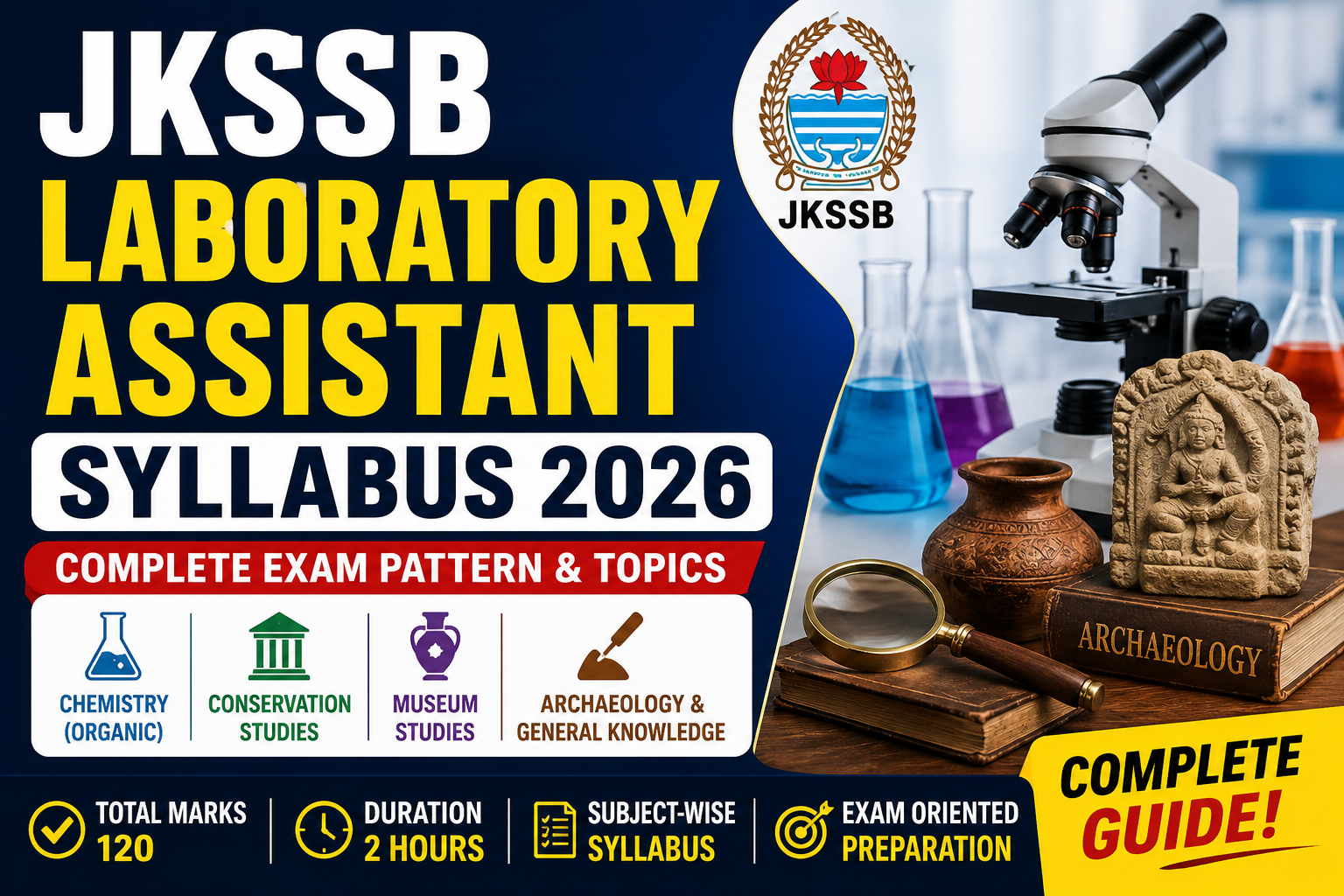
The Jammu and Kashmir Services Selection Board (JKSSB) Laboratory Assistant examination is one of the most important recruitment examinations for candidates belonging to Chemistry, Conservation, Museum Studies, Archaeology, and related disciplines. Candidates preparing for the JKSSB Laboratory Assistant Recruitment 2026 must have a clear understanding of the latest syllabus, exam pattern, marks distribution, and important topics to score well in the examination.
In this article, we have provided the complete JKSSB Laboratory Assistant Syllabus 2026 in a simplified and exam-oriented manner so that candidates can prepare effectively and cover every important topic before the examination.
JKSSB Laboratory Assistant Exam Pattern 2026
Before starting preparation, candidates should understand the examination structure.
| Particulars | Details |
|---|---|
| Total Marks | 120 Marks |
| Duration | 2 Hours |
| Type of Exam | Objective Type |
| Questions | Multiple Choice Questions |
| Negative Marking | As per JKSSB norms |
The examination consists of specialized Chemistry topics, Conservation Studies, Museum Studies, Archaeology, and General Knowledge related to archives and antiquities.
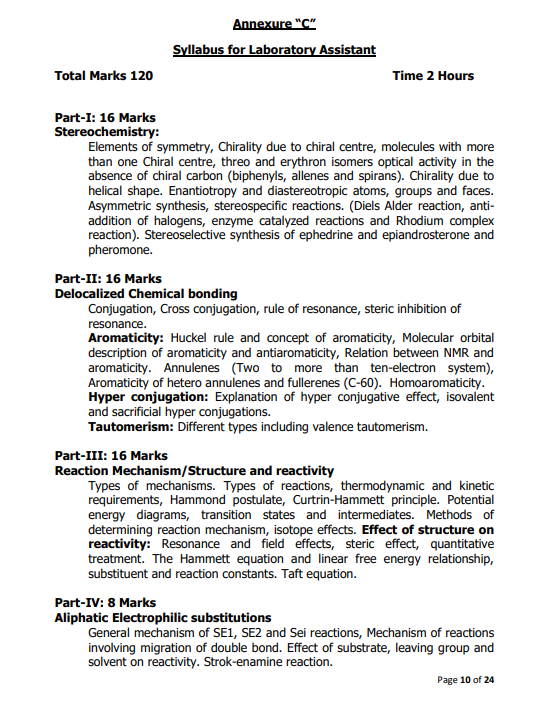
Part-I: Stereochemistry (16 Marks)
Stereochemistry is one of the most important sections of the syllabus and carries significant weightage.
Topics Covered
Elements of Symmetry
Candidates should study:
- Plane of symmetry
- Centre of symmetry
- Axis of symmetry
- Improper axis of symmetry
Chirality
Important concepts include:
- Chiral center
- Optical isomerism
- Enantiomers
- Diastereomers
Molecules with More Than One Chiral Centre
Students should understand:
- Configuration determination
- Multiple stereogenic centers
- Optical activity
Threo and Erythro Isomers
Frequently asked concepts:
- Fischer projections
- Difference between threo and erythro forms
- Configuration assignments
Optical Activity Without Chiral Carbon
Special attention should be given to:
- Biphenyls
- Allenes
- Spirans
Helical Chirality
Understand:
- Helical molecules
- Chirality due to molecular shape
Enantiotopic and Diastereotopic Atoms, Groups and Faces
Important for advanced stereochemical analysis.
Asymmetric Synthesis
Study:
- Principles of asymmetric synthesis
- Stereospecific reactions
Important Reactions
- Diels-Alder Reaction
- Anti-addition of Halogens
- Enzyme Catalyzed Reactions
- Rhodium Complex Reactions
Stereoselective Syntheses
Prepare:
- Ephedrine synthesis
- Epiandrosterone synthesis
- Pheromone synthesis
Part-II: Delocalized Chemical Bonding (16 Marks)
This section focuses on resonance, aromaticity, tautomerism, and hyperconjugation.
Conjugation
Study:
- Simple conjugation
- Cross conjugation
- Resonance stabilization
Resonance
Important topics:
- Resonance structures
- Rules of resonance
- Steric inhibition of resonance
Aromaticity
Very important topic.
Huckel Rule
Candidates should know:
- (4n + 2) π electron rule
- Aromatic compounds
- Non-aromatic compounds
- Antiaromatic compounds
Molecular Orbital Theory
Understand:
- Aromatic stabilization
- Antiaromaticity
NMR and Aromaticity
Relationship between aromaticity and NMR behavior.
Annulenes
Study:
- Two-electron systems
- Larger annulene systems
- Aromatic and antiaromatic annulenes
Aromaticity of Hetero Annulenes
Examples include:
- Pyrrole
- Furan
- Thiophene
Fullerenes (C-60)
Structure and aromatic nature.
Homoaromaticity
Concept and examples.
Hyperconjugation
Topics include:
- Hyperconjugative effect
- Isovalent hyperconjugation
- Sacrificial hyperconjugation
Tautomerism
Study all types including:
- Keto-enol tautomerism
- Valence tautomerism
Part-III: Reaction Mechanism, Structure and Reactivity (16 Marks)
This unit is highly important for conceptual understanding.
Types of Reaction Mechanisms
Study:
- Ionic mechanisms
- Radical mechanisms
- Concerted mechanisms
Types of Reactions
- Addition reactions
- Elimination reactions
- Substitution reactions
- Rearrangement reactions
Thermodynamic and Kinetic Requirements
Understand:
- Thermodynamic control
- Kinetic control
Hammond Postulate
Very important theoretical concept.
Curtin-Hammett Principle
Frequently asked in higher-level organic chemistry.
Potential Energy Diagrams
Study:
- Reaction coordinate diagrams
- Transition states
- Intermediates
Isotope Effects
Understand:
- Primary isotope effect
- Secondary isotope effect
Effect of Structure on Reactivity
Topics include:
- Resonance effect
- Field effect
- Steric effect
Hammett Equation
Important concepts:
- Linear Free Energy Relationship (LFER)
- Reaction constants
- Substituent constants
Taft Equation
Applications and significance.
Part-IV: Aliphatic Electrophilic Substitution (8 Marks)
General Mechanisms
Prepare:
- SE1 Mechanism
- SE2 Mechanism
- SEi Mechanism
Double Bond Migration
Mechanism and applications.
Factors Affecting Reactivity
- Nature of substrate
- Leaving group effects
- Solvent effects
Stork Enamine Reaction
Mechanism and synthetic applications.
Part-V: Aliphatic Nucleophilic Substitution (8 Marks)
One of the most frequently asked organic chemistry topics.
SN1 Mechanism
Study:
- Carbocation formation
- Rate-determining step
- Stereochemistry
SN2 Mechanism
Important concepts:
- Backside attack
- Inversion of configuration
SNi Mechanism
Mechanism and stereochemical outcome.
Neighbouring Group Participation
Study participation through:
- Single bonds
- Double bonds
Factors Affecting Reaction Rates
- Substrate structure
- Nucleophile strength
- Leaving group ability
- Solvent effects
Mixed SN1 and SN2 Reactions
Applications and examples.
Special Substitution Reactions
- Allylic carbon substitution
- Vinylic carbon substitution
- Trigonal carbon substitution
Part-VI: Elimination Reactions (8 Marks)
Important mechanisms include:
E1 Mechanism
- Carbocation intermediate
- Rate law
- Examples
E2 Mechanism
- One-step elimination
- Anti-periplanar geometry
E1cB Mechanism
Formation through carbanion intermediates.
E2C Mechanism
Mechanism and examples.
Factors Affecting Elimination
- Substrate structure
- Nature of base
- Leaving groups
Competition Between Substitution and Elimination
Very important examination topic.
Stereochemistry of E2 Elimination
Understand anti elimination and orientation.
Pyrolytic Eliminations
Mechanism and products.
Shapiro Reaction
Mechanism and synthetic applications.
Part-VII: Aromatic Electrophilic Substitution (8 Marks)
This chapter forms the foundation of aromatic chemistry.
Arenium Ion Mechanism
Study:
- Formation of sigma complex
- Stability
- Reaction pathway
Orientation and Reactivity
Learn:
- Ortho directing groups
- Para directing groups
- Meta directing groups
Energy Profile Diagrams
Reaction coordinate analysis.
Ortho/Para Ratio
Factors affecting product distribution.
Ipso Attack
Mechanism and examples.
Polysubstituted Benzene Rings
Orientation prediction in:
- Disubstituted benzenes
- Multisubstituted benzenes
Important Reactions
Prepare thoroughly:
- Diazonium Coupling Reaction
- Vilsmeier-Haack Reaction
- Gattermann-Koch Reaction
- Fries Rearrangement
Part-VIII: Conservation, Museum Studies and Archaeology (24 Marks)
This section is extremely important and scoring.
Preventive Conservation (8 Marks)
Candidates should understand protection of museum objects from deterioration.
Factors Affecting Conservation
- Light
- Insects
- Fungus
- Atmosphere
- Pollution
Preventive Conservation
Preventive conservation refers to all measures taken to prevent damage to cultural objects before deterioration occurs.
Curative Conservation (8 Marks)
Curative conservation involves treatment after damage has already occurred.
Topics Covered
- Care of stone collections
- Conservation of polished wood
- Conservation of unpolished wood
- Conservation of animal skin
- Conservation of photographs
- Conservation of sketches
Condition Report and Conservation Principles (8 Marks)
Condition Report
Candidates should learn:
- Object identification
- Material description
- Existing damages
- Treatment recommendations
Basic Conservation Principles
- Documentation
- Minimal intervention
- Reversibility
- Preservation of originality
- Scientific treatment methods
General Knowledge Section (16 Marks)
Important topics include:
Conservation
- Meaning of conservation
- Preventive conservation
- Curative conservation
Archaeology
- Definition of archaeology
- Scope and importance
Archives
- Meaning of archives
- History of archives in Jammu and Kashmir
- Establishment of archives in J&K
Museum Studies
- Definition of museum
- Functions of museums
- History of SPS Museum Srinagar
- Establishment of Dogra Art Museum Jammu
Documentation
Candidates should understand:
- Documentation process
- Cataloguing methods
- Record keeping
Antiquities
Important areas:
- Identification of antiquities
- Classification methods
- Preservation techniques
Harwan Archaeological Site
Candidates should prepare:
- Antiquities recovered during excavation
- Historical significance
- Archaeological importance
ALSO READ: JKSSB female and male mphw syllabus 2026
Preparation Strategy for JKSSB Laboratory Assistant 2026
To score high marks in the examination:
First Priority
- Stereochemistry
- Reaction Mechanisms
- Delocalized Chemical Bonding
These three sections alone carry 48 marks.
Second Priority
- SN1, SN2, E1, E2 Reactions
- Aromatic Electrophilic Substitution
Third Priority
- Conservation
- Museum Studies
- Archaeology
Final Priority
- General Knowledge related to archives, museums and antiquities.
Free MCQs available in our sub domain ask.jkexamlibrary.in
Last Tips for real struggling Aspirants
The JKSSB Laboratory Assistant Syllabus 2026 is highly specialized and focuses mainly on Organic Chemistry, Stereochemistry, Reaction Mechanisms, Conservation Science, Museum Studies, and Archaeology. Candidates who systematically cover all units according to their marks weightage can score excellent marks in the examination.
A smart preparation strategy should focus first on the high-weightage Chemistry sections carrying 72 marks, followed by Conservation and Archaeology topics. Regular revision, short notes, reaction mechanisms, and previous-year practice questions will significantly improve performance in the JKSSB Laboratory Assistant Examination 2026.