The Ultimate Time Management Blueprint for JKSSB Junior Assistant OMR 2026
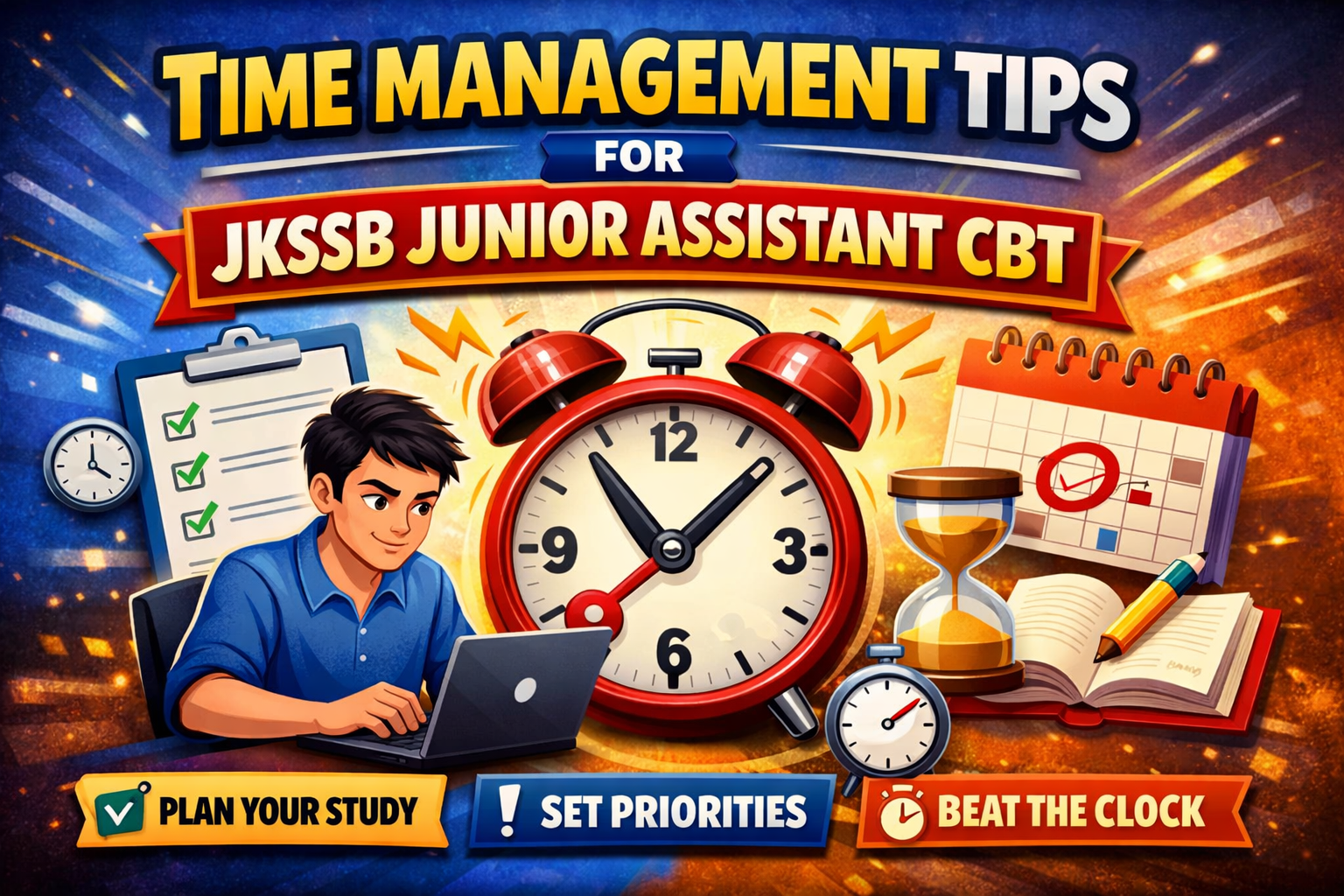
For thousands of aspirants, the JKSSB Junior Assistant OMR is a gateway to a prestigious government career in Jammu & Kashmir. As we step into the 2026 examination cycle, the competition is fiercer than ever. The key differentiator between success and disappointment often isn't just what you know, but how effectively you manage the exam's relentless clock. With 80 questions to solve in just 80 minutes, alongside a 0.25 mark penalty for every wrong answer, mastering time is not a skill—it's a necessity. This guide is your strategic playbook, updated for 2026, to transform time pressure into your greatest advantage.
Effective time management for the JKSSB Junior Assistant OMR is a systematic strategy that involves pre-exam planning, intelligent in-test question prioritization, and rigorous practice under simulated conditions to maximize attempts and accuracy within the 80-minute window, while minimizing losses from negative marking.
Understanding the 2026 Battlefield: Exam Pattern & Syllabus

Before you can manage time, you must understand what you're up against. The JKSSB Junior Assistant OMR follows a precise structure. Knowing the weight and complexity of each section allows for smart time allocation.
The Core Exam Pattern for JKSSB Junior Assistant OMR:
| Section | Expected Number of Questions | Approx. Weightage | Suggested Time Allocation |
|---|---|---|---|
| General Awareness (with special reference to J&K UT) | 20 | High | 18-22 minutes |
| General English | 20 | Medium | 14-18 minutes |
| Numerical & Reasoning Ability | 20 | Medium-High | 16-20 minutes |
| Computer Applications/Knowledge | 20 | Medium | 14-18 minutes |
| Total | 80 Questions | 80 Marks | 80 Minutes |
*Note: The exact distribution can vary slightly. Always refer to the official 2026 notification. A focused approach on J&K-specific General Knowledge is crucial, as it carries significant marks.*
Your 5-Step Pre-Exam Time Management Preparation Plan (2026 Edition)
Winning the time battle begins long before you enter the exam hall. Your preparation phase must be engineered for speed and precision.
Syllabus Mastery & Micro-Topic Analysis: Don't just read the syllabus—dissect it. Identify your strongest and weakest topics within each section (e.g., in English, you might be strong in tenses but weak in cloze tests). This self-awareness is the foundation of your strategy. Make sure to download the complete syllabus PDF for the 2026 cycle to avoid studying irrelevant topics.
Create a "Two-Tier" Study Schedule: Allocate your weekly study hours proportionally to the section weightage and your personal comfort level. Dedicate more time to weaker subjects but include daily short revisions for strong ones. The second tier involves scheduling weekly sectional mock tests to apply learned concepts under time pressure.
Embrace the Power of Sectional Mock Tests: This is non-negotiable. Jumping directly to full-length tests is a common mistake. Attempt JKSSB Junior Assistant sectional mock tests for each subject (General Awareness, English, etc.). These help you build speed and accuracy in isolation, diagnose weak spots, and develop a personalized time-limit for each topic.
Develop a Smart Question-Solving Methodology: Practice techniques like scanning questions quickly, identifying "sure-shot" answers immediately, and flagging time-consuming ones (like complex reasoning puzzles or lengthy calculations) for review later. This mental framework must become second nature.
Build Stamina with Full-Length Simulators: In the final 4-6 weeks of preparation, shift to full-length mock tests. Simulate the exact exam environment: sit for 80 uninterrupted minutes, use only a rough sheet, and stick to your time plan. The goal is to build the mental and physical stamina required for the real OMR. Analyze each test to see which sections consumed extra time and refine your approach.
The In-Exam Strategy: Your 80-Minute Game Plan
On exam day, a clear, pre-meditated strategy will keep panic at bay.
The First Pass (0-60 minutes): The "Confident Attempt" Round. Your sole mission in the first hour is to secure marks. Rapidly navigate through all questions. Answer every question you are 100% confident about. Use the "mark for review" option for any question that takes more than 45-50 seconds. Absolutely guess on questions you have no clue about, as random guessing can hurt more than help due to negative marking.
The Second Pass (60-75 minutes): The "Review & Solve" Round. Return to the questions you marked for review. With the pressure of unseen questions gone, you can now apply deeper focus. Solve the ones you can. For the rest, make an educated guess if you can eliminate at least two options.
The Final Buffer (Last 5 minutes): The "Double-Check" Round. Use this time to quickly review your answers, especially for the first few questions where nerves might have played a role. Ensure you haven't made any silly mistakes or mis-clicks. Practice previous year questions regularly to get a feel for common traps and question styles.
Top 5 FAQs on JKSSB Junior Assistant Time Management (2026)
1. How should I divide my 80 minutes among the four sections?
While the table above provides a guideline, your personal division should be based on your mock test analysis. A balanced approach is 20 minutes per section, but if you are exceptionally fast in Computers, you might allocate 15 minutes there and gift 5 extra minutes to a tougher section like Reasoning.
2. Is it true that I should attempt all 80 questions?
No. The goal is to maximize your score, not attempts. Forcing yourself to attempt every question leads to guesswork and negative marking. Focus on high-confidence attempts. A score of 65+ with high accuracy is better than 78 attempts with many errors.
3. What is the single best way to improve my speed?
Consistent practice with timed sectional tests. Speed comes from familiarity with question patterns and concept clarity. Regular practice with a stopwatch conditions your brain to solve faster.
4. How do I handle the pressure of the ticking clock during the exam?
Train for it. The pressure you feel in the exam is unfamiliar only if you haven't practiced under it. Taking 15-20 full-length mocks under strict timing will make the actual exam feel like just another practice session.
5. Should I start with my strongest or weakest section?
Most experts and toppers recommend starting with your strongest section. This builds confidence, secures quick marks, and settles initial nerves, allowing you to tackle tougher sections with a calm mind.
Conclusion: Time is Your Resource, Not Your Enemy
For the JKSSB Junior Assistant OMR 2026, time management is the invisible syllabus that every topper masters. It transforms the daunting 80-minute sprint into a controlled, strategic endeavor. Remember, this skill is built not in a day, but through weeks of disciplined practice and intelligent analysis. Start integrating these strategies into your preparation today. Attempt a free JKSSB mock test right now to benchmark your current speed and begin your journey from being a candidate who knows the answers to one who strategically conquers the paper. Your future in the Jammu & Kashmir administration awaits—go and claim it, one well-managed minute at a time.