JKSSB Junior Pharmacist Previous Year Paper PDF – 50+ Important Practice MCQs with Answers (2026)
If you are preparing for the JKSSB Junior Pharmacist Recruitment Examination, solving previous year paper pattern questions is one of the smartest ways to improve your preparation. Many candidates spend months reading notes but forget to practice objective questions. As a result, they struggle with time management and accuracy during the actual examination.
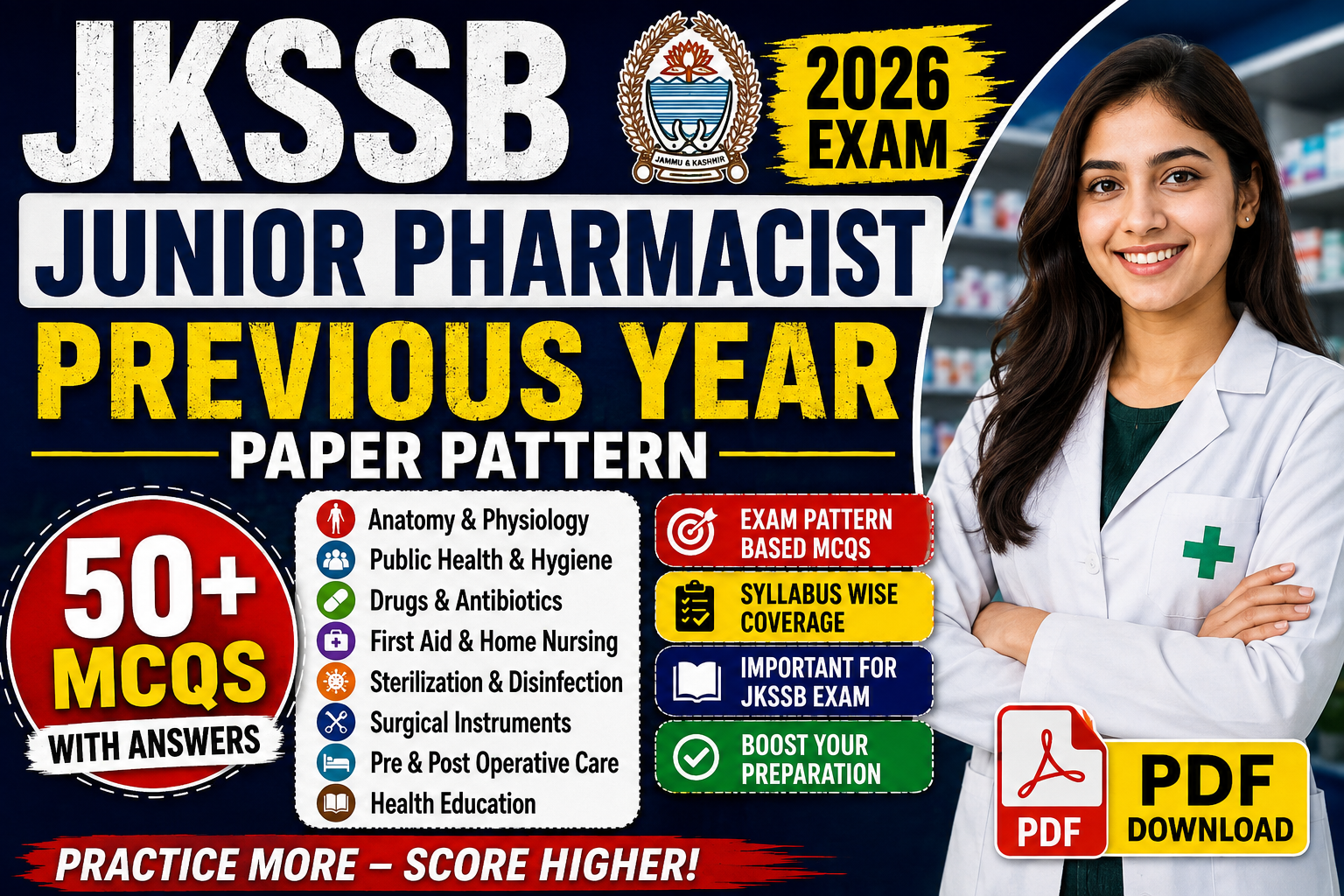
The JKSSB Junior Pharmacist examination generally tests both theoretical knowledge and practical understanding of pharmacy-related subjects. Questions are usually asked from Anatomy and Physiology, Public Health & Hygiene, Drugs and Antibiotics, Record Keeping, First Aid, Sterilization & Disinfection, Surgical Instruments, Pre & Post Operative Care, and Health Education.
Practicing syllabus-based questions helps candidates understand the standard of the examination and improves confidence before the exam day.
In this article, you will find a collection of JKSSB Junior Pharmacist Previous Year Pattern Practice MCQs prepared according to the latest syllabus. These questions are designed to closely resemble the level and style generally expected in competitive pharmacy examinations.
Download Full Study Material of jkssb junior pharmacist 2026
Why Should You Practice Previous Year Pattern Questions?
Every successful candidate follows one common strategy—practice.
Regularly solving objective questions helps you:
- Understand the examination pattern.
- Identify frequently asked topics.
- Improve speed and accuracy.
- Reduce negative marking risks.
- Strengthen weak concepts.
- Build confidence before the examination.
Instead of simply memorizing notes, applying concepts through MCQs allows you to retain information for a much longer period.
Important Subjects Covered
The practice questions in this article cover the following topics:
- Anatomy and Physiology
- Public Health and Hygiene
- Drugs and Antibiotics
- Record Keeping
- First Aid and Home Nursing
- Sterilization and Disinfection
- Surgical Instruments
- Pre-operative Care
- Post-operative Care
- Health Education
Let's begin with the first set of important practice questions.
Download Complete syllabus link for jkssb junior pharmacist 2026
JKSSB Junior Pharmacist Previous Year Pattern Practice MCQs (1–25)
1. Which chamber of the heart pumps oxygenated blood to the entire body?
A. Right Atrium
B. Right Ventricle
C. Left Atrium
D. Left Ventricle
✅ Answer: D. Left Ventricle
2. Which organ is primarily responsible for filtering blood?
A. Liver
B. Kidney
C. Lung
D. Pancreas
✅ Answer: B. Kidney
3. The normal adult pulse rate is approximately:
A. 20–40 bpm
B. 40–60 bpm
C. 60–100 bpm
D. 120–150 bpm
✅ Answer: C. 60–100 bpm
4. Which vitamin is essential for blood clotting?
A. Vitamin A
B. Vitamin C
C. Vitamin D
D. Vitamin K
✅ Answer: D. Vitamin K
5. The largest gland of the human body is:
A. Thyroid
B. Liver
C. Pancreas
D. Pituitary
✅ Answer: B. Liver
6. WHO stands for:
A. World Health Organization
B. World Human Organization
C. Welfare Health Office
D. World Hospital Organization
✅ Answer: A
7. Which disease spreads through contaminated water?
A. Malaria
B. Tuberculosis
C. Cholera
D. Dengue
✅ Answer: C
8. Which mosquito transmits malaria?
A. Aedes
B. Culex
C. Anopheles Female
D. House Fly
✅ Answer: C
9. ORS is mainly used to treat:
A. Fever
B. Dehydration
C. Diabetes
D. Asthma
✅ Answer: B
10. Vaccination provides:
A. Temporary weakness
B. Passive immunity only
C. Artificial active immunity
D. Digestion
✅ Answer: C
11. Penicillin belongs to:
A. Analgesics
B. Antibiotics
C. Antacids
D. Vitamins
✅ Answer: B
12. Which route gives the fastest drug action?
A. Oral
B. Topical
C. Intravenous
D. Rectal
✅ Answer: C
13. The abbreviation "Rx" represents:
A. Diagnosis
B. Prescription
C. Injection
D. Medicine Bottle
✅ Answer: B
14. Which dosage form is administered through the skin?
A. Capsule
B. Tablet
C. Syrup
D. Transdermal Patch
✅ Answer: D
15. Antibiotics are ineffective against:
A. Bacteria
B. Viruses
C. Fungi
D. Protozoa
✅ Answer: B
16. Hospital records should be:
A. Destroyed immediately
B. Maintained accurately
C. Written only in pencil
D. Optional
✅ Answer: B
17. A prescription should always contain:
A. Patient Name
B. Date
C. Doctor's Signature
D. All of these
✅ Answer: D
18. Inventory management mainly helps in:
A. Increasing infections
B. Avoiding medicine shortage
C. Wasting medicines
D. None
✅ Answer: B
19. First aid means:
A. Final treatment
B. Initial emergency care
C. Surgery
D. ICU admission
✅ Answer: B
20. CPR stands for:
A. Cardiac Pulse Recovery
B. Cardio Pulmonary Resuscitation
C. Cardio Pressure Recovery
D. Clinical Patient Rescue
✅ Answer: B
21. A burn should first be cooled using:
A. Ice directly
B. Running cool water
C. Butter
D. Toothpaste
✅ Answer: B
22. Sterilization means:
A. Washing
B. Complete destruction of microorganisms including spores
C. Dust removal
D. Cleaning only
✅ Answer: B
23. Which instrument is commonly used for sterilization?
A. Autoclave
B. Microscope
C. Stethoscope
D. Thermometer
✅ Answer: A
24. Which disinfectant is commonly used for hospital surfaces?
A. Sodium Hypochlorite
B. Sugar Solution
C. Vinegar
D. Distilled Water
✅ Answer: A
25. Which instrument is mainly used to cut tissues during surgery?
A. Forceps
B. Scalpel
C. Retractor
D. Needle Holder
✅ Answer: B
26. Which surgical instrument is primarily used to hold tissues during an operation?
A. Scalpel
B. Forceps
C. Retractor
D. Curette
✅ Answer: B. Forceps
27. Which instrument is used to hold a suture needle during stitching?
A. Scissors
B. Needle Holder
C. Forceps
D. Probe
✅ Answer: B. Needle Holder
28. A retractor is mainly used to:
A. Cut tissues
B. Hold dressings
C. Keep the surgical wound open
D. Inject medicines
✅ Answer: C
29. The purpose of pre-operative care is to:
A. Increase complications
B. Prepare the patient physically and mentally
C. Delay surgery
D. Avoid diagnosis
✅ Answer: B
30. Post-operative care mainly focuses on:
A. Preventing complications
B. Increasing pain
C. Avoiding medicines
D. Ignoring vital signs
✅ Answer: A
31. Which vital sign should be monitored regularly after surgery?
A. Pulse
B. Blood Pressure
C. Temperature
D. All of these
✅ Answer: D
32. Hand washing is the most effective method to prevent:
A. Hair loss
B. Hospital-acquired infections
C. Fractures
D. Hypertension
✅ Answer: B
33. Which biomedical waste bin is generally used for infectious waste?
A. Blue
B. Yellow
C. Black
D. Green
✅ Answer: B
34. Health education primarily aims to:
A. Increase disease spread
B. Promote healthy lifestyles
C. Increase medicine sales
D. Reduce awareness
✅ Answer: B
35. Which of the following is a communicable disease?
A. Diabetes
B. Hypertension
C. Tuberculosis
D. Arthritis
✅ Answer: C
36. BCG vaccine protects against:
A. Polio
B. Tuberculosis
C. Hepatitis
D. Cholera
✅ Answer: B
37. Which vitamin deficiency causes scurvy?
A. Vitamin A
B. Vitamin B12
C. Vitamin C
D. Vitamin D
✅ Answer: C
38. The normal body temperature is approximately:
A. 35°C
B. 36°C
C. 37°C
D. 39°C
✅ Answer: C
39. Which blood group is called the universal donor?
A. A+
B. B+
C. AB+
D. O Negative
✅ Answer: D
40. The functional unit of the kidney is:
A. Neuron
B. Nephron
C. Alveolus
D. Hepatocyte
✅ Answer: B
41. Which route of drug administration avoids first-pass metabolism?
A. Oral
B. Sublingual
C. Rectal
D. Gastric
✅ Answer: B
42. Which dosage form is meant for external application?
A. Syrup
B. Ointment
C. Tablet
D. Capsule
✅ Answer: B
43. Which microorganism is destroyed during sterilization?
A. Only bacteria
B. Only fungi
C. Only viruses
D. All microorganisms including spores
✅ Answer: D
44. The purpose of disinfectants is to:
A. Sterilize body tissues
B. Destroy microorganisms on inanimate objects
C. Increase bacterial growth
D. Preserve medicines
✅ Answer: B
45. Which surgical instrument is commonly used to cut sutures?
A. Sponge Holding Forceps
B. Surgical Scissors
C. Retractor
D. Artery Forceps
✅ Answer: B
46. Which condition requires immediate CPR?
A. Minor burn
B. Cardiac arrest
C. Headache
D. Fever
✅ Answer: B
47. Which record is maintained for medicine stock in hospitals?
A. Attendance Register
B. Stock Register
C. Visitor Register
D. Complaint Register
✅ Answer: B
48. Which of the following is an example of broad-spectrum antibiotics?
A. Amoxicillin
B. Doxycycline
C. Chloramphenicol
D. All of these
✅ Answer: D
49. Which of the following is the primary objective of home nursing?
A. Promote recovery and patient comfort
B. Increase hospitalization
C. Delay treatment
D. Replace surgery
✅ Answer: A
50. Which of the following best describes public health?
A. Treatment of one patient only
B. Prevention of disease and promotion of community health
C. Manufacturing medicines
D. Hospital administration only
✅ Answer: B
Frequently Asked Questions (FAQs)
1. Are previous year papers important for JKSSB Junior Pharmacist?
Yes. Previous year paper patterns help candidates understand the difficulty level, frequently asked topics, question style, and time management. Along with theory, practicing objective questions significantly improves exam performance.
2. What subjects are included in the JKSSB Junior Pharmacist syllabus?
The major subjects include:
- Anatomy and Physiology
- Public Health and Hygiene
- Drugs and Antibiotics
- Record Keeping
- First Aid and Home Nursing
- Sterilization and Disinfection
- Surgical Instruments
- Pre and Post Operative Care
- Health Education
3. How many MCQs should I practice daily?
A good target is 50–100 MCQs per day along with revision of concepts. Consistent practice improves speed, accuracy, and confidence for the examination.
4. What is the best strategy to crack the JKSSB Junior Pharmacist exam?
Focus on understanding concepts, revise the complete syllabus multiple times, solve previous year pattern practice questions, attempt mock tests regularly, and analyze your mistakes after every practice session.
5. Where can I find JKSSB Junior Pharmacist study material?
Candidates should study from reliable notes, topic-wise MCQs, mock tests, previous year pattern questions, and standard pharmacy reference books. Combining these resources provides comprehensive preparation.
Preparation Tips for JKSSB Junior Pharmacist
Many candidates focus only on reading textbooks, but competitive examinations demand much more than theoretical knowledge. A balanced preparation strategy should include concept revision, daily MCQ practice, previous year pattern questions, and regular mock tests.
Allocate separate time for Anatomy, Public Health, Pharmacology, and First Aid because these subjects carry significant weight in pharmacy examinations. Revise important drug classifications, sterilization methods, disease prevention measures, vaccination schedules, and surgical instruments regularly.
One highly effective strategy is to solve at least 50–100 pharmacy MCQs every day while revising the explanations. This improves both conceptual clarity and question-solving speed.
Remember that consistency matters more than studying for long hours occasionally. Even two focused study sessions daily can produce excellent results if combined with regular practice.
Most Important Topics to Revise Before the Exam
Before appearing in the JKSSB Junior Pharmacist examination, ensure you have thoroughly revised:
- Human body systems and organs
- Blood circulation
- Vitamins and deficiency diseases
- Antibiotics and antimicrobial drugs
- Drug administration routes
- Prescription writing
- Hospital pharmacy records
- First aid procedures
- CPR
- Burns and fractures
- Sterilization methods
- Disinfection techniques
- Surgical instruments
- Health education principles
- Public health programmes
- Immunization
- Communicable diseases
Candidates who revise these topics multiple times generally perform much better than those relying only on textbook reading.
Final Thoughts
Preparing for the JKSSB Junior Pharmacist Examination requires more than just reading textbooks. The key to success is building a strong conceptual foundation and reinforcing it through regular MCQ practice. While theory helps you understand the subject, solving previous year pattern practice questions trains you to think like an examiner and improves both speed and accuracy.
The 50 practice MCQs included in this guide cover the core syllabus areas such as Anatomy & Physiology, Public Health & Hygiene, Drugs & Antibiotics, Record Keeping, First Aid & Home Nursing, Sterilization & Disinfection, Surgical Instruments, Pre & Post Operative Care, and Health Education. Regular practice of these topics will strengthen your preparation and help you identify areas that need additional revision.
If you are aiming for a top score in the upcoming JKSSB Junior Pharmacist recruitment exam, make it a habit to revise important concepts daily, solve objective questions consistently, and take full-length mock tests before the examination.
For more JKSSB Junior Pharmacist Notes, Topic-wise MCQs, Mock Tests, PYQ Pattern Practice Sets, Current Affairs, and Complete Study Material, explore the resources available on JK Exam Library and continue your preparation with confidence.
Best wishes for your JKSSB Junior Pharmacist Examination!