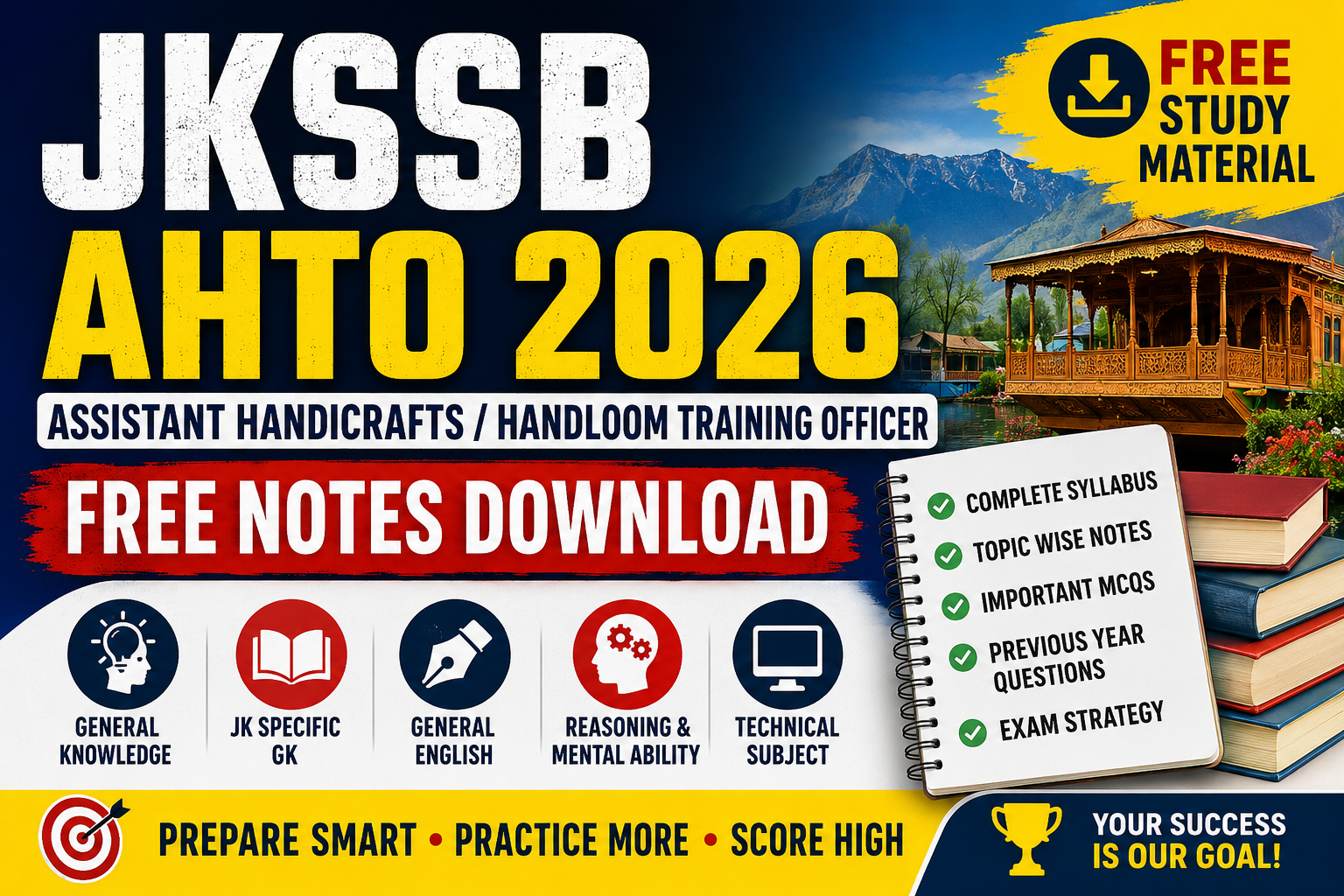
JKSSB AHTO Free Notes Download 2026 – Complete Study Material & Preparation Guide
Preparing for a JKSSB examination is not simply about collecting as many books and PDFs as possible. The real challenge is finding relevant study material, understanding the syllabus, revising important concepts and practising enough objective questions before the examination.
For candidates preparing for the JKSSB AHTO 2026 examination, having organised notes can make preparation much easier. AHTO refers to the Assistant Handicrafts Training Officer / Assistant Handloom Training Officer posts under the Department of Handicrafts and Handloom. Current syllabus information indicates that candidates need to prepare areas such as General Awareness, General English, General Knowledge with special reference to J&K, reasoning/mathematics and the relevant technical portion.
That is why we are providing JKSSB AHTO free notes in a simple, exam-oriented format so that candidates can revise important topics without wasting time searching through different sources.
Why JKSSB AHTO Notes Are Important
One common mistake made by competitive-exam aspirants is studying everything without giving enough importance to the actual examination syllabus.
The AHTO examination requires focused preparation. Instead of reading large textbooks from beginning to end, candidates should first identify the important syllabus areas and then prepare short, understandable notes for revision.
Good notes should help you:
- Understand concepts quickly
- Revise important facts repeatedly
- Remember important terminology
- Identify frequently asked topics
- Practise MCQs after completing each chapter
- Prepare for statement-based and conceptual questions
- Complete final revision quickly before the examination
The objective should not be to make hundreds of pages of notes. The objective should be to create high-quality revision material that you can actually remember.
JKSSB AHTO Free Notes – What You Can Expect
The free study material is designed especially for candidates who want direct and exam-focused preparation.
The notes can cover the major areas of the examination, including:
1. General Knowledge
General Knowledge is an important part of most JKSSB examinations. Candidates should revise Indian history, geography, polity, economy, important institutions, awards, sports, important days and other frequently asked general-awareness topics.
Rather than memorising random facts, concentrate on information that has a reasonable possibility of appearing in an objective examination.
2. General Knowledge with Special Reference to J&K
For JKSSB examinations, Jammu and Kashmir-specific knowledge deserves special attention.
Candidates should revise topics such as:
- History of Jammu and Kashmir
- Geography of J&K
- Rivers, lakes and mountains
- Districts and administrative divisions
- Important personalities
- Art and culture
- Handicrafts and handloom traditions
- Agriculture and horticulture
- Important historical places
- Government institutions and schemes
- Economy of Jammu and Kashmir
- Important current developments
A candidate who prepares J&K GK systematically can gain an advantage because these questions are directly connected with the region.
3. General English
English preparation should be practical and examination-oriented.
Important areas may include:
- Vocabulary
- Synonyms and antonyms
- One-word substitutions
- Idioms and phrases
- Spelling
- Sentence correction
- Fill in the blanks
- Comprehension
- Basic grammar
- Active and passive voice
- Direct and indirect speech
Do not spend all your preparation time trying to master advanced grammar. For an objective examination, regular MCQ practice is extremely useful.
4. Reasoning and Mental Ability
Reasoning questions are often scoring if you understand the underlying pattern.
Important topics include:
- Analogy
- Classification
- Number series
- Alphabet series
- Coding-decoding
- Blood relations
- Direction sense
- Ranking
- Calendar
- Clock
- Venn diagrams
- Statement-based reasoning
- Simple logical problems
The best way to improve reasoning is not by simply reading explanations. Solve questions yourself.
After solving a question, ask yourself:
“Why is this option correct, and why are the other options wrong?”
This small habit improves accuracy.
Important Exam Strategy for JKSSB AHTO
A good preparation strategy can be divided into three stages.
Stage 1 – Complete the Syllabus
First, go through the entire syllabus once.
Do not worry about remembering every detail during the first reading. Your objective should be to understand what topics are included and which areas require more attention.
Stage 2 – Notes + MCQs
After completing a topic, revise your notes and immediately solve MCQs.
For example:
Topic → Short Notes → MCQs → Mistake Analysis → Revision
This method is much more effective than reading the same chapter repeatedly without testing yourself.
Stage 3 – Final Revision
During the final stage, avoid starting completely new books.
Instead, revise:
- Short notes
- Important facts
- Previous-year questions
- Frequently repeated concepts
- Wrong MCQs
- Current affairs
- J&K-specific facts
The last phase should be about accuracy and retention, not collecting new study material.
Sample JKSSB AHTO MCQs
To make the notes more useful, candidates should practise objective questions along with theoretical material.
MCQ 1
The traditional crafts of Jammu and Kashmir are particularly associated with which of the following?
A. Handicrafts and handloom
B. Marine fisheries
C. Shipbuilding
D. Petroleum refining
Answer: A. Handicrafts and handloom
MCQ 2
Which one of the following is most useful for improving performance in an objective-type examination?
A. Reading without revision
B. Memorising every available book
C. Regular MCQ practice and revision
D. Studying only one day before examination
Answer: C. Regular MCQ practice and revision
MCQ 3
Which topic is especially important for candidates appearing in a Jammu and Kashmir government examination?
A. J&K-specific General Knowledge
B. International cricket only
C. Foreign taxation systems
D. Oceanography of the Pacific Ocean
Answer: A. J&K-specific General Knowledge
MCQ 4
The most effective sequence for preparation is:
A. MCQs → syllabus → notes
B. Syllabus → concepts → notes → MCQs → revision
C. Random books → random questions
D. Current affairs only
Answer: B. Syllabus → concepts → notes → MCQs → revision
How to Use These Free Notes Effectively
Downloading notes is only the first step.
Many students download PDFs but never complete them. A better approach is to create a simple daily target.
For example:
Day 1: Complete one topic
Day 2: Revise the previous topic + study the next topic
Day 3: Solve MCQs from both topics
Day 4: Revise mistakes
Day 5: Continue with the next chapter
At the end of every week, spend some time revising everything studied during that week.
This creates multiple revision cycles before the examination.
Why MCQs Matter in JKSSB Preparation
JKSSB examinations are objective in nature, so knowing a topic theoretically is not always enough.
You must also be comfortable with the way questions are framed.
A question may ask:
- A direct fact
- An incorrect statement
- A correct pair
- A matching question
- A statement-based question
- A conceptual application
- A combination of two related facts
Therefore, while studying your notes, try to convert important information into questions.
For example:
Fact: A particular craft is associated with Kashmir.
Instead of remembering the sentence alone, practise:
Which traditional craft is associated with Kashmir?
This transforms passive reading into active preparation.
Final Words
The JKSSB AHTO 2026 examination should be approached with a clear strategy rather than unnecessary study pressure. The current AHTO syllabus and exam discussions emphasise general subjects along with the relevant technical component, making balanced preparation important.
Use free notes as your foundation, but do not stop there. Read the concepts, revise them repeatedly and practise MCQs. Give special attention to J&K General Knowledge, General English, reasoning, current affairs and the technical syllabus applicable to your post.
Most importantly, avoid changing your study material every few days. Select reliable notes, complete them properly and revise them multiple times.
Download the JKSSB AHTO free notes, start topic-wise preparation, practise MCQs regularly and keep revising until the concepts become familiar.
In the next part, we will cover important AHTO study topics, preparation strategy, more exam-oriented MCQs and FAQs for JKSSB AHTO aspirants.
JKSSB AHTO 2026 Preparation Strategy
Once you have downloaded the JKSSB AHTO free notes, the next step is to use them correctly. Good study material can save time, but your final performance depends on revision, practice and consistency.
A simple strategy is to divide your preparation into four parts:
1. Read
Start with the syllabus and study one topic at a time. Do not try to complete everything in a single sitting.
2. Understand
Try to understand the concept instead of memorising every line. This becomes especially important for technical questions.
3. Practise
After completing a topic, solve MCQs. Questions help you discover which areas you have actually understood and which ones need more revision.
4. Revise
Revision should be repeated at regular intervals. A topic that appears easy during the first reading can easily be forgotten after a few weeks.
A useful revision cycle is:
First Reading → MCQs → Revision → Wrong Questions → Final Revision
Statement-Based MCQs for JKSSB AHTO
Candidates should not limit their preparation to simple one-line questions. Competitive examinations increasingly use statement-based questions to test conceptual understanding.
MCQ 1
Consider the following statements:
- Revision helps improve retention of previously studied information.
- MCQ practice can help identify weak areas.
- Reading a topic once guarantees long-term retention.
Which of the statements given above is/are correct?
A. 1 only
B. 1 and 2 only
C. 2 and 3 only
D. 1, 2 and 3
Answer: B. 1 and 2 only
MCQ 2
Consider the following statements regarding examination preparation:
- The syllabus should be studied before preparing a detailed study plan.
- Randomly collecting study material is always better than following one reliable source.
- Regular revision improves recall.
Which statements are correct?
A. 1 and 3 only
B. 1 only
C. 2 and 3 only
D. All three
Answer: A. 1 and 3 only
MCQ 3
Which approach is generally most useful for a technical subject?
A. Memorising answers without understanding concepts
B. Understanding concepts and practising application-based questions
C. Studying only current affairs
D. Avoiding MCQs
Answer: B. Understanding concepts and practising application-based questions
MCQ 4
For a Jammu and Kashmir government examination, which area deserves specific attention?
A. J&K history, geography, culture and economy
B. Only international affairs
C. Only world geography
D. Only sports
Answer: A. J&K history, geography, culture and economy
MCQ 5
A candidate repeatedly gets the same type of MCQ wrong. What should the candidate do?
A. Ignore the questions
B. Memorise the option only
C. Identify the underlying concept and revise it
D. Stop solving MCQs
Answer: C. Identify the underlying concept and revise it
How to Make Your AHTO Notes More Effective
Do not treat your notes as a book that must be read from the first page to the last page every time.
Instead, use them as a revision tool.
While studying, highlight:
- Important definitions
- Important dates
- Important personalities
- Technical terminology
- Important classifications
- J&K-specific facts
- Frequently confused concepts
- Important government schemes
- Questions you answered incorrectly
You can also maintain a separate “Wrong MCQs Notebook.”
Whenever you answer a question incorrectly, write the correct concept in one or two lines. Before the examination, this notebook can become one of your most valuable revision resources.
Common Mistakes to Avoid
Studying Too Many Sources
Downloading 20 PDFs does not mean you have prepared 20 times better.
Too many sources often create confusion. Select reliable material and complete it properly.
Ignoring J&K GK
Candidates preparing for JKSSB examinations should never treat J&K-specific knowledge as an optional subject.
Avoiding MCQs
Reading gives you knowledge; solving questions teaches you how that knowledge is tested.
Not Revising
Without revision, even well-understood topics can gradually disappear from memory.
Studying Only Easy Topics
Students often repeatedly study topics they already know because it feels comfortable.
Instead, identify your weak areas and spend additional time there.
JKSSB AHTO Free Notes – Frequently Asked Questions
1. Where can I download JKSSB AHTO free notes?
You can use the JKSSB AHTO study-material section on your preferred exam-preparation platform to access topic-wise notes, MCQs and other preparation resources. Always check that the material matches the latest applicable syllabus.
2. Are free notes enough for JKSSB AHTO preparation?
Free notes can provide a strong foundation, but candidates should also practise MCQs, revise current affairs and study the prescribed technical syllabus.
3. What should I study first for JKSSB AHTO?
Start with the official syllabus. Then divide the syllabus into general subjects and the relevant technical portion. Begin with topics that carry importance and those in which you are comparatively weak.
4. Is J&K General Knowledge important for JKSSB AHTO?
Yes. J&K-specific General Knowledge is an important preparation area for JKSSB examinations and should be revised systematically.
5. Should I practise previous-year questions?
Absolutely. Previous-year questions can help you understand the style, difficulty and recurring concepts of competitive examinations.
6. How many MCQs should I solve every day?
There is no universal number. Quality is more important than quantity. Even a focused set of MCQs is useful if you analyse your mistakes instead of simply checking the answers.
7. Should I make separate short notes?
Yes. Short notes are particularly useful during the final revision period. Keep them concise and include only information that you genuinely need to remember.
8. How can I improve my score in AHTO?
Focus on three things: concept clarity, repeated revision and MCQ practice. At the same time, avoid constantly changing your study material.
9. Should I study current affairs for JKSSB AHTO?
Yes. Current affairs should be included in your preparation, particularly important national and Jammu and Kashmir-related developments relevant to the examination period.
10. Are statement-based questions important?
Candidates should be prepared for different objective-question formats, including statement-based, matching, assertion-type and conceptual questions.
Final Preparation Checklist
Before the examination, make sure you have:
- Completed the prescribed syllabus
- Read your main notes at least once
- Revised important topics multiple times
- Practised topic-wise MCQs
- Reviewed previous-year questions
- Prepared J&K-specific GK
- Covered relevant current affairs
- Revised technical terminology and concepts
- Reviewed your wrong answers
- Prepared short notes for final revision
Conclusion
The right study material can make JKSSB AHTO preparation considerably more manageable. Instead of spending most of your time searching for resources, concentrate on studying, practising and revising.
The purpose of these JKSSB AHTO free notes is to give aspirants a structured starting point. Use the notes alongside MCQs and the prescribed syllabus, identify your weak areas and revise them repeatedly.
Remember, competitive examinations are rarely cleared by reading one topic once. They are cleared through consistent preparation and repeated revision.
If you are serious about JKSSB AHTO 2026, start with the syllabus, complete your notes topic by topic, practise MCQs every day and keep a record of your mistakes.
Study smart. Revise repeatedly. Practise consistently. And focus on accuracy.
For JKSSB aspirants, the goal should not simply be to “finish the syllabus”; the real goal is to reach the examination hall with the important concepts already familiar and well revised.