JKSSB Junior Pharmacist Free Daily Mock Tests 2026: Practice Tough MCQs Every Day
Preparing for the JKSSB Junior Pharmacist examination requires more than simply reading notes again and again. The real improvement comes when you start testing whether you can actually recall, understand and apply what you have studied.
This is where JKSSB Junior Pharmacist free daily mock tests can make a major difference. Regular practice helps you identify weak areas, improve accuracy and become comfortable with the type of tricky questions that can appear in a competitive examination.
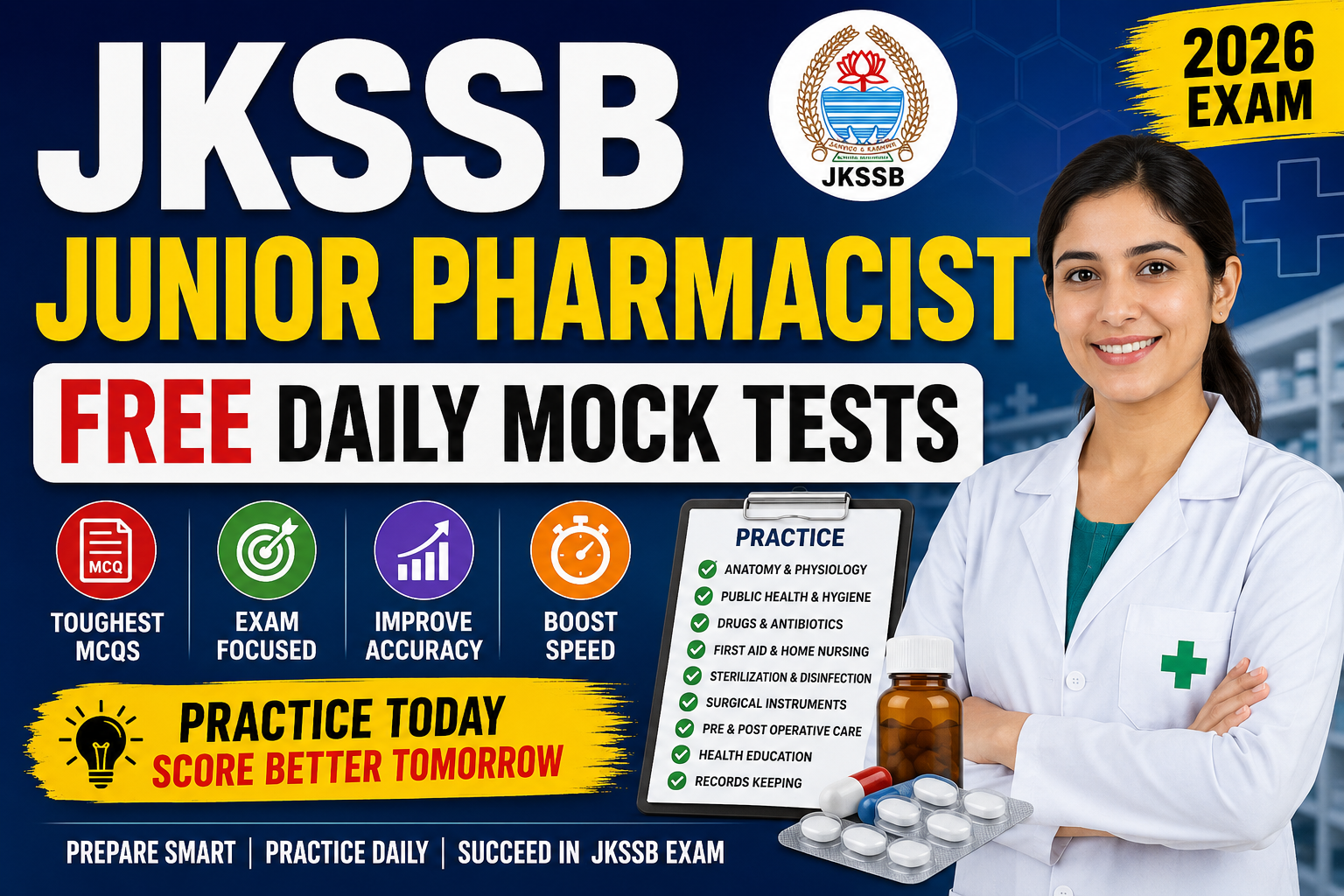
For candidates preparing for the JKSSB Junior Pharmacist exam 2026, daily MCQ practice should ideally cover the complete syllabus rather than focusing only on drugs and medicines. Topics such as Anatomy and Physiology, Public Health and Hygiene, Drugs and Antibiotics, Records Keeping, First Aid and Home Nursing, Sterilization and Disinfection, Surgical Instruments, Pre and Post Operative Care, and Health Education all deserve systematic revision.
DOWNLOAD COMPLETE JUNIOR PHARMACIST STUDY MATERIAL
Why Daily Mock Tests Matter for JKSSB Junior Pharmacist Preparation
Many students make the mistake of completing their syllabus and assuming that preparation is finished. In reality, completing the syllabus is only one stage.
The next stage is active recall through MCQs.
A daily practice test forces you to retrieve information from memory. This is particularly useful for Pharmacist preparation because many questions can look similar while testing a small but important difference between two concepts.
For example, a question may ask about the appropriate method of sterilization, the damaging stage of a microorganism, a particular surgical instrument, the physiological function of an organ, or the distinction between an antibiotic and another antimicrobial agent.
Daily practice can help you:
- Improve speed and question-solving accuracy.
- Identify repeatedly forgotten facts.
- Revise important pharmacology and pharmacy-related concepts.
- Strengthen Anatomy and Physiology MCQ preparation.
- Practice Public Health and Hygiene questions.
- Revise Drugs and Antibiotics systematically.
- Improve knowledge of sterilization and disinfection.
- Prepare for questions on first aid and home nursing.
- Understand surgical instruments and operative care.
- Build confidence before the actual examination.
JKSSB Junior Pharmacist Syllabus for Daily MCQ Practice
A good mock-test strategy should follow the actual syllabus. For this preparation, candidates should regularly practice questions from the following areas.
1. Anatomy and Physiology
This section requires conceptual understanding as well as factual recall. Important areas include the structure and functions of body organs, tissues, systems and basic physiological processes.
Instead of memorizing isolated facts, try to understand relationships between different organs and their functions. Statement-based questions are particularly useful here because they can test whether you genuinely understand the concept.
2. Public Health and Hygiene
Public health questions can cover sanitation, personal hygiene, environmental hygiene, prevention of disease and basic community health principles.
Candidates should revise the relationship between hygiene, sanitation and disease prevention rather than memorizing definitions alone.
3. Drugs and Antibiotics
This is one of the most important areas for a Pharmacist candidate.
While preparing Drugs and Antibiotics MCQs, pay attention to drug classes, uses, mechanisms, adverse effects, precautions and important distinctions between similar medicines.
Do not restrict your preparation to drug names. Competitive examinations can test the concept behind the drug.
4. Records Keeping
Record keeping may appear relatively straightforward, but questions can test the purpose, accuracy, confidentiality and systematic maintenance of health and pharmacy records.
A good pharmacist must understand that proper documentation is an important part of healthcare practice.
5. First Aid and Home Nursing
First aid questions require practical understanding. Revise basic emergency principles, immediate care, common injuries and appropriate first-response measures.
Questions may deliberately include an incorrect first step, so read every option carefully.
6. Sterilization and Disinfection
This is another area where students often confuse related terms.
You should clearly understand the difference between sterilization and disinfection, methods used for each, their applications and the conditions under which different techniques are appropriate.
7. Surgical Instruments
Learn the names, identification and general uses of commonly used surgical instruments. Instrument-based questions can be highly scoring if you revise them systematically.
8. Pre and Post Operative Care
Preparation before surgery and care after surgery require knowledge of basic patient-care principles. Pay attention to objectives, precautions, monitoring and common complications.
9. Health Education
Health education focuses on communicating health information effectively and encouraging healthy practices. Revise its objectives, principles, methods and importance in disease prevention.
How to Use Free Daily Mock Tests Effectively
Simply attempting hundreds of MCQs is not enough.
A better approach is:
Attempt → Check → Analyze → Revise → Reattempt
If you get a question wrong, do not just look at the correct answer and move on. Find out why you selected the wrong option.
For example, if you confuse sterilization with disinfection, revise that entire concept immediately. Similarly, if you repeatedly confuse two drug classes, create a short comparison note.
Keep a mistake notebook containing only questions or concepts that you repeatedly get wrong. Revising this notebook during the final days before the examination can be much more useful than rereading the entire syllabus.
Tough Statement-Based MCQs for JKSSB Junior Pharmacist
Q1. Consider the following statements regarding sterilization:
- Sterilization aims to destroy all forms of microbial life.
- Disinfection necessarily destroys bacterial spores in every situation.
- Moist heat under pressure can be used for sterilization.
Which of the statements given above is/are correct?
A. 1 and 2 only
B. 1 and 3 only
C. 2 and 3 only
D. 1, 2 and 3
Answer: B
Q2. Consider the following statements about antibiotics:
- Antibiotics may act against bacteria by interfering with essential cellular processes.
- Every antibiotic is effective against every bacterial species.
- Irrational antibiotic use can contribute to antimicrobial resistance.
Which statements are correct?
A. 1 only
B. 1 and 3 only
C. 2 and 3 only
D. 1, 2 and 3
Answer: B
Q3. Regarding human blood, consider the following statements:
- Red blood cells are primarily involved in oxygen transport.
- Platelets have an important role in blood clotting.
- White blood cells are exclusively responsible for oxygen transport.
Which is correct?
A. 1 only
B. 1 and 2 only
C. 2 and 3 only
D. 1, 2 and 3
Answer: B
Q4. Consider the following statements about first aid:
- First aid is intended to provide immediate assistance before definitive medical care.
- The first-aid provider should ignore the safety of the surrounding environment.
- Assessment of the patient's condition is an important part of emergency care.
Which statements are correct?
A. 1 and 3 only
B. 1 only
C. 2 and 3 only
D. 1, 2 and 3
Answer: A
Q5. Consider the following statements:
- The kidneys contribute to maintaining fluid and electrolyte balance.
- The kidneys play a role in removal of metabolic waste products.
- The kidneys have no role in regulation of blood pressure.
Which is correct?
A. 1 only
B. 1 and 2 only
C. 2 and 3 only
D. 1, 2 and 3
Answer: B
Q6. Consider the following statements about health education:
- Health education aims to promote healthier behaviors.
- Effective health education should consider the target population.
- Health education is useful only for treating established diseases.
Which is correct?
A. 1 only
B. 1 and 2 only
C. 2 and 3 only
D. 1, 2 and 3
Answer: B
Q7. Consider the following statements about records keeping:
- Accurate records can support continuity of patient care.
- Proper documentation can help in maintaining accountability.
- Patient records can be altered casually without maintaining appropriate documentation.
Which is correct?
A. 1 and 2 only
B. 1 only
C. 2 and 3 only
D. 1, 2 and 3
Answer: A
Q8. Consider the following statements regarding pre-operative care:
- Proper preparation can help reduce operative risks.
- Patient identification is an important safety consideration.
- Pre-operative assessment has no relevance to surgical safety.
Which statements are correct?
A. 1 only
B. 2 only
C. 1 and 2 only
D. 1, 2 and 3
Answer: C
Q9. Consider the following statements:
- Anatomy primarily deals with body structure.
- Physiology deals with normal body functions.
- Anatomy and physiology are completely unrelated fields.
Which is correct?
A. 1 only
B. 2 only
C. 1 and 2 only
D. 1, 2 and 3
Answer: C
Q10. Consider the following statements about antimicrobial resistance:
- Inappropriate antibiotic use may contribute to resistance.
- Completing an appropriately prescribed antibiotic course is part of responsible antimicrobial use.
- Antimicrobial resistance means that the patient's immune system becomes permanently resistant to all medicines.
Which is correct?
A. 1 only
B. 1 and 2 only
C. 2 and 3 only
D. 1, 2 and 3
Answer: B
Q11. Consider the following statements regarding disinfection:
- Disinfection is generally intended to eliminate many or all pathogenic microorganisms on inanimate objects.
- Disinfection and sterilization are interchangeable terms.
- The effectiveness of disinfection can depend on factors such as concentration, contact time and the type of microorganism.
Which statements are correct?
A. 1 and 2 only
B. 1 and 3 only
C. 2 and 3 only
D. 1, 2 and 3
Answer: B
Q12. Consider the following statements about the human respiratory system:
- The lungs are major organs of gaseous exchange.
- Oxygen is required by body cells for normal aerobic metabolism.
- Carbon dioxide is completely unrelated to cellular metabolism.
Which is correct?
A. 1 only
B. 1 and 2 only
C. 2 and 3 only
D. 1, 2 and 3
Answer: B
Q13. Consider the following statements about surgical instruments:
- Different surgical instruments are designed for different functions.
- Proper cleaning and sterilization of reusable instruments are important for infection control.
- Identification of an instrument should be based solely on its color.
Which is correct?
A. 1 and 2 only
B. 1 only
C. 2 and 3 only
D. 1, 2 and 3
Answer: A
Q14. Consider the following statements about post-operative care:
- Monitoring the patient after surgery can help identify complications early.
- Observation of vital signs may be important during post-operative care.
- Post-operative care becomes unnecessary once the surgical procedure is completed.
Which is correct?
A. 1 only
B. 1 and 2 only
C. 2 and 3 only
D. 1, 2 and 3
Answer: B
Q15. Consider the following statements regarding public health:
- Public health focuses substantially on prevention of disease and promotion of health.
- Sanitation can contribute to prevention of communicable diseases.
- Public health is concerned exclusively with individual treatment in hospitals.
Which is correct?
A. 1 and 2 only
B. 1 only
C. 2 and 3 only
D. 1, 2 and 3
Answer: A
Q16. Consider the following statements regarding drug administration:
- The correct medicine should be given to the correct patient.
- Appropriate dose and route of administration are important considerations.
- Drug administration can be performed safely without considering the patient's medication history.
Which is correct?
A. 1 only
B. 1 and 2 only
C. 2 and 3 only
D. 1, 2 and 3
Answer: B
Q17. Consider the following statements about hygiene:
- Personal hygiene can contribute to reducing the spread of infections.
- Hand hygiene is an important infection-control measure.
- Hygiene has no relationship with public health.
Which is correct?
A. 1 only
B. 1 and 2 only
C. 2 and 3 only
D. 1, 2 and 3
Answer: B
Q18. Consider the following statements about the digestive system:
- The small intestine is an important site for absorption of nutrients.
- The stomach contributes to digestion.
- The liver has no metabolic function.
Which is correct?
A. 1 only
B. 1 and 2 only
C. 2 and 3 only
D. 1, 2 and 3
Answer: B
Q19. Consider the following statements regarding home nursing:
- Observation of the patient's condition is an important nursing responsibility.
- Maintaining cleanliness can support infection prevention.
- Home nursing means that professional medical advice is never required.
Which is correct?
A. 1 and 2 only
B. 1 only
C. 2 and 3 only
D. 1, 2 and 3
Answer: A
Q20. Consider the following statements about drug storage:
- Appropriate storage conditions can help maintain drug quality.
- Temperature and humidity may affect the stability of some medicines.
- All medicines can be stored under identical conditions.
Which is correct?
A. 1 only
B. 1 and 2 only
C. 2 and 3 only
D. 1, 2 and 3
Answer: B
Q21. Consider the following statements about sterilization by moist heat:
- An autoclave uses steam under pressure.
- Moist heat can destroy microorganisms through protein denaturation and related effects.
- An autoclave is simply a device that uses dry hot air.
Which is correct?
A. 1 only
B. 1 and 2 only
C. 2 and 3 only
D. 1, 2 and 3
Answer: B
Q22. Consider the following statements about health education:
- Communication is an important component of health education.
- Health education should ideally be understandable to its intended audience.
- Merely providing information always guarantees behavioral change.
Which is correct?
A. 1 only
B. 1 and 2 only
C. 2 and 3 only
D. 1, 2 and 3
Answer: B
Q23. Consider the following statements about the nervous system:
- The brain and spinal cord constitute the central nervous system.
- The nervous system plays a role in coordination and control of body functions.
- The spinal cord has no role in communication between the brain and peripheral structures.
Which is correct?
A. 1 only
B. 1 and 2 only
C. 2 and 3 only
D. 1, 2 and 3
Answer: B
Q24. Consider the following statements regarding antibiotic resistance:
- Bacteria can develop resistance to antimicrobial drugs.
- Misuse and overuse of antibiotics can contribute to the problem.
- Antibiotic resistance means that antibiotics become universally toxic to humans.
Which is correct?
A. 1 only
B. 1 and 2 only
C. 2 and 3 only
D. 1, 2 and 3
Answer: B
Q25. Consider the following statements regarding patient care:
- Patient safety should remain an important consideration before and after surgery.
- Accurate records can assist healthcare professionals in maintaining continuity of care.
- Infection prevention is relevant only during surgery and not during recovery.
Which is correct?
A. 1 only
B. 1 and 2 only
C. 2 and 3 only
D. 1, 2 and 3
Answer: B
How to Score Better Through JKSSB Junior Pharmacist Daily Mock Tests
The biggest advantage of daily practice is not the number of questions you attempt. It is the quality of analysis after the test.
Suppose you attempt 50 questions and score 35. Do not simply feel that you got 15 questions wrong. Divide those mistakes into categories:
Concept mistake: You did not understand the topic.
Memory mistake: You studied it but could not recall it.
Confusion mistake: Two options appeared similar.
Careless mistake: You knew the answer but misread the question.
This simple classification can tell you exactly what needs improvement.
Make a Topic-Wise Revision Cycle
Instead of attempting random questions every day, rotate the syllabus.
For example:
Day 1: Anatomy & Physiology
Day 2: Drugs & Antibiotics
Day 3: Public Health & Hygiene
Day 4: Sterilization & Disinfection
Day 5: First Aid & Home Nursing
Day 6: Surgical Instruments + Operative Care
Day 7: Mixed Revision Test
Then repeat the cycle with more difficult questions.
This approach gives you repeated exposure to the complete JKSSB Junior Pharmacist syllabus without making preparation monotonous.
Focus on Statement-Based Questions
Statement-based MCQs deserve special attention because they test whether you can distinguish between a correct and partially correct statement.
Look for words such as:
- Always
- Never
- Only
- All
- None
- Exclusively
- Completely
Such words can sometimes make an otherwise familiar statement incorrect.
However, do not automatically reject an option simply because it contains an absolute word. Judge the statement according to the actual concept.
Revise the High-Value Areas Repeatedly
For JKSSB Junior Pharmacist exam preparation, give repeated revision to:
- Anatomy and Physiology
- Drugs and Antibiotics
- Pharmacology basics
- Public Health and Hygiene
- Sterilization methods
- Disinfection principles
- First Aid
- Home Nursing
- Surgical instruments
- Pre-operative care
- Post-operative care
- Health education
- Medical and pharmacy records
- Infection prevention and control
These areas should not be studied only once. Repeated revision combined with MCQ practice is much more effective.
Final Words
If you are preparing for the JKSSB Junior Pharmacist 2026 examination, make daily MCQ practice a regular part of your routine. Use free daily mock tests to identify weak topics, practice difficult statement-based questions and improve your speed without depending entirely on full-length tests.
Most importantly, don't judge your preparation by one day's score. A low score in a practice test is not a failure—it is a diagnostic tool showing you what to revise.
Your target should be simple:
Study the concept → Attempt MCQs → Analyze mistakes → Revise weak areas → Attempt again.
With consistent practice, this cycle can make your preparation more focused and exam-oriented.
For candidates searching for JKSSB Junior Pharmacist free mock tests, Junior Pharmacist MCQs, JKSSB Pharmacist practice sets, Pharmacist online test series, Anatomy and Physiology MCQs, Drugs and Antibiotics questions, Sterilization and Disinfection MCQs, First Aid questions, Surgical Instruments MCQs and JKSSB Junior Pharmacist study material, regular daily practice can provide a structured way to prepare across the entire syllabus.