JKSSB English Notes 2026 – Complete English Study Material
English is one of those sections where a candidate can improve marks steadily with the right kind of preparation. You do not need to read hundreds of pages of difficult grammar books for JKSSB. What matters is understanding the rules that are repeatedly tested and then practising questions based on those rules.
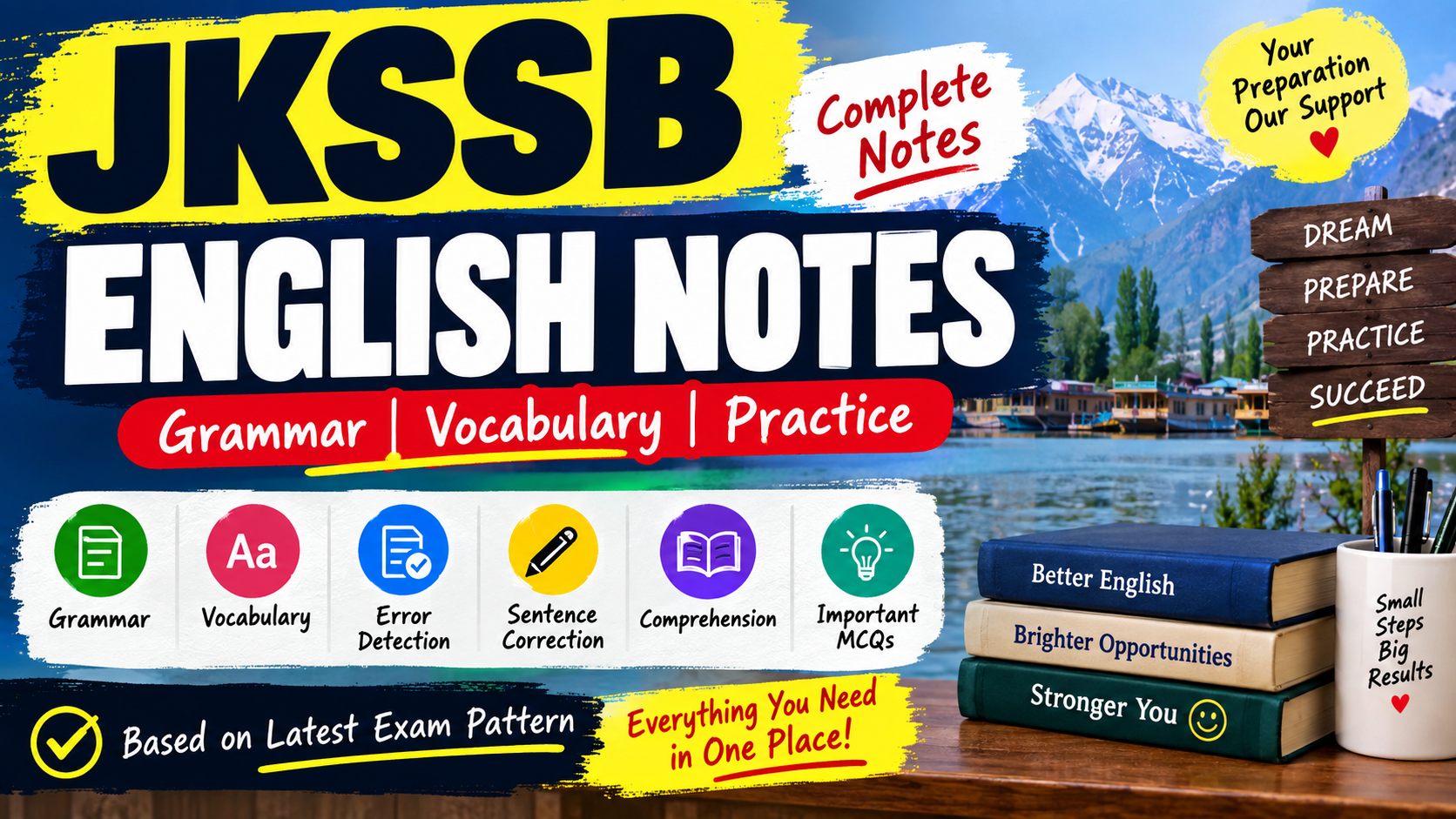
These JKSSB English Notes are prepared as a complete revision resource for candidates preparing for JKSSB, JKP, JKPSC and other competitive examinations. The notes cover grammar, vocabulary, sentence correction, comprehension, usage of words and other important areas.
The idea is simple: understand the rule, see the example, and then practise questions.
Download Complete PDF English notes
1. Parts of Speech
Parts of speech are the basic building blocks of English grammar.
There are eight major parts of speech:
- Noun
- Pronoun
- Adjective
- Verb
- Adverb
- Preposition
- Conjunction
- Interjection
1. Noun
A noun is the name of a person, place, thing, animal or idea.
Examples:
- Rahul is a student.
- Jammu is beautiful.
- The book is interesting.
- Honesty is the best policy.
Types of Nouns
Proper Noun: Particular name of a person, place or thing.
Examples: India, Kashmir, Jammu, Delhi, Rahul.
Common Noun: General name.
Examples: boy, city, river, country.
Collective Noun: Name of a group.
Examples:
- army
- team
- committee
- flock
- bunch
Abstract Noun: Name of an idea, quality, feeling or state.
Examples:
- honesty
- courage
- beauty
- childhood
- wisdom
Material Noun: Name of a material or substance.
Examples:
- gold
- silver
- water
- milk
- iron
2. Pronoun
A pronoun is used in place of a noun.
Examples:
- Rahul is a student. He is intelligent.
- Sara has a book. She reads it daily.
Important pronouns include:
Personal: I, we, you, he, she, it, they
Possessive: mine, ours, yours, his, hers, theirs
Reflexive: myself, ourselves, yourself, himself, herself, themselves
Demonstrative: this, that, these, those
Interrogative: who, whom, whose, which, what
Relative: who, whom, whose, which, that
Important Rule
After than or as, the correct pronoun depends on the grammatical structure.
Example:
- He is taller than I am.
- She is as intelligent as he is.
3. Adjective
An adjective describes or qualifies a noun or pronoun.
Examples:
- a beautiful girl
- a large house
- an honest man
- five books
Degrees of Comparison
There are three degrees:
Positive: tall
Comparative: taller
Superlative: tallest
Examples:
- Ram is tall.
- Shyam is taller than Ram.
- Mohan is the tallest boy in the class.
Important Rules
Use than with the comparative degree.
Correct:
Kashmir is more beautiful than many other places.
Use the with the superlative degree.
He is the tallest boy in the class.
4. Verb
A verb expresses an action, state or occurrence.
Examples:
- run
- eat
- write
- study
- sleep
- become
- is
- are
Main Types
Main Verb
She writes a letter.
Helping Verb
She is writing a letter.
Common helping verbs:
- is
- am
- are
- was
- were
- has
- have
- had
- do
- does
- did
Modal auxiliaries include:
- can
- could
- may
- might
- shall
- should
- will
- would
- must
- ought to
5. Adverb
An adverb modifies a verb, adjective or another adverb.
Examples:
- He runs quickly.
- She sings beautifully.
- He is very intelligent.
Common adverbs:
- quickly
- slowly
- carefully
- honestly
- always
- never
- often
- very
- quite
- too
6. Preposition
A preposition shows the relationship between a noun/pronoun and another word.
Common prepositions:
in, on, at, by, with, from, to, for, of, into, over, under, between, among, beside, behind
Important Preposition Rules
At – generally used for a specific point of time/place.
at 5 PM
at the station
On – used with days and dates.
on Monday
on 15 August
In – used with months, years and longer periods.
in January
in 2026
in the morning
Between vs Among
Between is generally used for two.
Divide the money between Ram and Shyam.
Among is generally used for more than two.
The sweets were distributed among the students.
7. Conjunction
A conjunction joins words, phrases or clauses.
Examples:
- and
- but
- or
- because
- although
- if
- unless
- while
- since
Common Correlative Conjunctions
- either...or
- neither...nor
- both...and
- not only...but also
- whether...or
Example:
Either Rahul or his friends are coming.
The verb generally agrees with the subject closer to it in structures such as either...or and neither...nor.
8. Interjection
An interjection expresses sudden emotion.
Examples:
- Hurrah!
- Alas!
- Wow!
- Oh!
- Bravo!
Example:
Hurrah! We won the match.
9. Articles – A, An and The
Articles are extremely important for competitive examinations.
There are two types:
- Indefinite articles: A, An
- Definite article: The
Use of A
Use a before a consonant sound.
Examples:
- a boy
- a book
- a university
- a European
Notice:
a university
Although "university" begins with the letter u, it begins with a /yu/ sound, so a is used.
Use of An
Use an before a vowel sound.
Examples:
- an apple
- an umbrella
- an honest man
- an hour
Because h is silent in honest and hour, they begin with a vowel sound.
Use of The
Use the when talking about something specific.
Examples:
The book on the table is mine.
The is also commonly used with:
- rivers
- seas
- oceans
- mountain ranges
- deserts
- newspapers
- certain geographical names
Examples:
- the Ganga
- the Arabian Sea
- the Indian Ocean
- the Himalayas
10. Tenses
Tense indicates the time of an action.
There are three main tenses:
- Present
- Past
- Future
Each has four forms.
Present Simple
Structure:
Subject + V1 + object
Example:
He plays cricket.
Used for habits, routines and general truths.
The sun rises in the east.
Present Continuous
Structure:
Subject + is/am/are + V-ing
She is studying.
Used for an action happening now.
Present Perfect
Structure:
Subject + has/have + V3
He has completed his work.
Present Perfect Continuous
Structure:
Subject + has/have been + V-ing
She has been studying for two hours.
11. Past Tense
Simple Past
Subject + V2
He went to school.
Past Continuous
Subject + was/were + V-ing
They were playing football.
Past Perfect
Subject + had + V3
The train had left before we reached the station.
Past Perfect Continuous
Subject + had been + V-ing
He had been working for three hours.
12. Future Tense
Simple Future
Subject + will + V1
I will help you.
Future Continuous
Subject + will be + V-ing
She will be studying tomorrow.
Future Perfect
Subject + will have + V3
He will have completed the work by tomorrow.
Future Perfect Continuous
Subject + will have been + V-ing
They will have been working for five hours.
13. Subject-Verb Agreement
This is one of the most important areas for error detection questions.
The verb must agree with its subject in number and person.
Correct:
He plays cricket.
Incorrect:
He play cricket.
Important Rules
Each / Every + singular noun + singular verb
Every student is present.
Each boy has a book.
One of + plural noun + singular verb
One of my friends is a doctor.
Not:
One of my friends are a doctor.
Neither...nor / Either...or
The verb generally agrees with the nearer subject.
Neither the teacher nor the students are ready.
Neither the students nor the teacher is ready.
14. Active and Passive Voice
In active voice, the subject performs the action.
Ram wrote a letter.
In passive voice, the subject receives the action.
A letter was written by Ram.
Basic Structure
Active:
Subject + Verb + Object
Passive:
Object + suitable form of be + V3 + by + Subject
Examples:
She writes a letter.
A letter is written by her.
15. Direct and Indirect Speech
Direct speech gives the exact words of the speaker.
He said, "I am tired."
Indirect speech reports the statement.
He said that he was tired.
Common Changes
Present → Past
am → was
is → was
are → were
Past → Past Perfect
went → had gone
Pronouns and time expressions may also change depending on context.
Common Time Changes
today → that day
tomorrow → the next day
yesterday → the previous day
now → then
here → there
16. Modals
Modals express ability, possibility, permission, obligation, advice or necessity.
Can
Ability:
I can swim.
Could
Past ability/polite request:
Could you help me?
May
Permission/possibility:
May I come in?
Might
Possibility:
It might rain today.
Must
Strong necessity:
You must follow the rules.
Should
Advice:
You should study regularly.
Would
Polite request/habitual past action in some contexts:
Would you help me?
Ought to
Moral duty/advice:
We ought to respect our elders.
17. Subject-Verb Agreement – Important Exam Rules
Remember these patterns carefully:
News → singular
The news is shocking.
Mathematics → singular
Mathematics is difficult.
Politics → generally singular when referring to the subject/activity
Politics is a complex subject.
Scissors → plural
The scissors are on the table.
But:
A pair of scissors is on the table.
Furniture → uncountable and singular
The furniture is expensive.
Information → uncountable
The information is useful.
18. Countable and Uncountable Nouns
Countable
Can be counted.
Examples:
- book
- pen
- student
- apple
We can say:
five books
Uncountable
Cannot normally be counted individually.
Examples:
- advice
- information
- furniture
- knowledge
- luggage
- equipment
- news
Incorrect:
an advice
Correct:
a piece of advice
Incorrect:
informations
Correct:
information
19. Commonly Confused Words
Competitive examinations frequently test confusing words.
Affect vs Effect
Affect – generally a verb.
The weather affected the match.
Effect – generally a noun.
The medicine had a positive effect.
Accept vs Except
Accept = receive/agrees
He accepted the offer.
Except = excluding
Everyone came except Rahul.
Advice vs Advise
Advice = noun
He gave me good advice.
Advise = verb
I advise you to study.
Principal vs Principle
Principal = head of an institution / main
Principle = rule or belief
Stationary vs Stationery
Stationary = not moving
Stationery = writing materials
Compliment vs Complement
Compliment = praise
Complement = something that completes
20. Synonyms
A synonym is a word having the same or nearly the same meaning.
Important examples:
| Word | Synonym |
|---|---|
| Abandon | Leave |
| Abundant | Plentiful |
| Accurate | Correct |
| Brave | Courageous |
| Calm | Peaceful |
| Difficult | Hard |
| Famous | Renowned |
| Happy | Joyful |
| Honest | Truthful |
| Intelligent | Clever |
| Large | Huge |
| Rapid | Fast |
| Rich | Wealthy |
| Silent | Quiet |
| Strange | Unusual |
21. Antonyms
An antonym has an opposite meaning.
| Word | Antonym |
|---|---|
| Ancient | Modern |
| Arrival | Departure |
| Artificial | Natural |
| Brave | Cowardly |
| Expand | Contract |
| Failure | Success |
| Freedom | Slavery |
| Generous | Stingy |
| Honest | Dishonest |
| Maximum | Minimum |
| Permanent | Temporary |
| Poverty | Wealth |
| Victory | Defeat |
| Visible | Invisible |
22. One Word Substitution
One-word substitution is a favourite vocabulary area in competitive exams.
One who cannot read or write – Illiterate
One who loves mankind – Philanthropist
One who hates mankind – Misanthrope
One who knows many languages – Polyglot
One who speaks many languages – Polyglot
One who loves books – Bibliophile
One who collects stamps – Philatelist
One who cannot be corrected – Incorrigible
A place where books are kept – Library
A place where animals are kept – Zoo
A person who looks at the bright side of things – Optimist
A person who looks at the negative side – Pessimist
23. Idioms and Phrases
Idioms are expressions whose meanings are different from the literal meanings of their individual words.
A blessing in disguise
Something that appears bad initially but turns out to be beneficial.
Once in a blue moon
Something that happens very rarely.
Break the ice
To start a conversation or make people feel comfortable.
Hit the nail on the head
To say or do exactly the right thing.
A piece of cake
Something very easy.
Spill the beans
To reveal a secret.
Under the weather
Feeling unwell.
At the eleventh hour
At the last possible moment.
Burn the midnight oil
To work or study late at night.
In hot water
To be in trouble.
24. Phrasal Verbs
A phrasal verb consists of a verb combined with another word or words.
Give up
To stop trying.
Never give up.
Look after
To take care of.
She looks after her younger brother.
Look for
To search.
I am looking for my book.
Put off
To postpone.
The meeting was put off.
Call off
To cancel.
The match was called off.
Bring up
To mention or raise a subject.
Carry on
To continue.
Find out
To discover information.
25. Question Tags
A question tag is a short question added to the end of a statement.
Positive statement → negative tag.
He is coming, isn't he?
Negative statement → positive tag.
He isn't coming, is he?
Examples:
You are a student, aren't you?
She doesn't know him, does she?
They went there, didn't they?
Special Case
I am late, aren't I?
This is the standard question-tag form.
26. Degrees of Comparison
Positive
Ram is as tall as Shyam.
Comparative
Ram is taller than Shyam.
Superlative
Ram is the tallest boy in the class.
Some irregular forms:
| Positive | Comparative | Superlative |
|---|---|---|
| Good | Better | Best |
| Bad | Worse | Worst |
| Little | Less | Least |
| Much | More | Most |
| Many | More | Most |
| Far | Farther/Further | Farthest/Furthest |
27. Conditional Sentences
Conditional sentences express a condition and its result.
Zero Conditional
Used for general truths.
If you heat ice, it melts.
First Conditional
Possible future condition.
If it rains, we will stay home.
Second Conditional
Unreal or unlikely present/future situation.
If I were rich, I would help the poor.
Third Conditional
Unreal past situation.
If he had studied, he would have passed.
28. Gerund
A gerund is an -ing form functioning as a noun.
Examples:
Swimming is good exercise.
Reading improves knowledge.
Common verbs followed by gerund:
- enjoy
- avoid
- admit
- deny
- finish
- mind
- suggest
Example:
I enjoy reading.
Not:
I enjoy to read.
29. Infinitive
An infinitive generally uses:
to + V1
Examples:
- to read
- to write
- to study
- to play
Example:
I want to study.
Some verbs are followed by infinitives:
- want
- hope
- decide
- plan
- wish
- agree
- promise
30. Common Errors with Prepositions
Remember these common combinations:
good at
He is good at mathematics.
interested in
She is interested in music.
afraid of
He is afraid of dogs.
depend on
Success depends on hard work.
different from
This book is different from that one.
married to
She is married to a doctor.
senior to
He is senior to me.
junior to
He is junior to me.
31. Important Word Pairs
Prefer
Use:
I prefer tea to coffee.
Not:
I prefer tea than coffee.
Senior
Use:
He is senior to me.
Not:
He is senior than me.
Superior
This product is superior to that one.
Inferior
This material is inferior to that one.
32. Sentence Correction
Sentence correction questions usually test:
- subject-verb agreement
- tense
- articles
- prepositions
- pronouns
- conjunctions
- comparison
- word usage
- redundancy
Example:
❌ He do not know me.
✅ He does not know me.
❌ She is senior than me.
✅ She is senior to me.
❌ He is one of the best player.
✅ He is one of the best players.
33. Error Detection
While solving an error detection question, divide the sentence into parts.
Check in this order:
- Subject
- Verb
- Tense
- Article
- Preposition
- Pronoun
- Adjective/adverb
- Conjunction
- Vocabulary
- Overall meaning
This saves time during the examination.
34. Redundant Words
Avoid unnecessary repetition.
Incorrect:
Return back the book.
Correct:
Return the book.
Incorrect:
Repeat again.
Correct:
Repeat.
Incorrect:
Discuss about the matter.
Correct:
Discuss the matter.
Incorrect:
Revert back.
Correct:
Revert.
35. Commonly Asked Spelling Corrections
Remember these spellings:
- Accommodation
- Government
- Separate
- Necessary
- Definitely
- Environment
- Beginning
- Committee
- Privilege
- Maintenance
- Occurrence
- Embarrassment
- Successful
- Receive
- Believe
Important Rule
I before E except after C is a useful general rule, but it has exceptions, so do not treat it as absolute.
36. Prefixes and Suffixes
Prefixes are added at the beginning of a word.
Examples:
un-
happy → unhappy
dis-
honest → dishonest
re-
write → rewrite
mis-
understand → misunderstand
Suffixes are added at the end.
Examples:
kind → kindness
happy → happiness
teach → teacher
develop → development
37. Vocabulary Building for JKSSB
For vocabulary questions, do not try to memorise thousands of random words.
Create four groups:
Group 1 – Synonyms
Example:
Rapid – Fast
Group 2 – Antonyms
Ancient – Modern
Group 3 – One Word Substitution
One who loves books – Bibliophile
Group 4 – Idioms
Once in a blue moon – Rarely
Revise these groups repeatedly.
38. Reading Comprehension
A comprehension passage tests your ability to understand written English.
Questions may ask:
- main idea
- meaning of a word
- inference
- title
- factual information
- author's argument
- statement that is true/false
Best Method
First read the question.
Then read the passage carefully.
Do not use outside knowledge unless the question specifically requires it.
The answer should normally be based on the passage.
39. Cloze Test
A cloze test contains a passage with blanks.
You have to select the most suitable word.
Check:
- grammar
- tense
- vocabulary
- preposition
- context
- singular/plural agreement
Do not select an option merely because it sounds familiar. Read the complete sentence.
40. Sentence Rearrangement
In para-jumble questions, sentences are given in a mixed order.
Look for:
- introductory sentence
- pronouns
- connecting words
- chronological order
- cause and effect
- conclusion
Words such as therefore, however, therefore, finally, thus, because, then often provide clues.
41. Important Conjunction Rules
Although / Though
Do not normally use but with although in the same construction.
❌ Although he was poor, but he was honest.
✅ Although he was poor, he was honest.
Because
Avoid unnecessary therefore in the same basic construction.
❌ Because he was ill, therefore he stayed home.
✅ Because he was ill, he stayed home.
Unless
Unless already expresses a negative condition.
❌ Unless you do not work hard, you will fail.
✅ Unless you work hard, you will fail.
42. Important Rules for "Too"
Too...to often indicates an excessive degree preventing an action.
He is too weak to walk.
Meaning: He is so weak that he cannot walk.
But avoid blindly replacing every "too" construction. Context matters.
43. Important Rules for "Very" and "Much"
Very generally modifies adjectives/adverbs.
very good
very slowly
Much commonly modifies comparative forms and certain past participles/adjectives.
much better
much more
much improved
44. Few, A Few, The Few
Few
Means almost none.
Few students passed the difficult test.
A Few
Means some.
A few students helped me.
The Few
Refers to a small specific number.
The few friends I have are loyal.
45. Little, A Little, The Little
Little
Almost none.
There is little hope.
A Little
Some amount.
There is a little water in the bottle.
The Little
The small amount that exists.
The little money he had was spent on books.
46. Much, Many, Some and Any
Many → countable plural nouns.
many books
Much → uncountable nouns.
much water
Some → commonly used in affirmative sentences.
I have some money.
Any → commonly used in negatives/questions.
I don't have any money.
47. Since and For
Since is used with a point of time.
since 2020
since Monday
since morning
For is used with a period of time.
for two years
for three hours
for five days
Example:
I have lived here since 2020.
I have lived here for six years.
48. During and For
During refers to a particular period/event.
during the meeting
For indicates duration.
for two hours
49. By and Until
By means not later than a particular time.
Complete the work by Monday.
Until means up to a particular time.
Wait until Monday.
50. Commonly Tested Vocabulary
Some useful words for competitive examinations:
Abstain – refrain
Adversity – difficulty
Benevolent – kind
Candid – frank
Diligent – hardworking
Eloquent – fluent/persuasive
Frugal – economical
Hostile – unfriendly
Impartial – unbiased
Magnanimous – generous
Obsolete – outdated
Optimistic – hopeful
Reluctant – unwilling
Vigilant – watchful
Versatile – capable of many different things
51. Important Idioms for Revision
| Idiom | Meaning |
|---|---|
| A blessing in disguise | Hidden benefit |
| A piece of cake | Very easy |
| Break the ice | Start conversation |
| Burn the midnight oil | Work late at night |
| Call it a day | Stop working |
| Hit the nail on the head | Say/do exactly right |
| In hot water | In trouble |
| Once in a blue moon | Very rarely |
| Spill the beans | Reveal a secret |
| Under the weather | Feel unwell |
| Beat around the bush | Avoid the main point |
| Cost an arm and a leg | Very expensive |
| Let the cat out of the bag | Reveal a secret |
| Make both ends meet | Manage financially |
| Through thick and thin | In good and bad times |
52. Important One-Word Substitutions
A person who speaks two languages – Bilingual
A person who speaks three languages – Trilingual
A person who speaks many languages – Polyglot
A person who loves mankind – Philanthropist
A person who hates mankind – Misanthrope
A person who loves wisdom – Philosopher
A person who loves books – Bibliophile
A person who studies stars – Astronomer
A person who studies plants – Botanist
A person who studies animals – Zoologist
A person who studies insects – Entomologist
A person who studies society – Sociologist
A person who studies the earth – Geologist
53. Important Spelling-Based Questions
JKSSB-style English preparation should include spelling practice because a single incorrect letter can change the answer.
Pay special attention to:
- Separate
- Necessary
- Privilege
- Questionnaire
- Pronunciation
- Restaurant
- Rhythm
- Receive
- Occasion
- Maintenance
- Existence
- Conscious
- Discipline
- Intelligence
- Knowledge
54. English Exam Strategy for JKSSB
Do not try to study English randomly.
Divide your preparation into four areas:
Grammar
Focus on:
- Tenses
- Articles
- Prepositions
- Subject-verb agreement
- Pronouns
- Voice
- Narration
- Modals
- Conjunctions
- Degrees of comparison
Vocabulary
Focus on:
- Synonyms
- Antonyms
- One-word substitutions
- Idioms
- Phrasal verbs
- Commonly confused words
- Spellings
Sentence-Based Questions
Practise:
- Error detection
- Sentence correction
- Fill in the blanks
- Cloze test
- Sentence improvement
- Para jumbles
Reading
Practise:
- Reading comprehension
- Vocabulary from passages
- Main idea
- Inference-based questions
55. How to Prepare English for JKSSB
A good English preparation routine does not need to be complicated.
Start with the basic grammar rules and gradually move towards questions.
For example, if you are studying subject-verb agreement, first understand the rules. Then solve 20–30 questions based specifically on those rules.
After that, revise the mistakes.
The same approach works for vocabulary. Instead of learning 100 completely new words every day and forgetting most of them, revise a smaller set repeatedly.
Recommended Daily Practice
Grammar: 20 questions
Vocabulary: 20 questions
Error Detection: 10 questions
Sentence Improvement: 10 questions
Comprehension/Cloze: 1 passage
This kind of consistent practice is much more useful than simply reading grammar rules again and again.
56. Most Important English Topics for JKSSB
For revision, keep these topics at the top of your list:
- Parts of Speech
- Articles
- Tenses
- Subject-Verb Agreement
- Prepositions
- Pronouns
- Adjectives
- Adverbs
- Conjunctions
- Modals
- Active and Passive Voice
- Direct and Indirect Speech
- Synonyms
- Antonyms
- One Word Substitution
- Idioms and Phrases
- Phrasal Verbs
- Spellings
- Error Detection
- Sentence Correction
- Fill in the Blanks
- Cloze Test
- Reading Comprehension
- Sentence Rearrangement
- Vocabulary
ALSO read: Agriculture and Economic Development Notes for JKSSB
Final Revision Advice
For JKSSB English, revision and question practice matter more than collecting too many books.
Keep one notebook or digital list for your mistakes. Whenever you get a question wrong, write down the rule or word that caused the mistake.
For example:
Wrong: He is senior than me.
Correct: He is senior to me.
After a few weeks, this mistake notebook becomes one of the most useful revision resources you have.
Also remember that English preparation should be connected with actual MCQ practice. Reading a rule once does not mean you have mastered it. The real test is whether you can identify the correct option quickly when four choices are sitting in front of you.
For JKSSB aspirants, the best approach is therefore:
Learn → Practise → Check mistakes → Revise → Practise again.
These notes can serve as your base English study material, while topic-wise MCQs and previous-year questions should be used alongside them to develop exam-level accuracy.