JKSSB Class IV MTS Previous Year Cutoff Marks: Complete District-Wise Analysis
The previous year cutoff marks for the Jammu and Kashmir Services Selection Board (JKSSB) Class IV recruitment are an important reference for candidates preparing for Multi-Tasking Staff (MTS) and other Class IV posts. Previous cutoff figures help aspirants understand how merit varied across districts, divisions and reservation categories.
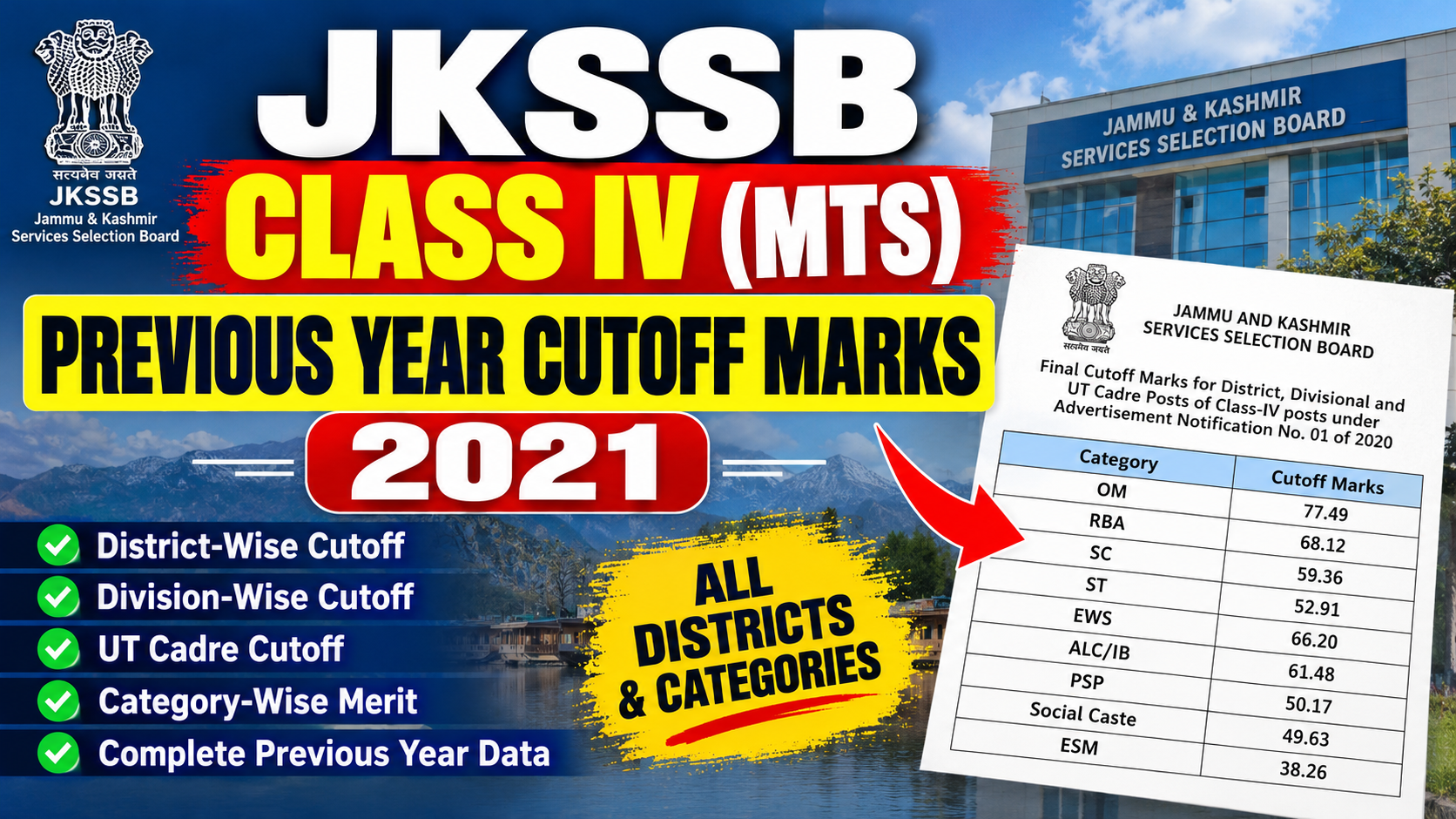
For accuracy, this article uses the final cutoff-merit table published by JKSSB on 19 October 2021 for Advertisement Notification No. 01 of 2020, rather than mixing it with earlier provisional shortlisting cutoffs. The recruitment covered 8,575 Class IV posts across district, divisional and Union Territory cadres. JKSSB also applied additional weightage under the rules governing that recruitment, so these figures should be understood as historical merit cutoffs, not automatically as raw written-exam marks.
The Complete Guide to JKSSB Class IV (MTS) Previous Year Cut Off Marks
The Jammu and Kashmir Services Selection Board (JKSSB) Class IV recruitment drive of 2020 remains one of the largest hiring initiatives in the region's recent history. Advertised under Notification No. 01 of 2020, the board sought to fill 8,575 Class IV (now classified as Multi-Tasking Staff) vacancies across various departments. With the recent announcement of 2,863 new MTS vacancies under Advertisement No. 09 of 2026, candidates are actively analyzing historical data to set realistic target scores.
Understanding the previous cut off marks is the most reliable way to gauge the competitive landscape. Because the JKSSB allocates posts based on a complex matrix of UT, Divisional, and District cadres, the cut off fluctuates significantly depending on the applicant's domicile, chosen preferences, and category.
Download Complete JKSSB Class iv mts Complete Study Material with full mocktests
Why Analyze the 2020/2021 Cut Off?
When the OMR-based written examinations were conducted in batches on February 27, February 28, and March 1, 2021, the competition was unprecedented. Over 3.7 lakh candidates successfully submitted applications for the 8,575 available posts.
The cut off marks established during this recruitment cycle provide a baseline for what constitutes a "safe score." However, direct comparisons require nuance. The 2020 recruitment featured 50.7% of its seats allocated to Open Merit (OM), whereas the 2026 distribution allocates 41.1% to OM. Furthermore, the total volume of posts has decreased by approximately 66.6%, dropping from 8,575 to 2,863. This reduction inherently signals that future cut off thresholds may shift higher, assuming the difficulty level of the examination remains constant.
Key Factors Influencing JKSSB Cut Off Marks
The cut off is never predetermined. It is a dynamic threshold shaped by several intersecting variables:
Total Vacancy Volume: Higher vacancies generally stabilize the cut off. The drop from 8,575 posts to 2,863 posts will be the primary driver of increased competition in upcoming cycles.
Cadre Preferences: The JKSSB allows candidates to prioritize District, Divisional, or UT cadres. Historically, home districts see varied cut offs based on localized competition and literacy rates. Candidates applying outside their home district often face different qualification criteria.
Difficulty of the Examination: The 2021 papers were considered moderate, blending basic mathematics, reasoning, English, and general awareness. A shift toward more analytical, statement-based questions (a trend observed in recent JKSSB exams) can suppress the overall average score.
Category-Wise Competition: The implementation of reservation rules heavily segments the cut off. While Open Merit (OM) consistently demands the highest scores, categories like RBA (Resident of Backward Area), SC (Scheduled Caste), ST (Scheduled Tribe), and ALC/IB have distinct, lower thresholds.
Negative Marking: The presence of a negative marking penalty (typically 0.25 marks per incorrect answer) prevents candidates from blindly guessing, which anchors the top scores and widens the spread in the middle percentiles.
Accurate District & Divisional Cadre Cut Off Marks (Previous Year)
Below is the verified historical cut off data for the JKSSB Class IV recruitment derived from the official 2021 merit and shortlisting declarations.
Kashmir Division Districts
The Kashmir Division exhibited highly competitive scores, particularly in districts with dense applicant pools like Srinagar and Anantnag.
| District Cadre | Open Merit (OM) | RBA |
| Anantnag | 52.73 | 49.75 |
| Bandipora | 51.99 | 48.75 |
| Baramulla | 49.23 | 45.65 |
| Budgam | 50.25 | 47.21 |
| Ganderbal | 54.00 | 49.50 |
| Kulgam | 54.23 | 49.99 |
| Kupwara | 51.24 | 48.50 |
| Shopian | 53.28 | 49.90 |
| Srinagar | 50.75 | 46.66 |
Note: Ganderbal and Kulgam recorded some of the highest Open Merit cut offs in the valley, breaching the 54-mark threshold.
Jammu Division Districts
The Jammu Division saw similarly tight margins, with Samba and Reasi demanding strong performances from Open Merit candidates.
| District Cadre | Open Merit (OM) | RBA / Social Caste |
| Jammu (District) | 52.76 | 46.50 |
| Kathua | 50.02 | 39.81 (ST) |
| Kishtwar | 51.99 | 50.54 (Social Caste) |
| Poonch | 52.75 | 50.54 (Social Caste) |
| Reasi | 51.99 | 48.50 |
| Samba | 54.00 | 49.09 |
Divisional and UT Cadres
Posts allocated at the Divisional and Union Territory levels generally draw from a broader applicant base. The Divisional Cadres merge competition across multiple districts, stabilizing the extreme highs and lows seen in isolated district data.
| Cadre | Open Merit (OM) | ST / Other Categories |
| Kashmir (Division) | 48.99 | 35.77 (ST) |
| Jammu (Division) | 47.56 | 43.60 |
Analyzing the Data: Trends and Takeaways
1. The "Safe Score" Fallacy
A common trap for candidates is treating previous cut offs as hard targets. While a score of 52.76 secured an Open Merit post in Jammu District previously, the reduction in overall vacancies means that replicating a score of 52 in the upcoming cycle may not yield the same result. The data serves as a floor, not a ceiling.
2. The RBA and Social Caste Margins
The Residents of Backward Areas (RBA) category remains highly competitive. In districts like Anantnag and Shopian, the gap between Open Merit and RBA was remarkably narrow—often separated by less than 4 marks. Candidates relying on category certificates must prepare with the intensity of Open Merit applicants, as the advantage margin is shrinking.
3. District Volatility
Districts like Baramulla (OM 49.23) and Jammu Division (OM 47.56) offered slightly more accessible thresholds compared to peak districts like Samba (OM 54.00) and Kulgam (OM 54.23). This volatility highlights the importance of strategic cadre preference selection during the application process.
ALSO READ:Daily JKSSB Current Affairs 2026–2027: Complete Preparation Guide for Upcoming Exams
Evolving Exam Patterns and Strategy
The JKSSB has actively modernized its testing methodology since 2021. The transition away from straightforward factual recall to deeper, conceptual questioning requires a shift in preparation strategy.
Historically, general awareness sections relied on direct, one-line questions (e.g., identifying capitals or straightforward historical dates). Recent examinations demonstrate a preference for multi-statement questions that test comprehensive understanding over rote memorization.
To bridge the gap between historical cut offs and future requirements, candidates should focus heavily on foundational mathematics and logical reasoning. These sections are high-yield and less prone to the ambiguities of general knowledge. Securing 80% or more of the available marks in the quantitative and reasoning sections provides a massive buffer against the unpredictable nature of current affairs and general science. Furthermore, mastering the specific geographical, historical, and economic contexts of Jammu & Kashmir remains non-negotiable, as regional questions consistently form a high-weightage core of the syllabus.