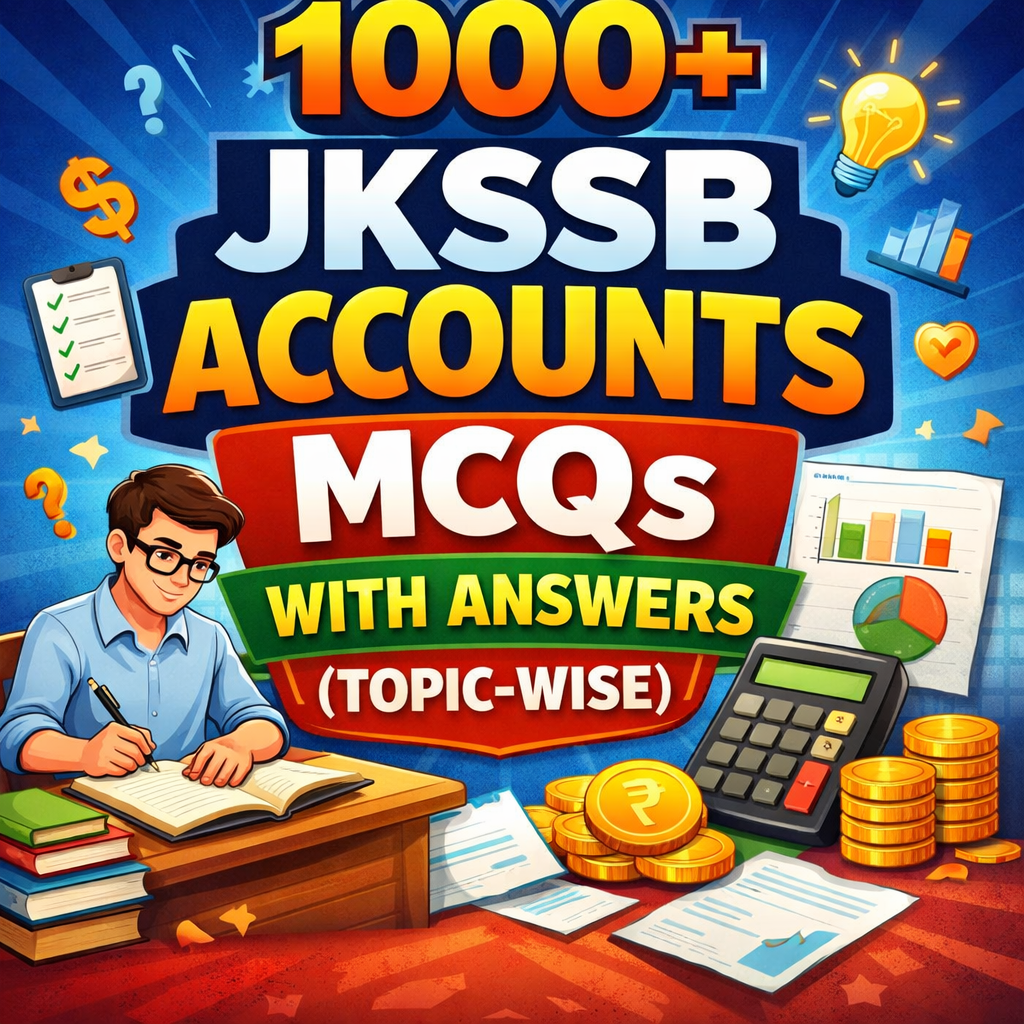
JKSSB Accounts MCQs 2026 with complete study material is the absolute golden key to securing your name in the final merit list.
As competition peaks this year, relying on outdated or unverified study material will cost you precious marks. You need targeted, highly accurate questions that mirror the exact exam pattern.
What are the most important Accounts MCQs for JKSSB 2026? > The most highly tested Accountancy questions in JKSSB exams cover Financial Accounting principles, the Double Entry System, Bank Reconciliation Statements (BRS), Ledger Posting, and Partnership Accounts. Practicing topic-wise objective questions with detailed solutions helps aspirants build 100% accuracy and understand the core bookkeeping concepts required for final selection.
Why is Accountancy Crucial for JKSSB 2026?
Accountancy and Bookkeeping form the backbone of major JKSSB recruitment exams, especially for Finance Department roles. It is a highly scoring section if your basic concepts are crystal clear.
Unlike General Knowledge, which has an infinite scope, Accountancy has defined rules and principles. If you memorize the golden rules and practice consistently, you can easily secure full marks in this section.
As per the latest official update, conceptual clarity over rote memorization is heavily favored in modern JKSSB exam patterns.
Key Topics in JKSSB Accountancy Syllabus
To streamline your preparation, here is a breakdown of the core topics you must focus on. This will help you prioritize your study time effectively.
| Accountancy Topic | Importance Level | Key Focus Areas |
| Introduction to Accounting | High | Basic terms, GAAP, Accounting Concepts |
| Double Entry System | Very High | Golden Rules, Journal Entries, Ledgers |
| Bank Reconciliation Statement | High | Causes of difference, Overdraft balances |
| Trial Balance & Errors | Medium | Types of errors, Suspense account |
| Depreciation | High | SLM, WDV methods, Accounting treatment |
| Partnership Accounts | Very High | Admission, Retirement, Goodwill valuation |
Top 10 JKSSB Accounts MCQs with Answers (2026 Edition)
Here are the highest-probability questions for your upcoming exam. Evaluate your current preparation level below.
Question 1: Which of the following is considered the fundamental accounting equation? a) Capital + Liabilities = Assets
b) Capital + Assets = Liabilities
c) Assets + Liabilities = Equity
d) Liabilities - Assets = Capital
Answer: a
Solution: The fundamental accounting equation is Assets = Liabilities + Capital (or Equity). This ensures that the balance sheet always remains balanced according to the dual aspect concept.
Question 2: According to the matching concept, which of the following is true? a) All assets must equal liabilities
b) Expenses of a period must be matched with revenues of the same period
c) Cash inflows must match cash outflows
d) Debits must always equal credits
Answer: b
Solution: The matching concept states that expenses incurred to generate revenue must be recognized and reported in the same accounting period as the related revenue.
Question 3: A cash book with discount and bank columns is known as a: a) Single column cash book
b) Double column cash book
c) Three column cash book
d) Petty cash book
Answer: c
Solution: A three-column cash book records cash transactions, bank transactions, and discount allowed/received in three separate columns on both the debit and credit sides.
Question 4: Which error is NOT disclosed by a Trial Balance? a) Error of principle
b) Error of casting
c) Posting to the wrong side of an account
d) Omitting a balance completely
Answer: a
Solution: Errors of principle (violating accounting rules, like treating a capital expenditure as revenue) do not affect the agreement of a Trial Balance because the debit and credit amounts remain mathematically equal.
Question 5: What is the main purpose of preparing a Bank Reconciliation Statement (BRS)? a) To calculate the net profit
b) To reconcile the cash book balance with the passbook balance
c) To detect frauds by bank employees
d) To record petty cash expenses
Answer: b
Solution: A BRS is prepared to identify and explain the reasons for the difference between the bank balance as per the cash book and the balance as per the bank passbook.
Question 6: Goodwill brought in by a new partner in cash is credited to: a) New partner's capital account
b) Old partners' capital accounts in the sacrificing ratio
c) Old partners' capital accounts in the old profit-sharing ratio
d) Revaluation account
Answer: b
Solution: When a new partner brings their share of goodwill in cash, it is distributed among the old (sacrificing) partners in their sacrificing ratio to compensate them for giving up a share of their future profits.
Question 7: Under the Straight Line Method of depreciation, the amount of depreciation: a) Increases every year
b) Decreases every year
c) Remains constant every year
d) Fluctuates based on usage
Answer: c
Solution: In the Straight Line Method (SLM), a fixed and equal amount of depreciation is charged to the Profit and Loss Account every year over the useful life of the asset.
Question 8: Outstanding wages are classified as a: a) Current Asset
b) Current Liability
c) Fixed Asset
d) Capital Receipt
Answer: b
Solution: Outstanding wages represent expenses that have been incurred but not yet paid. Therefore, they are an obligation the business must settle in the short term, making them a current liability.
Question 9: The preparation of a Trial Balance helps in achieving: a) Arithmetical accuracy of ledger accounts
b) Exact net profit of the firm
c) Total valuation of assets
d) Market value of the business
Answer: a
Solution: A Trial Balance lists all debit and credit balances of ledger accounts. If the totals match, it ensures the arithmetical accuracy of the books of accounts, though it doesn't prove the absence of all errors.
Question 10: Which of the following is an example of an Intangible Asset? a) Land and Building
b) Plant and Machinery
c) Patents and Trademarks
d) Closing Stock
Answer: c
Solution: Intangible assets are non-physical assets that have a monetary value. Patents, trademarks, copyrights, and goodwill are classic examples of intangible assets.
How to Prepare Accountancy for JKSSB Effectively?
First, clear your core concepts before rushing into multiple-choice questions. Start by understanding the golden rules of accounting and basic terminology.
Make sure you download complete syllabus PDF from the official website so you don't waste time on irrelevant topics. Stick strictly to the outlined curriculum.
Once you finish a topic, immediately solve 50-100 MCQs related to it. You must practice previous year questions to understand the exact difficulty level of the JKSSB board.
To build exam temperament, attempt free JKSSB mock test series online. This will help you manage your time and reduce negative marking during the actual paper.
What Are the Common Mistakes Aspirants Make?
Many students skip the theory and jump straight into numerical problems. This is a fatal flaw; JKSSB focuses heavily on theoretical concepts and accounting principles.
Ignoring the "Error and Suspense Account" and "BRS" topics is another major blunder. These areas consistently produce tricky questions that trap unprepared candidates.
Lastly, failing to revise regularly leads to forgetting formulas and rules. Spaced repetition is mandatory for subjects like bookkeeping.
Quick Revision Summary
Understand Concepts First: Never memorize Accountancy MCQs without understanding the underlying GAAP or Golden Rule.
Focus on High-Weightage Topics: Double Entry, BRS, Depreciation, and Partnership are non-negotiable.
Accuracy Over Speed: In your initial days, focus on getting the answer right. Speed will naturally develop.
Analyze Mistakes: Every time you get a mock test question wrong, read the detailed solution and note down the core concept.
Frequently Asked Questions (FAQs)
Q: Is Accountancy difficult for non-commerce students in JKSSB 2026? A: Not at all. The JKSSB syllabus focuses on fundamental bookkeeping principles. With consistent practice and conceptual clarity, non-commerce students can easily score high marks.
Q: Where can I find the best topic-wise Accounts MCQs for JKSSB? A: You can find highly curated, exam-oriented MCQs right here on our platform. We regularly update our database to match the latest 2026 JKSSB exam patterns.
Q: Does JKSSB ask complex numerical questions in Accountancy? A: Generally, the exam features conceptual and straightforward numericals. Complex, lengthy calculations are rare because of the time constraints of objective-type exams.
Q: How many questions are usually asked from the Bookkeeping section? A: The weightage varies by specific notification. For posts like Finance Accounts Assistant, it is the highest-scoring section, often carrying up to 30 marks.
Q: Are previous year questions enough to pass the JKSSB Accounts exam? A: While previous papers are crucial for understanding the trend, they are not enough on their own. You must pair them with updated 2026 mock tests and full syllabus coverage.
Q: What is the negative marking for JKSSB 2026 exams? A: As per standard JKSSB patterns, there is usually a negative marking of 0.25 marks for every incorrect answer. Accuracy is vital to stay in the merit list.
Conclusion
Securing a government job in 2026 requires smart work, unwavering dedication, and the right study materials. By mastering these JKSSB Accounts MCQs, you are already one step closer to your dream career. Keep revising your basics, trust your preparation, and don't let the competition intimidate you. Would you like me to provide a customized 30-day study plan specifically for the Accountancy section?