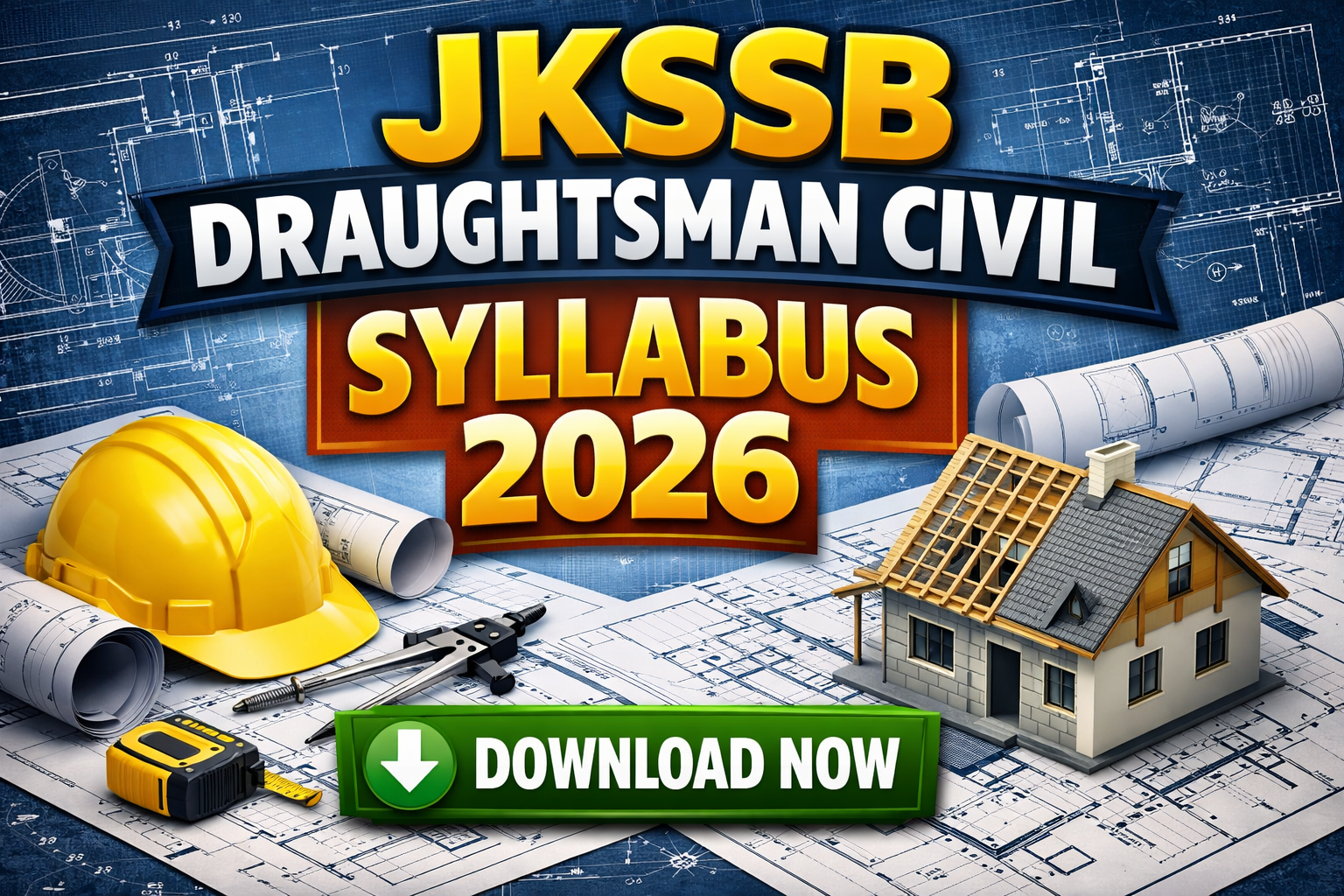
JKSSB Draughtsman Civil Syllabus 2026 Download – Complete Unit-Wise
If you are preparing for the JKSSB Draughtsman Civil exam, the biggest advantage you can gain is understanding the syllabus in depth. Most candidates simply download the PDF and start studying randomly. That approach rarely works.
The JKSSB Draughtsman Civil Syllabus 2026 is structured into five major units, each designed to test technical drawing skills, construction knowledge, surveying concepts, and modern drafting tools.
The JKSSB Draughtsman Civil Syllabus 2026 consists of 5 units covering Engineering Drawing, Building Construction, Surveying, Irrigation & RCC, and Estimation with AutoCAD. The exam carries 120 marks and is conducted for 120 minutes.
Download Pdf Link SYLLABUS OFFICIAL
Download JKP CONSTABLE STUDY MATERIAL
Complete Syllabus Overview
The syllabus is not theoretical alone. It is designed to evaluate whether a candidate can perform real drafting and civil-related tasks.
Key Highlights
- Total Marks: 120
- Duration: 120 Minutes
- 5 Units with defined weightage
- Strong focus on practical civil knowledge
- Drawing and drafting concepts are core
- Includes modern tools like AutoCAD
- Based on BIS standards
- Covers both field and office-level skills
- Includes estimation and planning
- Aligns with real job responsibilities
Unit-Wise Detailed Syllabus (Explained)
Unit 1 – Engineering Drawing & Materials (25 Marks)
This unit forms the foundation. Without mastering this, scoring high becomes difficult.
Key areas:
- Drawing instruments, tools, and safety
- BIS code and architectural drawings
- Lettering techniques and proportions
- Geometrical constructions
- Orthographic projections and scales
- Dimensioning and sketching
- Conventional symbols
- Basic building materials like bricks, cement, sand
Exam Insight:
Based on recent JKSSB patterns, questions from this section are often concept-based and require visualization skills.
Unit 2 – Building Construction & Architecture (30 Marks)
This is the highest weightage section and extremely important.
Topics include:
- Building construction sequence
- Brick and stone masonry
- Foundations and soil bearing capacity
- Damp proofing methods
- Flooring techniques
- Arches, lintels, and scaffolding
- Doors, windows, ventilators
- Roof structures (king post, queen post trusses)
- Stairs design and planning
- Residential building planning and bylaws
- Estimation basics
- Safety practices and basic tools
Advanced Insight:
This unit tests real-world understanding. Questions are often scenario-based rather than direct definitions.
Unit 3 – Surveying, Roads, Railways & Bridges (25 Marks)
A technical and scoring section if concepts are clear.
Includes:
- Chain surveying and plane table
- Compass surveying and leveling
- Contouring and plotting
- Road construction basics
- Railway engineering fundamentals
- Bridge components and classification
- Tunnel basics
Exam Trend:
Surveying numericals and instrument-based questions are commonly seen in competitive exams.
Unit 4 – Irrigation, RCC & Public Health (20 Marks)
This unit blends civil engineering fundamentals with applied concepts.
Topics:
- Irrigation terms and hydrology
- Types of dams and reservoirs
- Canal systems and structures
- Cross drainage works
- Hydroelectric structures
- Public health engineering basics
- RCC materials and construction
- Concrete mixing and slump test
- Riveted joints and connections
Important Note:
Concept clarity is essential, especially for irrigation and RCC.
Unit 5 – Estimation, Computer & AutoCAD (20 Marks)
This unit reflects modern drafting requirements.
Topics include:
- Estimation and rate analysis
- Building planning and bylaws
- Basic computer knowledge
- DOS and Windows commands
- AutoCAD tools and commands
- Coordinate systems
- 3D drafting basics
High-Value Insight:
AutoCAD questions are usually straightforward and scoring if practiced properly.
Summary Table: Unit-Wise Breakdown
| Unit | Subject Area | Marks | Priority |
|---|---|---|---|
| Unit 1 | Drawing & Materials | 25 | High |
| Unit 2 | Construction & Architecture | 30 | Very High |
| Unit 3 | Surveying & Transport | 25 | High |
| Unit 4 | Irrigation & RCC | 20 | Medium |
| Unit 5 | Estimation & AutoCAD | 20 | High |
Exam Relevance (JKSSB 2026 Perspective)
Based on recent JKSSB patterns, the exam is becoming more practical and application-oriented.
Candidates should expect:
- Drawing-based conceptual questions
- Real-life construction scenarios
- Surveying instruments and applications
- Estimation-based logic questions
This shift means that understanding concepts is more important than memorization.
Smart Preparation Strategy
A structured plan is essential.
Step 1: Understand the Syllabus
Start by reviewing all 5 units clearly. You can also download complete syllabus PDF for quick reference.
Step 2: Focus on High-Weight Units
Prioritize:
- Unit 2 (Construction)
- Unit 1 (Drawing)
- Unit 3 (Surveying)
Step 3: Practice Regularly
- attempt free JKSSB mock test
- practice previous year questions
This builds accuracy and speed.
Step 4: Revise Smartly
Create short notes for formulas, diagrams, and definitions.
Common Mistakes to Avoid
- Ignoring unit-wise weightage
- Skipping drawing practice
- Not studying BIS standards
- Avoiding AutoCAD completely
- Lack of revision
- Over-reliance on theory
Avoiding these mistakes can significantly improve performance.
Quick Revision Points
- Unit 2 carries highest marks
- Drawing is core of the exam
- Surveying is highly scoring
- RCC and irrigation need concept clarity
- AutoCAD is easy scoring section
- Practice is key to success
- Focus on real-life applications
- Revision improves retention
Advanced Strategy for High Score
Top performers focus on:
- Concept clarity over memorization
- Diagram-based learning
- Previous year pattern analysis
- Mock test performance tracking
Understanding examiner mindset is the real game changer.
jkssb je civil full mocktests attempt it now
FAQs
1. What is total marks in JKSSB Draughtsman Civil exam?
The exam is conducted for 120 marks in 120 minutes.
2. How many units are in the syllabus?
There are 5 units covering technical and practical subjects.
3. Which unit is most important?
Unit 2 (Building Construction) has the highest weightage.
4. Is AutoCAD included in syllabus?
Yes, basic AutoCAD and drafting knowledge is included.
5. Is syllabus same every year?
Core structure remains similar but minor updates may occur.
6. How to prepare effectively?
Focus on concepts, practice questions, and take mock tests.
7. Are diagrams important?
Yes, drawing-based understanding is critical.
8. Is this exam difficult?
Moderate difficulty but requires strong technical preparation.
Final Words
The JKSSB Draughtsman Civil Syllabus 2026 is comprehensive and designed to test real technical skills. Candidates who align their preparation strictly with the syllabus and focus on practical understanding always stay ahead of the competition.
Do not just read the syllabus—analyze it, break it into units, and prepare strategically. Combine study with practice, and consistently evaluate your performance.
Success in this exam is not about studying more, but studying smart.