The landscape of competitive examinations in Jammu and Kashmir is undergoing a significant transformation. For aspirants targeting the 2026 recruitment cycle, the shift towards analytical assessment is evident. The days of relying solely on rote memorization of isolated facts are fading. The upcoming examinations demand a rigorous, multi-layered understanding of core subjects, heavily penalizing superficial preparation.
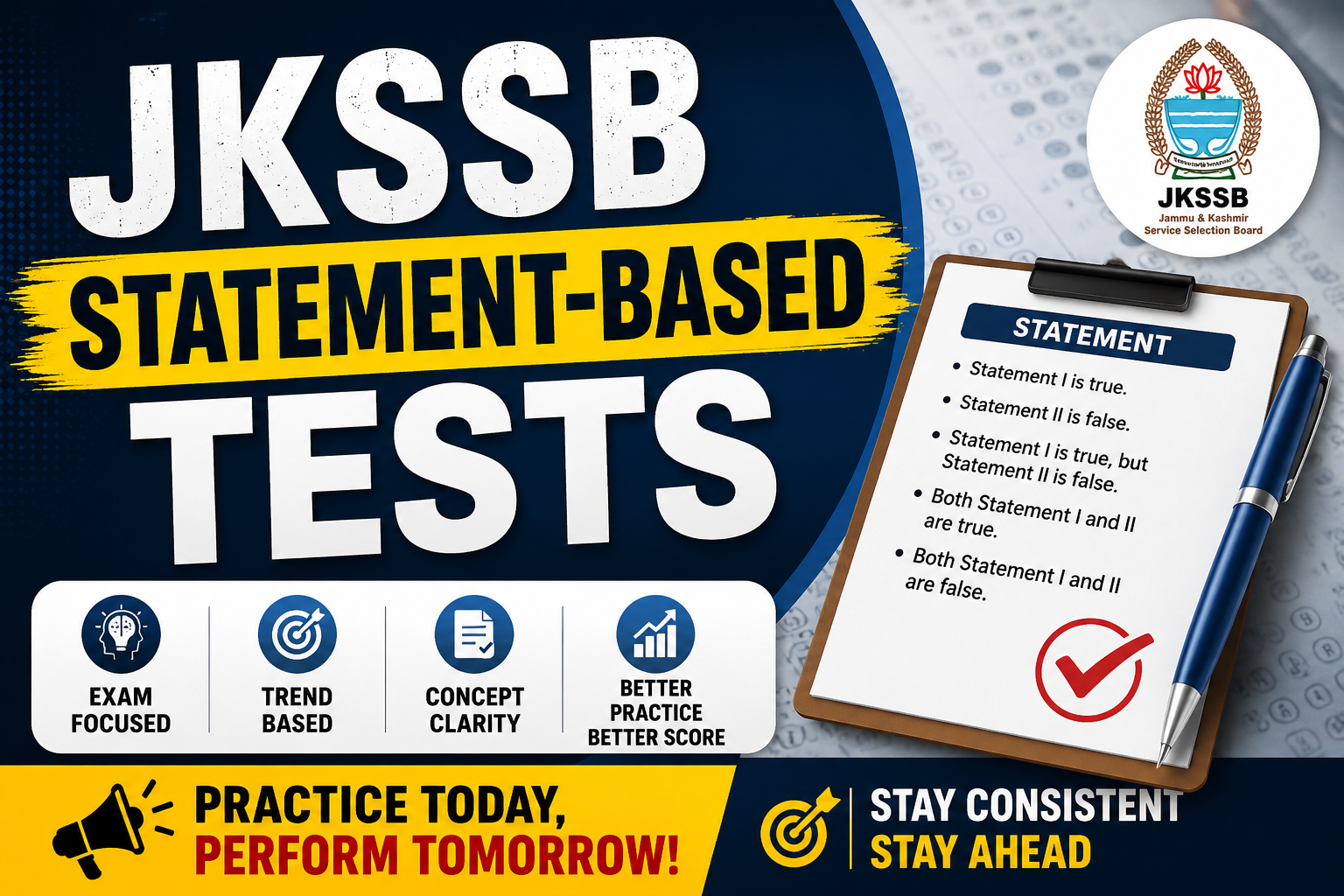
Statement-based questions in the JKSSB Finance Account Assistant (FAA) exam require candidates to analyze two or more factual or conceptual sentences to determine their individual correctness and logical relationship. Preparing with topic-wise statement tests ensures deep conceptual clarity, moving beyond surface-level facts to tackle the evolving, highly analytical 2026 exam pattern effectively.
JKSSB FAA Statement Based Topic Wise Tests 2026
The structural shift in question formulation is designed to identify candidates who possess genuine subject mastery. A statement-based question typically presents two to three distinct propositions. Candidates must evaluate each proposition independently before selecting a combined answer code. This format tests accuracy, reading comprehension, and the ability to connect disparate concepts under severe time constraints.
To navigate this complexity, adopting a granular, topic-by-topic approach is non-negotiable. Breaking down the massive syllabus into digestible modules allows for targeted practice, ensuring that foundational weaknesses are identified and rectified before attempting full-length simulations.
The Evolution of the Finance Account Assistant
Historically, state-level accounting examinations leaned heavily on direct one-liner questions. If you knew the capital of a country or the formula for current ratio, you secured the mark instantly. The transition to statement-based formats mirrors the evolution of central regulatory exams. It is a calculated move by examining bodies to elevate the quality of inducted personnel.
Tests deep conceptual understanding over rote memorization.
Effectively eliminates the possibility of blind guessing.
Requires comprehensive and exhaustive syllabus coverage.
Increases the average time taken per question significantly.
Demands high-level reading comprehension and parsing skills.
Focuses heavily on the nuances of Accountancy and Economics fundamentals.
Rewards consistent, highly focused topic-wise practice.
Reflects the rigorous standard of modern civil service examinations.
Acts as a strict filter to isolate highly serious candidates.
Highlights the critical importance of precision in recalling facts.
Penalizes candidates who skip "minor" sub-topics within the syllabus.
Core Strategies for Analytical Question Parsing
Tackling complex propositions requires a methodical approach. The first rule is hyper-vigilance regarding absolute terminology. Words such as "always," "never," "only," "must," and "all" are engineered traps. While a statement might be generally true, the presence of an absolute word often renders it technically incorrect in a strict academic context. Conversely, terms like "generally," "often," "can," and "may" usually indicate a correct proposition, as they allow for standard exceptions.
Another vital strategy is the isolation technique. Treat each statement as a completely independent true/false question first. Do not let the truth value of Statement 1 bias your evaluation of Statement 2. Only after independently verifying each claim should you look at the available options. This prevents the brain from seeking confirmation bias based on the provided a, b, c, d choices.
Applied Topic Practice
To master this format, rigorous practice with exact exam-level questions is required. Consider the following specific topic applications:
Question: Consider the following statements regarding the preparation of a Bank Reconciliation Statement (BRS):
Statement 1: A BRS is prepared to reconcile the difference between the cash book balance and the passbook balance.
Statement 2: Bank charges debited by the bank are added to the cash book balance to arrive at the passbook balance.
a) Only Statement 1 is correct
b) Only Statement 2 is correct
c) Both Statement 1 and Statement 2 are correct
d) Neither Statement 1 nor Statement 2 is correct
Answer: a) Only Statement 1 is correct
Solution: Statement 1 is conceptually accurate as it defines the primary purpose of a BRS. Statement 2 is incorrect. When a bank deducts charges, the passbook balance decreases. To reconcile from the cash book to the passbook, these charges must be subtracted from the cash book balance, not added.
Question: Read the following statements concerning Macroeconomic indicators:
Statement 1: Gross Domestic Product (GDP) includes the value of intermediate goods to avoid underestimating the economy's output.
Statement 2: Real GDP is adjusted for inflation and represents the true volume of production in an economy.
a) Only Statement 1 is correct
b) Only Statement 2 is correct
c) Both Statement 1 and Statement 2 are correct
d) Neither Statement 1 nor Statement 2 is correct
Answer: b) Only Statement 2 is correct
Solution: Statement 1 is fundamentally flawed. GDP calculation strictly excludes the value of intermediate goods to prevent the problem of double counting, ensuring only final goods and services are measured. Statement 2 is entirely correct, as Real GDP uses constant prices to strip away the effects of inflation, providing a true measure of economic growth.
Analyzing Topic Weightage and Conceptual Depth
Understanding the depth required for different subjects is paramount. Not all topics are equally susceptible to complex statement framing. Accountancy and Economics are prime targets for these analytical structures because they are built on overlapping principles and conditional rules.
| Subject Area | Traditional Question Focus | Statement-Based Question Focus |
| Accountancy | Direct formulas, basic journal entries, definitions. | Interplay of GAAP principles, impact of specific errors on trial balance. |
| Economics | Definitions of inflation, basic demand curves. | Fiscal vs. Monetary policy impacts, nuanced macroeconomic indicators. |
| General Knowledge | Single dates, locations, simple historical facts. | Chronological sequences, detailed provisions of the J&K Reorganization Act. |
| General Science | SI Units, basic chemical formulas. | Application of physical laws in real-world scenarios, biological processes. |
| Computers | Shortcut keys, basic hardware definitions. | Distinguishing between specific malware types, networking protocols. |
The current testing mindset, based on recent JKSSB patterns, heavily favors the application of knowledge. Examiners are constructing questions that require candidates to project the outcome of a specific scenario. For instance, instead of asking what depreciation is, an examiner will provide two statements about how changing a depreciation method affects the net profit and the balance sheet simultaneously.
To bridge the gap between theoretical knowledge and practical application, candidates must routinely evaluate their standing. You should frequently attempt free JKSSB mock test resources that accurately mirror this multi-statement difficulty. Analyzing your performance in these controlled environments exposes gaps in logic and memory.
Formulating a Resilient Study Architecture
Success in the 2026 exams relies on a structured, layered study plan. Begin by securing the foundational documents. Before purchasing advanced books or enrolling in expensive courses, you must download complete syllabus PDF files directly from the official portal. This document is your ultimate boundary; everything inside is testable, everything outside is a distraction.
Once the syllabus is mapped, transition into phase two: concept building. Read from standard, authoritative textbooks. When studying Accountancy, do not just memorize that 'Debit comes in, Credit goes out'. Understand the underlying logic of the dual aspect concept. Why does every transaction have two sides? How does an increase in an asset affect owner's equity? This deep questioning is the exact mental framework required to solve statement questions.
Phase three involves intense, focused application. After completing a specific module, such as 'Partnership Accounts', immediately subject yourself to a rigorous topic-wise test containing only complex propositions. This immediate reinforcement cements the knowledge. Furthermore, it is critical to practice previous year questions from similar tier exams, as examining bodies often recycle high-quality analytical structures.
Navigating the Pitfalls of Analytical Assessment
Even well-prepared candidates falter due to poor execution strategies during the examination. The most frequent error is rapid skimming. The brain, under stress, tends to read what it expects to see rather than what is actually printed. Missing a tiny "not" or "unlikely" buried in the middle of a lengthy sentence completely reverses its meaning and leads to a negative mark.
Another critical misstep is overthinking. While statement questions are complex, they are still grounded in standard syllabus facts. Candidates sometimes imagine highly unlikely edge cases or exceptions that the examiner never intended, talking themselves out of the correct answer. Stick to the core principles taught in standard textbooks. If a statement requires four massive leaps of logic to be true, it is almost certainly intended to be marked false.
Read every single word of the proposition; never skim or speed-read during the actual exam.
Physically circle or underline absolute modifiers (all, none, always, strictly) on the question paper.
Evaluate Statement 1 completely independent of Statement 2 to prevent cognitive bias.
Do not look at the option codes until you have definitively judged the truth value of the statements.
Maintain a strict time budget; if a dual-statement question is taking longer than 90 seconds, mark it for review and move forward.
Trust your initial conceptual grounding; avoid inventing convoluted scenarios to justify a false statement.
Frequently Asked Questions
What is the most effective way to prepare for statement-based questions?
The most effective approach is to transition from superficial reading to conceptual studying. Break the syllabus down and take topic-wise tests immediately after completing a chapter. Focus on the "why" and "how" of a concept rather than just the "what."
Will the JKSSB FAA 2026 exam only contain statement questions?
No. Competitive exams utilize a mixed-bag approach to maintain a balanced difficulty curve. While analytical questions will dictate the merit list and act as the primary differentiator, direct, single-fact questions will still be present to test basic recall and speed.
How much time should I allocate to a complex question during the exam?
Ideally, you should aim to parse and solve a multi-statement question within 60 to 75 seconds. If the statements are exceptionally lengthy or confusing, do not let it destroy your momentum. Flag it and return during your second pass of the paper.
Is it important to study the J&K Reorganization Act deeply for this format?
Absolutely. The Reorganization Act is highly technical and contains numerous specific provisions, making it an ideal candidate for complex, multi-statement framing. Surface-level knowledge of dates will not suffice; you must understand the specific articles and their implications.
Why do I keep getting assertion-reasoning questions wrong despite knowing the topic?
Assertion-Reasoning requires a specific logical link. The reason must not only be a true statement on its own, but it must be the direct, scientific, or logical cause of the assertion. Often, candidates select "Both are true and R is the correct explanation" simply because both statements are factually correct, ignoring the lack of a causal relationship.
What should I do if I am completely unsure about one statement out of three?
Utilize the power of elimination. If you are 100% certain that Statement 1 is false, look at the options and eliminate any choice that includes Statement 1. Often, this technique will reduce your choices down to a 50/50 probability, making an educated guess mathematically viable.
Achieving a top rank in the highly competitive environment of Jammu and Kashmir recruitment demands more than just hard work; it requires strategic alignment with the examining body's current methodology. The transition toward rigorous, analytical testing is not an obstacle, but an opportunity for dedicated candidates to separate themselves from the crowd. By shifting your preparation away from superficial memorization and embracing the depth required for statement-based topic tests, you build an intellectual resilience that will serve you flawlessly on exam day. Focus on clarity, enforce strict topic-wise discipline, and approach the 2026 assessment with absolute academic confidence.