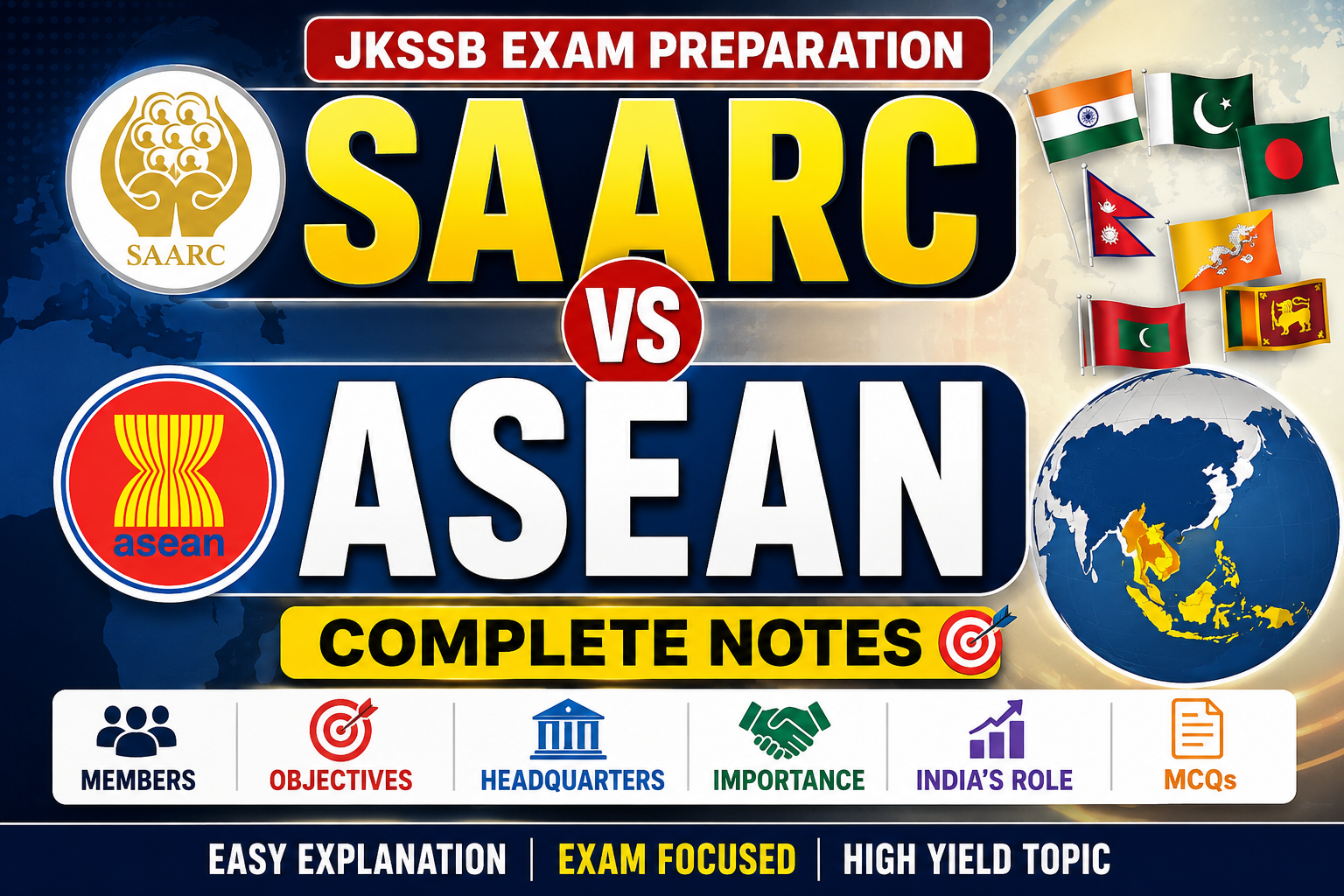
SAARC and ASEAN – Detailed Notes for JKSSB
Introduction
In almost every competitive examination today — especially JKSSB, SSC, Banking, UPSC foundation level, and state-level exams — questions from international organizations are asked repeatedly. Among them, SAARC and ASEAN are two of the most important regional organizations related to Asia.
Students often memorize only:
- headquarters,
- member countries,
- formation year,
but examiners increasingly ask:
- conceptual questions,
- regional cooperation questions,
- India’s strategic role,
- economic significance,
- differences between organizations,
- summit-related facts,
- geopolitical relevance.
Therefore, understanding these organizations conceptually is extremely important.
These notes are designed not merely to help you remember facts but to help you understand:
- why these organizations were formed,
- how they function,
- why some organizations succeed while others struggle,
- how India uses regional diplomacy,
- why ASEAN is considered more effective than SAARC,
- and how such topics connect with geography, economics, diplomacy, trade, and current affairs.
Chck first in india notes and JK Reorganisation act 2019 notes
Understanding Regional Organizations
Before studying SAARC and ASEAN separately, students should first understand what a regional organization actually means.
What is a Regional Organization?
A regional organization is a group of neighboring countries that cooperate for:
- economic development,
- peace and security,
- trade,
- cultural exchange,
- regional stability,
- and political coordination.
These organizations are formed because neighboring countries usually share:
- geographical proximity,
- cultural similarities,
- economic interests,
- common security concerns,
- environmental challenges.
Why Countries Form Regional Organizations
| Reason | Explanation |
|---|---|
| Economic Cooperation | Increase trade and investment |
| Political Stability | Reduce conflicts between neighboring countries |
| Security Cooperation | Fight terrorism, piracy, trafficking |
| Cultural Exchange | Improve regional understanding |
| Infrastructure Development | Better transport and connectivity |
| Collective Voice | Stronger influence in world politics |
SAARC (South Asian Association for Regional Cooperation)
Introduction to SAARC
SAARC is the most important regional organization of South Asia.
It was established to promote:
- regional cooperation,
- socio-economic development,
- mutual trust,
- peace among South Asian countries.
South Asia is one of the most populated regions in the world, but historically it has faced:
- poverty,
- political tensions,
- border disputes,
- terrorism,
- underdevelopment.
To address these common challenges, SAARC was formed.
Formation of SAARC
| Particular | Details |
|---|---|
| Full Form | South Asian Association for Regional Cooperation |
| Established | 8 December 1985 |
| Place of Formation | Dhaka, Bangladesh |
| Headquarters | Kathmandu, Nepal |
| Secretary-General | Rotational position among member states |
Historical Background of SAARC
The idea of SAARC was first proposed by:
Ziaur Rahman
He believed South Asian countries should cooperate despite political differences.
At that time:
- India and Pakistan had tensions,
- regional trade was extremely low,
- poverty levels were high,
- cooperation was weak.
Bangladesh initiated diplomatic discussions among South Asian countries in the late 1970s.
Finally, SAARC was officially established in 1985 in Dhaka.
SAARC Member Countries
Initially SAARC had 7 members.
Later Afghanistan joined.
Current Members of SAARC
| Country | Capital |
|---|---|
| India | New Delhi |
| Pakistan | Islamabad |
| Bangladesh | Dhaka |
| Nepal | Kathmandu |
| Bhutan | Thimphu |
| Sri Lanka | Colombo |
| Maldives | Male |
| Afghanistan | Kabul |
Memory Trick for SAARC Countries
“MBBS NIPA”
| Letter | Country |
|---|---|
| M | Maldives |
| B | Bhutan |
| B | Bangladesh |
| S | Sri Lanka |
| N | Nepal |
| I | India |
| P | Pakistan |
| A | Afghanistan |
Observer Countries in SAARC
Some countries and organizations participate as observers.
| Observer |
|---|
| China |
| USA |
| European Union |
| Japan |
| Iran |
| South Korea |
| Mauritius |
Exam Observation
Students often confuse:
- members
- observers
China is NOT a SAARC member.
This is a very common MCQ trap.
Objectives of SAARC
The organization was created to improve the condition of South Asian people.
Main Objectives
| Objective | Explanation |
|---|---|
| Promote Welfare | Improve quality of life |
| Economic Growth | Regional trade and development |
| Social Progress | Education, health, poverty reduction |
| Cultural Development | Regional harmony |
| Collective Self-Reliance | Reduce dependence on outside powers |
| Mutual Trust | Better relations among neighbors |
Important Principles of SAARC
SAARC functions on certain principles.
Core Principles
| Principle | Meaning |
|---|---|
| Sovereign Equality | All countries treated equally |
| Territorial Integrity | Respect for borders |
| Political Independence | No interference in internal affairs |
| Mutual Benefit | Cooperation should help all |
| Consensus-Based Decisions | Decisions taken unanimously |
Important Concept: Consensus Principle
This is one of the biggest reasons SAARC often becomes ineffective.
Why?
Because:
- every decision requires agreement of all members,
- India-Pakistan tensions frequently block progress.
If even one country objects, decisions can stall.
This is an important conceptual point for exams.
Organizational Structure of SAARC
Main Organs of SAARC
| Organ | Function |
|---|---|
| Summit | Meeting of Heads of State/Government |
| Council of Ministers | Foreign Ministers level |
| Standing Committee | Foreign Secretaries |
| Secretariat | Administrative body |
| Technical Committees | Sector-specific cooperation |
SAARC Secretariat
| Feature | Detail |
|---|---|
| Headquarters | Kathmandu, Nepal |
| Established | 1987 |
| Function | Coordination and monitoring |
Areas of Cooperation in SAARC
SAARC works in several sectors.
Major Areas
| Sector | Importance |
|---|---|
| Agriculture | Food security |
| Rural Development | Poverty reduction |
| Education | Human development |
| Health | Disease control |
| Environment | Climate cooperation |
| Science & Technology | Innovation |
| Tourism | Regional connectivity |
SAFTA – South Asian Free Trade Area
One of the most important initiatives under SAARC is SAFTA.
What is SAFTA?
SAFTA is an agreement to reduce trade barriers among SAARC countries.
| Feature | Detail |
|---|---|
| Full Form | South Asian Free Trade Area |
| Signed | 2004 |
| Came into Force | 2006 |
| Objective | Promote regional trade |
Why SAFTA Matters
South Asia has one of the lowest levels of intra-regional trade in the world.
Despite geographical closeness:
- countries trade more with distant nations than with neighbors.
SAFTA aimed to:
- reduce tariffs,
- encourage economic integration,
- increase exports and imports within South Asia.
Why SAFTA Did Not Fully Succeed
| Problem | Impact |
|---|---|
| India-Pakistan tensions | Trade disruptions |
| Political mistrust | Weak cooperation |
| Poor connectivity | High transport costs |
| Protectionist policies | Limited market openness |
Challenges Faced by SAARC
This is one of the most important conceptual sections for JKSSB exams.
Major Challenges
1. India-Pakistan Conflict
The biggest obstacle in SAARC functioning.
Issues include:
- Kashmir dispute,
- cross-border terrorism,
- diplomatic tensions.
Many SAARC summits have been postponed because of these tensions.
2. Lack of Economic Integration
Trade among SAARC countries remains very low compared to:
- European Union,
- ASEAN.
3. Political Instability
Some member countries face:
- internal conflicts,
- regime changes,
- terrorism,
- economic crises.
4. Poor Connectivity
Transport and communication networks remain weak.
Examples:
- railway connectivity issues,
- border restrictions,
- visa difficulties.
5. Dominance Concerns
Smaller countries sometimes fear India’s dominance because India is:
- geographically largest,
- economically strongest,
- militarily powerful.
Importance of SAARC for India
Even though SAARC has limitations, it remains strategically important for India.
Why India Values SAARC
| Reason | Explanation |
|---|---|
| Neighborhood Policy | Better ties with neighbors |
| Regional Stability | Peace in South Asia |
| Trade Opportunities | Economic growth |
| Counter Chinese Influence | Strategic importance |
| Connectivity Projects | Regional integration |
India’s “Neighborhood First Policy”
India emphasizes improving ties with neighboring countries.
SAARC fits naturally into this policy framework.
India provides:
- aid,
- infrastructure support,
- disaster assistance,
- medical cooperation,
- digital connectivity.
SAARC During COVID-19
A very important contemporary example.
India proposed:
- SAARC COVID Emergency Fund.
This showed regional cooperation during crisis situations.
Students Often Confuse
| Organization | Region |
|---|---|
| SAARC | South Asia |
| ASEAN | Southeast Asia |
| EU | Europe |
| AU | Africa |
ASEAN (Association of Southeast Asian Nations)
Introduction to ASEAN
ASEAN is one of the most successful regional organizations in the world.
It focuses on:
- economic growth,
- political stability,
- regional peace,
- trade integration,
- strategic cooperation.
Unlike SAARC, ASEAN has achieved much stronger regional integration.
Formation of ASEAN
| Particular | Detail |
|---|---|
| Full Form | Association of Southeast Asian Nations |
| Established | 8 August 1967 |
| Bangkok Declaration | Foundation document |
| Headquarters | Jakarta, Indonesia |
Founding Members of ASEAN
ASEAN originally had 5 members.
| Founding Country |
|---|
| Indonesia |
| Malaysia |
| Philippines |
| Singapore |
| Thailand |
Current ASEAN Members
| Country | Capital |
|---|---|
| Indonesia | Jakarta |
| Thailand | Bangkok |
| Singapore | Singapore |
| Malaysia | Kuala Lumpur |
| Philippines | Manila |
| Vietnam | Hanoi |
| Myanmar | Naypyidaw |
| Laos | Vientiane |
| Cambodia | Phnom Penh |
| Brunei | Bandar Seri Begawan |
Memory Trick for ASEAN Countries
“MIT SBV CMLP”
This mnemonic helps students revise quickly.
Objectives of ASEAN
Main Goals
| Objective | Explanation |
|---|---|
| Economic Growth | Regional prosperity |
| Social Progress | Better living standards |
| Cultural Development | Regional identity |
| Peace & Stability | Prevent conflicts |
| Regional Cooperation | Joint development |
ASEAN Motto
“One Vision, One Identity, One Community”
This reflects regional unity.
ASEAN Symbol
The ASEAN logo contains:
- ten rice stalks,
- representing unity among ten member nations.
This type of symbolic question sometimes appears in competitive exams.
Why ASEAN Became Successful
This is a very important analytical topic.
Reasons Behind ASEAN Success
1. Economic Cooperation
ASEAN countries strongly promoted:
- trade,
- investment,
- industrial cooperation.
2. Less Political Conflict
Unlike SAARC, ASEAN members avoided major bilateral conflicts affecting the organization.
3. Strong Regional Identity
ASEAN gradually built trust and institutional cooperation.
4. Strategic Location
ASEAN lies near:
- South China Sea,
- Malacca Strait,
- major global trade routes.
This increased economic importance.
ASEAN Economic Importance
ASEAN is one of the fastest-growing economic regions in the world.
Economic Features
| Feature | Importance |
|---|---|
| Manufacturing Hub | Electronics, automobiles |
| Global Trade Routes | Maritime trade importance |
| Foreign Investment | Attractive market |
| Young Population | Large workforce |
ASEAN and India Relations
This is extremely important for exams.
India’s relationship with ASEAN has become strategically significant.
India’s “Act East Policy”
Earlier India followed:
“Look East Policy”
Later it evolved into:
“Act East Policy”
The purpose was:
- stronger engagement with Southeast Asia,
- economic integration,
- strategic cooperation,
- connectivity projects.
Areas of India–ASEAN Cooperation
| Area | Cooperation |
|---|---|
| Trade | Free trade agreements |
| Defense | Maritime security |
| Connectivity | Highways, ports |
| Culture | Buddhist heritage |
| Education | Academic exchange |
ASEAN-India Free Trade Agreement
| Feature | Detail |
|---|---|
| Signed | 2009 |
| Purpose | Trade liberalization |
| Importance | Economic integration |
Strategic Importance of ASEAN for India
ASEAN is important because:
- it balances China’s influence,
- supports Indo-Pacific strategy,
- strengthens maritime partnerships.
Indo-Pacific Concept
Students should understand this carefully.
What is Indo-Pacific?
It refers to the interconnected strategic region of:
- Indian Ocean,
- Pacific Ocean.
ASEAN plays a central role in Indo-Pacific geopolitics.
South China Sea Issue
A highly important current affairs topic.
Several ASEAN countries have disputes with China over:
- islands,
- maritime boundaries,
- resources.
Countries involved include:
- Vietnam,
- Philippines,
- Malaysia,
- Brunei.
ASEAN Way
This term is often asked in exams.
Meaning of ASEAN Way
It refers to:
- informal diplomacy,
- consensus,
- non-interference,
- gradual cooperation.
Difference Between SAARC and ASEAN
This is one of the most important revision topics.
SAARC vs ASEAN
| Basis | SAARC | ASEAN |
|---|---|---|
| Region | South Asia | Southeast Asia |
| Established | 1985 | 1967 |
| Headquarters | Kathmandu | Jakarta |
| Members | 8 | 10 |
| Success Level | Limited | Highly successful |
| Major Obstacle | India-Pakistan tensions | Relatively fewer conflicts |
| Economic Integration | Weak | Strong |
| Trade Cooperation | Limited | Extensive |
| Global Influence | Moderate | High |
Students Often Confuse
| Organization | Headquarters |
|---|---|
| SAARC | Kathmandu |
| ASEAN | Jakarta |
| UN | New York |
| WHO | Geneva |
Quick Revision Block
| Topic | Key Fact |
|---|---|
| SAARC Formation | 1985 |
| ASEAN Formation | 1967 |
| SAARC HQ | Kathmandu |
| ASEAN HQ | Jakarta |
| SAFTA | South Asian Free Trade Area |
| ASEAN Motto | One Vision, One Identity, One Community |
Most Important One-Liners for JKSSB
- SAARC headquarters is located in Kathmandu, Nepal.
- ASEAN headquarters is located in Jakarta, Indonesia.
- Afghanistan is the newest SAARC member.
- ASEAN was established through the Bangkok Declaration.
- SAFTA came into force in 2006.
- ASEAN consists of 10 member nations.
- India follows the Act East Policy toward ASEAN.
- China is an observer, not a member, of SAARC.
Exam Trap Section
Commonly Confused Facts
| Statement | Correct/Incorrect |
|---|---|
| China is SAARC member | Incorrect |
| ASEAN has 10 members | Correct |
| SAARC headquarters is in Dhaka | Incorrect |
| SAFTA is linked with SAARC | Correct |
| ASEAN founded in 1985 | Incorrect |
MCQs for JKSSB
1. SAARC was established in:
A. 1967
B. 1975
C. 1985
D. 1991
Answer:
C. 1985
Explanation:
SAARC was established on 8 December 1985 in Dhaka, Bangladesh.
2. Headquarters of ASEAN is located in:
A. Bangkok
B. Jakarta
C. Singapore
D. Kuala Lumpur
Answer:
B. Jakarta
Explanation:
ASEAN headquarters is located in Jakarta, Indonesia.
3. Which country is NOT a member of SAARC?
A. Nepal
B. China
C. Bhutan
D. Maldives
Answer:
B. China
Explanation:
China is only an observer in SAARC.
4. SAFTA stands for:
A. South Asian Free Trade Area
B. South Asia Federal Trade Agreement
C. Strategic Asian Free Trade Association
D. South Asian Financial Trade Agency
Answer:
A. South Asian Free Trade Area
5. ASEAN was formed through:
A. Manila Agreement
B. Bangkok Declaration
C. Jakarta Treaty
D. Colombo Pact
Answer:
B. Bangkok Declaration
6. Which policy guides India’s engagement with ASEAN?
A. Neighborhood First
B. Go West Policy
C. Act East Policy
D. Regional Trade Policy
Answer:
C. Act East Policy
7. SAARC headquarters is located in:
A. Islamabad
B. Kathmandu
C. Dhaka
D. New Delhi
Answer:
B. Kathmandu
8. Which is the latest member of SAARC?
A. Bhutan
B. Afghanistan
C. Maldives
D. Nepal
Answer:
B. Afghanistan
Frequently Asked Questions (FAQs)
What is the main purpose of SAARC?
The main purpose of SAARC is to promote regional cooperation and socio-economic development among South Asian countries.
Why is ASEAN more successful than SAARC?
ASEAN became more successful because:
- member countries maintained better cooperation,
- economic integration was stronger,
- political conflicts were comparatively lower.
What is SAFTA?
SAFTA stands for South Asian Free Trade Area. It aims to increase trade among SAARC nations.
What is the ASEAN Way?
The ASEAN Way refers to:
- consensus,
- informal diplomacy,
- non-interference,
- peaceful cooperation.
Final Revision Summary
SAARC
| Feature | Detail |
|---|---|
| Established | 1985 |
| Headquarters | Kathmandu |
| Members | 8 |
| Region | South Asia |
| Key Challenge | India-Pakistan tensions |
ASEAN
| Feature | Detail |
|---|---|
| Established | 1967 |
| Headquarters | Jakarta |
| Members | 10 |
| Region | Southeast Asia |
| Key Strength | Strong economic cooperation |