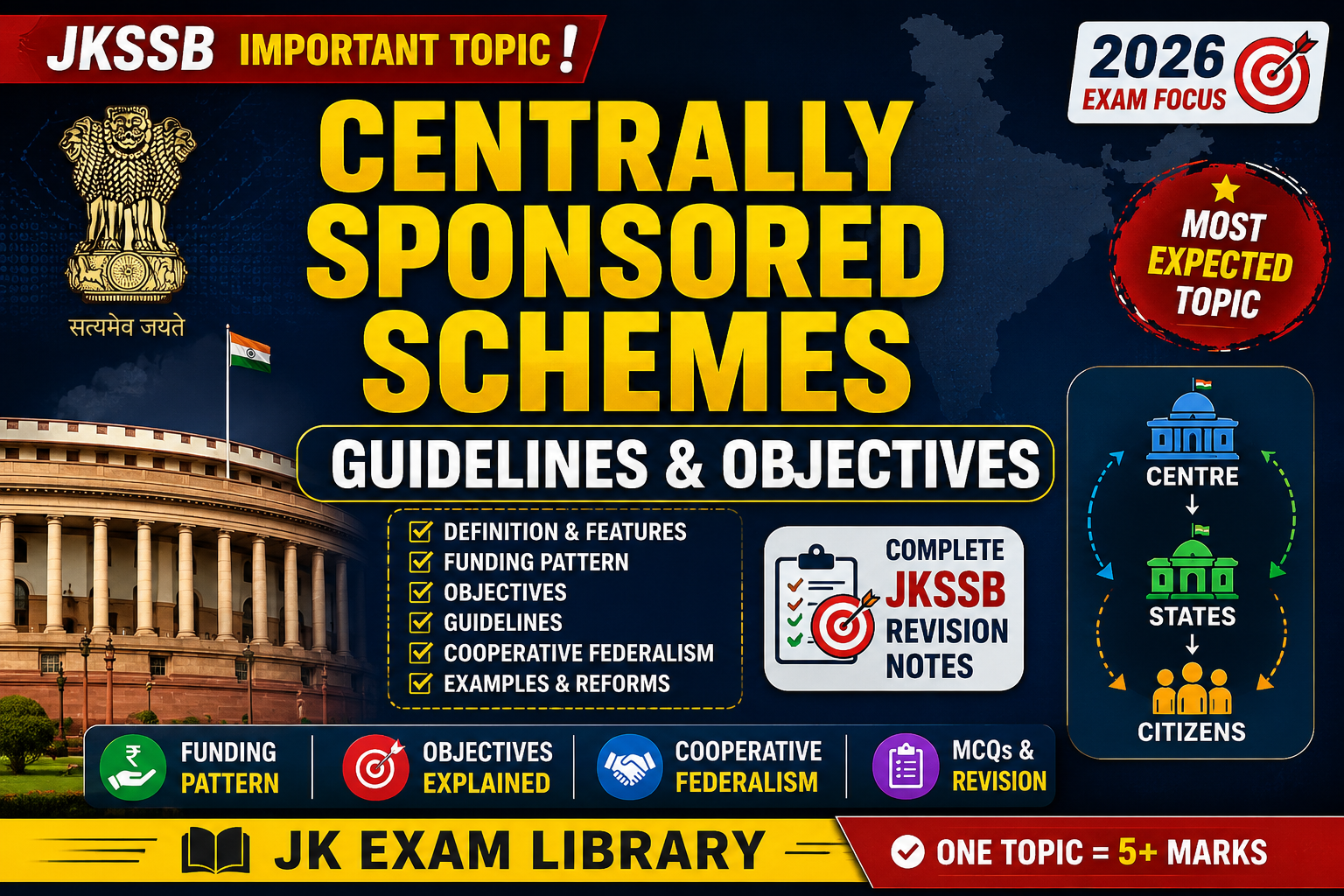
Centrally Sponsored Schemes (CSS): Guidelines and Objectives
Introduction
In modern governance, governments are not merely expected to maintain law and order. Citizens also expect quality education, healthcare, rural development, employment opportunities, housing, sanitation, social security, and infrastructure.
India follows a federal system where powers are divided between the Union Government and State Governments. However, many developmental challenges such as poverty, malnutrition, unemployment, poor healthcare, and educational inequality require coordinated action across the country.
To address these issues, the Government of India implements Centrally Sponsored Schemes (CSS) in partnership with State Governments.
For JKSSB aspirants, Centrally Sponsored Schemes form an important topic under:
- Indian Polity
- Governance
- Public Administration
- Social Welfare
- Economic Development
- Current Affairs
Questions are frequently asked regarding:
- Funding patterns
- Objectives
- Examples
- Implementation mechanism
- Difference between Central Sector and Centrally Sponsored Schemes
- NITI Aayog recommendations
- Role of States
Understanding the concept is more important than memorizing scheme names.
Read J&K Reorganisation Act 2019
What are Centrally Sponsored Schemes?
Definition
Centrally Sponsored Schemes (CSS) are schemes funded jointly by the Central Government and State Governments but implemented mainly by the States.
The Central Government designs the scheme and provides a major share of funding, while States contribute the remaining amount and implement the programme at the ground level.
Simple Understanding
Think of CSS as a partnership model.
- Centre provides policy direction.
- Centre provides significant funding.
- States execute the scheme.
- Benefits reach citizens through local administration.
Quick Concept Summary
| Aspect | Centrally Sponsored Scheme |
|---|---|
| Funding | Shared by Centre and States |
| Design | Central Government |
| Implementation | State Governments |
| Objective | National development goals |
| Monitoring | Centre and States jointly |
| Beneficiaries | Citizens |
Constitutional Background of CSS
A common question among students is:
If India is a federal country, why does the Centre intervene in state subjects?
The answer lies in cooperative federalism.
Many welfare subjects fall under the State List, such as:
- Public health
- Agriculture
- Local governance
- Rural development
However, national development requires uniform progress.
Therefore:
- Centre provides financial assistance.
- States implement according to local needs.
This arrangement strengthens national development without weakening federalism.
Concept of Cooperative Federalism
Meaning
Cooperative Federalism refers to collaboration between the Union and State Governments for achieving common developmental goals.
Instead of competing, both levels of government work together.
CSS as an Example of Cooperative Federalism
Examples:
- Health programmes
- Rural employment
- School education
- Drinking water projects
All require:
- National planning
- State execution
Thus CSS has become one of the strongest practical examples of cooperative federalism in India.
Objectives of Centrally Sponsored Schemes
The government introduces CSS to achieve several national objectives.
1. Reduction of Regional Imbalances
India has vast regional disparities.
Some regions have:
- Better roads
- Better schools
- Better healthcare
Others lag behind.
CSS ensures that poorer and backward regions receive targeted assistance.
Example
Educational schemes help improve literacy in educationally backward districts.
2. Poverty Alleviation
One of the primary objectives is poverty reduction.
Various schemes target:
- Rural poor
- Urban poor
- Farmers
- Women
- Scheduled Castes
- Scheduled Tribes
Importance
Poverty reduction contributes directly to:
- Social justice
- Economic growth
- Human development
3. Social Welfare
The government seeks to protect vulnerable groups.
These include:
- Women
- Children
- Elderly
- Persons with disabilities
- Marginalized communities
Many CSS focus specifically on welfare and social protection.
4. Human Resource Development
Human development is impossible without:
- Education
- Health
- Nutrition
Several CSS aim at improving:
- Literacy
- School attendance
- Skill development
- Maternal health
- Child health
5. Infrastructure Development
Infrastructure remains essential for development.
CSS support:
- Rural roads
- Housing
- Irrigation
- Water supply
- Electrification
6. National Priorities
Certain issues require uniform nationwide attention.
Examples:
- Swachh Bharat Mission
- Jal Jeevan Mission
- National Health Mission
These are treated as national priorities.
Major Features of Centrally Sponsored Schemes
Shared Funding Pattern
The most important feature.
Both Centre and States contribute financially.
National Objectives
Every CSS seeks to achieve national developmental goals.
Flexibility for States
States can adapt implementation according to local conditions.
This is important because:
- Geography differs.
- Population differs.
- Socio-economic conditions differ.
Performance Monitoring
The Central Government continuously monitors:
- Utilization of funds
- Progress
- Outcomes
Accountability Mechanism
Regular:
- Audits
- Reports
- Reviews
- Evaluations
ensure accountability.
Funding Pattern of CSS
This is one of the most frequently asked exam areas.
General Category States
| Contributor | Share |
|---|---|
| Centre | 60% |
| State | 40% |
North-Eastern and Himalayan States
| Contributor | Share |
|---|---|
| Centre | 90% |
| State | 10% |
Why Higher Central Share?
Because these states face:
- Difficult terrain
- Connectivity challenges
- Development constraints
Examples:
- Arunachal Pradesh
- Nagaland
- Mizoram
- Sikkim
- Himachal Pradesh
- Uttarakhand
Union Territories with Legislature
| Contributor | Share |
|---|---|
| Centre | 60% |
| UT | 40% |
Union Territories without Legislature
| Contributor | Share |
|---|---|
| Centre | 100% |
Students Often Confuse
| Topic | Meaning |
|---|---|
| Central Sector Scheme | Fully funded by Centre |
| Centrally Sponsored Scheme | Funded jointly by Centre and States |
Difference Between Central Sector Schemes and Centrally Sponsored Schemes
| Basis | Central Sector Scheme | Centrally Sponsored Scheme |
|---|---|---|
| Funding | 100% Centre | Shared |
| Implementation | Central agencies | State Governments |
| State Contribution | No | Yes |
| Control | Centre | Shared |
| Federal Nature | Less collaborative | Cooperative federalism |
Guidelines Governing Centrally Sponsored Schemes
The Government of India issues detailed operational guidelines.
These guidelines define:
- Objectives
- Beneficiaries
- Funding
- Monitoring mechanism
- Evaluation methods
Components of CSS Guidelines
Eligibility Criteria
Who can receive benefits?
Examples:
- Farmers
- Women
- Students
- Rural households
Financial Guidelines
Specify:
- Cost sharing
- Fund release mechanism
- Utilization certificates
Monitoring Framework
Monitoring ensures:
- Transparency
- Efficiency
- Accountability
Reporting Mechanism
States submit:
- Progress reports
- Financial reports
- Outcome reports
Evaluation Procedures
Independent agencies may assess:
- Impact
- Effectiveness
- Performance
Rationalization of Centrally Sponsored Schemes
Over time, the number of CSS increased significantly.
This created:
- Duplication
- Administrative burden
- Financial inefficiency
Therefore reforms became necessary.
Recommendations of NITI Aayog
The successor of the NITI Aayog, which replaced the Planning Commission, recommended streamlining CSS.
Major objectives:
- Better efficiency
- Reduced overlap
- Improved outcomes
- Greater flexibility
Why Rationalization Was Needed?
| Problem | Impact |
|---|---|
| Too many schemes | Administrative complexity |
| Overlapping objectives | Resource wastage |
| Multiple reporting systems | Delays |
| Poor coordination | Reduced effectiveness |
Core Principles of CSS Reforms
Flexibility
States should have flexibility according to local requirements.
Outcome-Based Governance
Focus should shift from expenditure to outcomes.
Earlier
Money spent = Success
Now
Results achieved = Success
Transparency
Digital monitoring systems improve transparency.
Accountability
Officials become accountable for performance indicators.
Major Centrally Sponsored Schemes in India
National Health Mission (NHM)
Objectives:
- Improve healthcare delivery
- Reduce maternal mortality
- Reduce infant mortality
- Strengthen health infrastructure
PM Poshan Scheme
Formerly Mid-Day Meal Scheme.
Objectives:
- Improve nutrition
- Increase school attendance
- Reduce dropout rates
Jal Jeevan Mission
Objective:
Provide safe tap water to every rural household.
Pradhan Mantri Awas Yojana (PMAY)
Objective:
Affordable housing for all.
Mahatma Gandhi National Rural Employment Guarantee Scheme (MGNREGS)
Officially linked with employment guarantee.
Objectives:
- Rural employment
- Asset creation
- Poverty reduction
Swachh Bharat Mission
Objectives:
- Sanitation
- Cleanliness
- Open Defecation Free villages
Importance of CSS in Jammu & Kashmir
For JKSSB examinations, local relevance is extremely important.
Jammu & Kashmir benefits from numerous CSS in sectors such as:
- Rural development
- Healthcare
- Tourism
- Education
- Water supply
- Agriculture
Because of difficult terrain and developmental requirements, centrally supported programmes play a significant role in improving infrastructure and public services.
Challenges Faced by Centrally Sponsored Schemes
Delay in Fund Release
Funds may not reach beneficiaries on time.
Administrative Bottlenecks
Complex procedures can slow implementation.
Lack of Capacity
Some regions may lack trained manpower.
Monitoring Issues
Ground-level verification remains challenging.
Duplication of Efforts
Different schemes sometimes target similar objectives.
Exam-Oriented One-Liners
| Fact | Answer |
|---|---|
| CSS are funded by | Centre and States |
| CSS represent | Cooperative Federalism |
| Central Sector Schemes funded by | Centre only |
| Main implementing authority of CSS | State Governments |
| CSS guidelines include | Funding, monitoring, reporting |
| Monitoring focuses on | Outcomes and performance |
| Rationalization recommended by | NITI Aayog |
| Objective of Jal Jeevan Mission | Tap water to households |
| Objective of PMAY | Housing for all |
| Objective of NHM | Better healthcare |
Memory Trick
CSS
C → Cooperative Federalism
S → Shared Funding
S → State Implementation
Remember:
"CSS = Centre Supports, States Serve"
Quick Revision Block
| Topic | Key Point |
|---|---|
| CSS | Jointly funded schemes |
| Funding Pattern | Usually 60:40 |
| Himalayan & NE States | 90:10 |
| Objective | National development |
| Implementation | States |
| Monitoring | Centre + States |
| Federal Concept | Cooperative Federalism |
| Examples | NHM, PMAY, SBM, JJM |
JKSSB Practice MCQs
1. Centrally Sponsored Schemes are financed by:
A. Centre only
B. States only
C. Centre and States jointly
D. Local Bodies only
Answer: C
Solution: CSS follow a shared funding pattern between Centre and States.
2. Which principle is best reflected by Centrally Sponsored Schemes?
A. Judicial Review
B. Cooperative Federalism
C. Separation of Powers
D. Parliamentary Sovereignty
Answer: B
Solution: CSS involve cooperation between Union and State Governments.
3. Which of the following is fully funded by the Central Government?
A. Centrally Sponsored Scheme
B. Central Sector Scheme
C. State Sector Scheme
D. District Plan Scheme
Answer: B
Solution: Central Sector Schemes are funded entirely by the Centre.
4. Which institution recommended rationalization of CSS?
A. Election Commission
B. Finance Commission
C. NITI Aayog
D. UPSC
Answer: C
Solution: NITI Aayog recommended streamlining and rationalization of CSS.
5. Jal Jeevan Mission primarily aims to provide:
A. Free electricity
B. Rural roads
C. Tap water connections
D. Health insurance
Answer: C
Solution: Jal Jeevan Mission focuses on household tap water supply.
6. Typical funding pattern for General Category States under CSS is:
A. 100:0
B. 90:10
C. 75:25
D. 60:40
Answer: D
Solution: Most CSS follow a 60:40 Centre-State sharing pattern.
Frequently Asked Questions (FAQs)
What are Centrally Sponsored Schemes?
These are schemes funded jointly by the Union Government and State Governments but implemented mainly through State Governments.
Why are CSS important?
They help achieve national development goals while respecting India's federal structure.
What is the main objective of CSS?
To support socio-economic development through coordinated action between Centre and States.
What is the difference between CSS and Central Sector Schemes?
CSS are jointly funded, whereas Central Sector Schemes are fully funded by the Central Government.
Which constitutional principle is reflected in CSS?
Cooperative Federalism.
Final Revision for aspirants use
Centrally Sponsored Schemes are among the most important instruments of welfare governance in India. They combine national priorities with local implementation through a partnership between the Union and State Governments. Their primary objectives include poverty reduction, social welfare, infrastructure development, human resource development, and balanced regional growth. The usual funding pattern is 60:40, while North-Eastern and Himalayan States generally receive 90:10 assistance. CSS embody the spirit of cooperative federalism and remain a favourite area for JKSSB, SSC, UPSC, and other competitive examinations.
Last-Minute JKSSB Revision
- CSS = Centre + State Funding
- Central Sector Scheme = 100% Centre Funding
- CSS = Cooperative Federalism in Practice
- General Funding Pattern = 60:40
- Himalayan/NE States = 90:10
- Implemented Mainly by States
- Monitored by Centre and States
- Rationalization Recommended by NITI Aayog
- Important Examples: NHM, PMAY, Jal Jeevan Mission, Swachh Bharat Mission, PM Poshan, MGNREGS
JKSSB Exam Tip: Questions are often framed around funding patterns, cooperative federalism, differences between CSS and Central Sector Schemes, and flagship welfare programmes. Focus on concepts rather than memorizing only scheme names.