
Time and Distance – Complete Study Notes for JKSSB Aspirants
Time and Distance is one of the most important chapters in Quantitative Aptitude. Questions from this topic regularly appear in JKSSB, SSC, Banking, Railways, Police, Army, and other competitive examinations.
Many students initially find this chapter difficult because it involves formulas, unit conversions, trains, boats, relative speed, and average speed. However, once the core concepts are understood properly, it becomes one of the easiest scoring topics in the entire syllabus.
The examiner rarely asks complicated mathematics. Most questions are based on conceptual understanding and correct application of formulas.
Therefore, instead of memorizing tricks blindly, students should first understand the logic behind speed, distance, and time.
Chck General English Article Notes
Introduction to Time and Distance
Every movement involves three basic quantities:
- Distance Covered
- Time Taken
- Speed of Movement
These three quantities are interconnected.
Suppose a person travels:
- 60 km in 1 hour
- 120 km in 2 hours
- 180 km in 3 hours
In all cases, the speed remains the same:
60 km/hour
This simple relationship forms the foundation of the entire chapter.
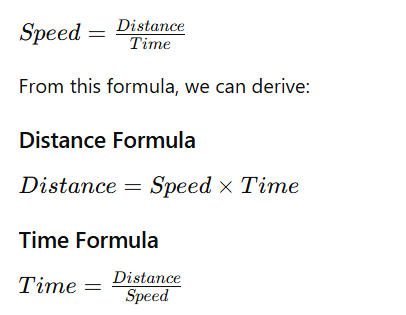
Basic Formula of Time and Distance
Understanding Speed
Speed tells us how much distance is covered in a unit of time.
Example
A car travels 120 km in 2 hours.
Speed = 120 ÷ 2
Speed = 60 km/hr
Meaning:
The vehicle covers 60 kilometres every hour.
Relationship Between Time and Distance
Students often miss this conceptual point.
When distance remains constant:
| Speed Increases | Time Taken |
|---|---|
| More | Less |
| Speed Decreases | Time Taken |
|---|---|
| Less | More |
This means:
Time is inversely proportional to speed.
Important Concept of Proportion
Suppose:
- Speed becomes double
- Distance remains same
Then:
Time becomes half.
Similarly:
| Change in Speed | Change in Time |
|---|---|
| Double | Half |
| Triple | One-third |
| Half | Double |
| One-fourth | Four times |
Exam Observation
JKSSB frequently asks conceptual questions based on this inverse relationship.
Units of Speed
Speed may be expressed in:
- km/hr
- m/s
- m/min
- cm/s
Students often lose marks due to incorrect unit conversion.
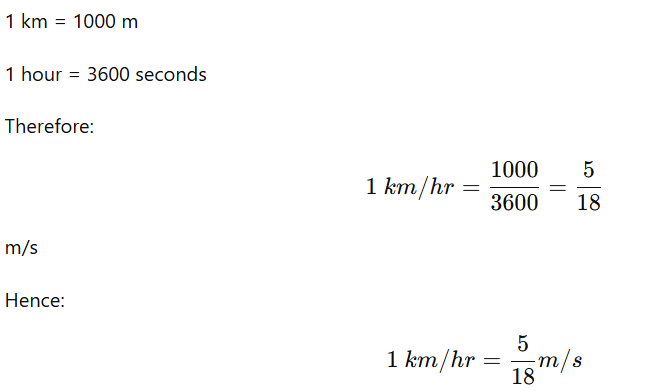
Conversion Between km/hr and m/s
This is one of the most important concepts.
km/hr to m/s
Multiply by:
5/18
m/s to km/hr
Multiply by:
18/5
Why 5/18 and 18/5?
Students usually memorize this without understanding.
We know:
Important Conversion Table
| km/hr | m/s |
|---|---|
| 18 | 5 |
| 36 | 10 |
| 54 | 15 |
| 72 | 20 |
| 90 | 25 |
| 108 | 30 |
Quick Revision Trick
Remember:
18 ↔ 5
Everything else can be derived instantly.
Average Speed
Average speed is one of the most misunderstood topics.
Many students incorrectly calculate average speed by taking simple averages.
This works only in special situations.
Formula of Average Speed
Average Speed=Total DistanceTotal TimeAverage\ Speed=\frac{Total\ Distance}{Total\ Time}Average Speed=Total TimeTotal Distance
Always use this formula.
Example
A person travels:
- 100 km at 50 km/hr
- Another 100 km at 25 km/hr
Find average speed.
Step 1
Time for first journey:
100 ÷ 50 = 2 hours
Step 2
Time for second journey:
100 ÷ 25 = 4 hours
Step 3
Total Distance
100 + 100 = 200 km
Step 4
Total Time
2 + 4 = 6 hours
Step 5
Average Speed
200 ÷ 6
= 33.33 km/hr
Special Formula for Equal Distances
When distances are equal:
Average Speed=2xyx+yAverage\ Speed = \frac{2xy}{x+y}Average Speed=x+y2xy
Where:
x = first speed
y = second speed
Example
Speeds:
- 40 km/hr
- 60 km/hr
Average Speed
=2×40×60100= \frac{2\times40\times60}{100}=1002×40×60 =48= 48=48
km/hr
Important Exam Trap
Many students write:
(40 + 60)/2 = 50
This is wrong.
Correct answer = 48 km/hr
Relative Speed
Relative speed means the speed of one object with respect to another object.
This topic is heavily used in:
- Trains
- Boats
- Racing problems
- Crossing problems
Case 1: Moving in Same Direction
Relative Speed
=Difference of Speeds= Difference\ of\ Speeds=Difference of Speeds
Example
Train A = 70 km/hr
Train B = 50 km/hr
Relative Speed
= 70 – 50
= 20 km/hr
Case 2: Moving in Opposite Directions
Relative Speed
=Sum of Speeds= Sum\ of\ Speeds=Sum of Speeds
Example
Train A = 60 km/hr
Train B = 40 km/hr
Relative Speed
= 60 + 40
= 100 km/hr
Students Often Confuse
| Situation | Relative Speed |
|---|---|
| Same Direction | Difference |
| Opposite Direction | Sum |
| Boat Upstream | Difference |
| Boat Downstream | Sum |
| Train Crossing Train | Relative Speed |
Time Taken to Cover Distance
Once speed is known:
Time = Distance ÷ Speed
This simple idea solves most train questions.
Percentage Change in Speed and Time
Very important for JKSSB.
If speed increases by x%
Then:
Time decreases=x100+x×100Time\ decreases= \frac{x}{100+x} \times100Time decreases=100+xx×100
%
Example
Speed increases by 25%.
Decrease in time:
25125×100\frac{25}{125} \times10012525×100
= 20%
Answer = 20%
Percentage Revision Table
| Increase in Speed | Decrease in Time |
|---|---|
| 20% | 16.67% |
| 25% | 20% |
| 50% | 33.33% |
| 100% | 50% |
These values are frequently asked.
Trains – Most Important Competitive Exam Topic
A train question is simply a Time and Distance question.
Students fear trains unnecessarily.
The same formula applies:
Distance = Speed × Time
Only the distance changes.
When a Train Crosses a Pole
Distance Covered
=
Length of Train
Only the train length matters because the pole has no length.
Formula
Time=Length of TrainSpeedTime = \frac{Length\ of\ Train}{Speed}Time=SpeedLength of Train
Example
Train Length = 180 m
Speed = 54 km/hr
Convert speed:
54 × 5/18
= 15 m/s
Time
= 180 ÷ 15
= 12 seconds
Answer = 12 seconds
When a Train Crosses a Platform
Distance Covered
=
Length of Train + Length of Platform
Example
Train Length = 150 m
Platform Length = 250 m
Distance Covered
= 400 m
If speed = 20 m/s
Time
= 400 ÷ 20
= 20 seconds
Quick Revision Table
| Situation | Distance Covered |
|---|---|
| Crossing Pole | Train Length |
| Crossing Person | Train Length |
| Crossing Platform | Train Length + Platform Length |
| Crossing Bridge | Train Length + Bridge Length |
Memory Map
Train Crossing Problems
Pole → Train Length

Person → Train Length

Platform → Train + Platform

Bridge → Train + Bridge

Train → Sum of Train Lengths
Train Crossing Another Train
When two trains cross each other:
Distance Covered
=
Sum of Lengths of Both Trains
Speed Used
=
Relative Speed
Example
Train A = 150 m
Train B = 250 m
Total Distance
= 400 m
If relative speed = 20 m/s
Time
= 400 ÷ 20
= 20 seconds
Exam-Oriented One-Liners
| Fact | Remember |
|---|---|
| Pole has length | Zero |
| Train crossing train | Relative speed used |
| Opposite direction | Add speeds |
| Same direction | Subtract speeds |
| Platform crossing | Add lengths |
| Train speed conversion | 5/18 and 18/5 |
Quick Revision Block
Core Formulas
| Formula | Expression |
|---|---|
| Speed | Distance ÷ Time |
| Distance | Speed × Time |
| Time | Distance ÷ Speed |
| Average Speed | Total Distance ÷ Total Time |
| Relative Speed (same direction) | Difference |
| Relative Speed (opposite direction) | Sum |