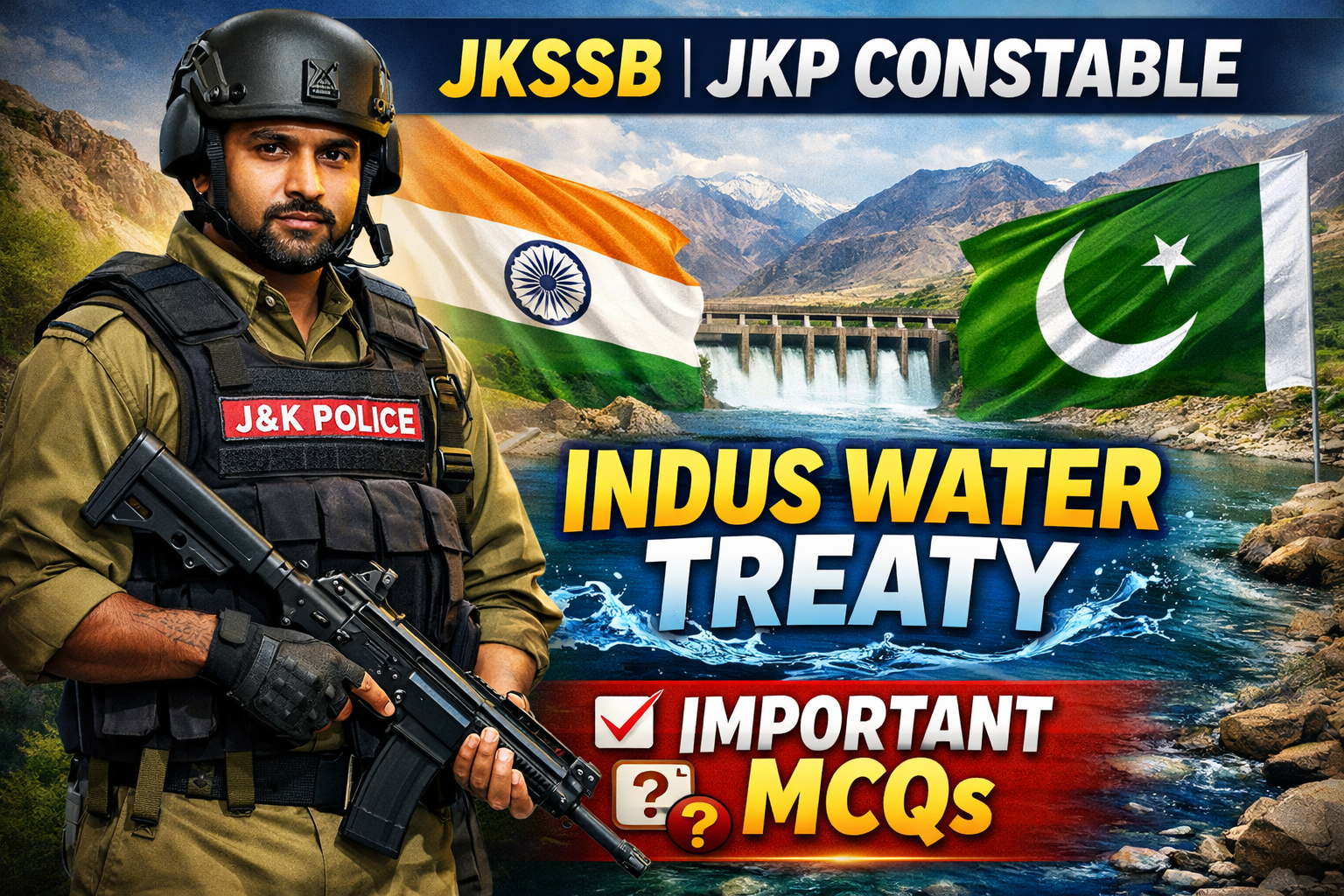
JKSSB JKP Constable 2026, mastering Indus Water Treaty Important MCQs is crucial. Questions from the Indus River system, India-Pakistan relations, and static GK frequently appear in JKSSB exams. Many aspirants lose easy marks in such topics due to incomplete conceptual clarity.
This 2026-updated topiccovers verified facts, structured notes, a summary table, and exam-oriented MCQs to help you dominate this topic.
Download complete Study material and Full mocktests for jkp constable from jk exam library
What is the Indus Water Treaty?
The Indus Water Treaty (1960) is a water-sharing agreement between India and Pakistan, brokered by the World Bank. Signed on 19 September 1960 in Karachi by Indian Prime Minister Jawaharlal Nehru and Pakistani President Ayub Khan, it allocated the Eastern Rivers to India and the Western Rivers to Pakistan.
Indus Water Treaty for JKSSB JKP Constable 2026
Background of Indus Water Treaty 1960
After the partition of India in 1947, water disputes arose over the Indus basin rivers. To resolve tensions, the World Bank facilitated negotiations lasting nearly a decade.
The treaty was finally signed on 19 September 1960 in Karachi.
Signed By:
India – Jawaharlal Nehru
Pakistan – Ayub Khan
Brokered by the World Bank
This makes it one of the most successful and long-standing India Pakistan river agreements.
Which Rivers Are Covered Under Indus Water Treaty?
The Indus River system consists of six major rivers divided into Eastern and Western Rivers.
Allocation Pattern:
| River Category | Rivers | Allocation |
|---|---|---|
| Eastern Rivers | Ravi, Beas, Sutlej | Exclusive use by India |
| Western Rivers | Indus, Jhelum, Chenab | Primarily for Pakistan (India allowed limited use for hydroelectric & non-consumptive purposes) |
This classification is extremely important for JKSSB static GK 2026.
What Are the Key Features of Indus Water Treaty?
Major Provisions:
Division of rivers into Eastern and Western categories
India granted full rights over Eastern Rivers
Pakistan granted rights over Western Rivers
India allowed limited irrigation and hydroelectric projects on Western Rivers
Establishment of Permanent Indus Commission
Dispute resolution mechanism (Neutral Expert / Court of Arbitration)
Projects like Salal Dam dispute, Baglihar dam dispute, and Kishanganga project issue were addressed within treaty mechanisms.
As per the latest official update, the treaty continues to remain operational despite periodic diplomatic tensions.
Why Is Indus Water Treaty Important for JKSSB 2026?
Frequently asked in JKSSB JKP Constable GK
Appears in previous year questions
Relevant for Jammu & Kashmir region (Chenab, Jhelum flow through J&K)
Linked with current affairs and India-Pakistan relations
Important under Polity + Geography + International Relations cluster
If you check JKSSB exam important topics 2026, this treaty consistently remains relevant.
Indus Water Treaty Important MCQs 2026
Below are fully verified MCQs for JKSSB Constable exam.
1. When was the Indus Water Treaty signed?
A. 1947
B. 1955
C. 1960
D. 1971
Answer: C
Solution: Signed on 19 September 1960.
2. Indus Water Treaty was brokered by which organization?
A. United Nations
B. IMF
C. World Bank
D. WTO
Answer: C
Solution: The World Bank mediated negotiations.
3. Which river is NOT an Eastern River?
A. Ravi
B. Beas
C. Sutlej
D. Chenab
Answer: D
Solution: Chenab is a Western River.
4. Which Prime Minister signed the treaty from India?
A. Lal Bahadur Shastri
B. Jawaharlal Nehru
C. Indira Gandhi
D. Rajiv Gandhi
Answer: B
Solution: Signed by Jawaharlal Nehru.
5. The Permanent Indus Commission consists of:
A. One commissioner from each country
B. Two from India only
C. UN representatives
D. Five members
Answer: A
Solution: Each country appoints one commissioner.
6. India has exclusive rights over which rivers?
A. Indus, Jhelum, Chenab
B. Ravi, Beas, Sutlej
C. Jhelum, Ravi, Chenab
D. Sutlej, Indus, Chenab
Answer: B
Solution: These are Eastern Rivers.
7. Baglihar Dam is built on which river?
A. Ravi
B. Chenab
C. Beas
D. Indus
Answer: B
Solution: Located on Chenab in J&K.
8. Kishanganga Project is related to which river?
A. Jhelum Basin
B. Ravi
C. Sutlej
D. Beas
Answer: A
Solution: It is on a tributary of Jhelum.
How to Prepare Indus Water Treaty for JKSSB 2026?
Step-by-Step Strategy
Understand river classification clearly.
Memorize signing year and signatories.
Revise dispute examples (Baglihar, Kishanganga).
Practice previous year questions.
Attempt free JKSSB mock test regularly.
Download complete syllabus PDF and mark static GK topics.
Practice previous year questions weekly.
Consistency ensures retention in static GK.
3 Question-Based Concepts for Voice Search Optimization
What is the role of World Bank in Indus Water Treaty?
The World Bank mediated negotiations, helped draft the agreement, and provided financial assistance for infrastructure adjustments.
Can India stop water to Pakistan under Indus Water Treaty?
As per treaty provisions, India must follow allocated rights. It can utilize its permitted share but cannot arbitrarily stop Western Rivers allocated to Pakistan.
Why is Indus Water Treaty relevant for JKP Constable exam?
Because Jammu & Kashmir lies in the Indus basin region, making river and hydroelectric disputes directly relevant for regional exams.
Quick Revision Summary (One-Page Recall)
Signed: 19 September 1960
Mediator: World Bank
Signed by: Jawaharlal Nehru & Ayub Khan
Eastern Rivers: Ravi, Beas, Sutlej (India)
Western Rivers: Indus, Jhelum, Chenab (Pakistan)
Commission: Permanent Indus Commission
Disputes: Baglihar, Kishanganga
Highly important for JKSSB 2026
Revise this summary before exam day.
FAQs – Indus Water Treaty JKSSB 2026
1. When was Indus Water Treaty signed and by whom?
It was signed on 19 September 1960 by Jawaharlal Nehru (India) and Ayub Khan (Pakistan), brokered by the World Bank.
2. Which rivers are given to India under Indus Water Treaty?
India has exclusive rights over Ravi, Beas, and Sutlej (Eastern Rivers).
3. Which rivers are allocated to Pakistan?
Indus, Jhelum, and Chenab (Western Rivers) are primarily allocated to Pakistan.
4. Is Indus Water Treaty important for JKSSB JKP Constable 2026?
Yes. It is a high-weightage static GK topic frequently asked in JKSSB and other government exams.
5. What is Permanent Indus Commission?
It is a bilateral commission with one commissioner from each country to implement and manage treaty provisions.
6. Has the Indus Water Treaty been cancelled?
As per the latest official update, the treaty remains in force.
7. Which dam dispute went to Neutral Expert under the treaty?
Baglihar Dam dispute was referred to a Neutral Expert.
8. From which subject does Indus Water Treaty question come in JKSSB?
It comes under Static GK, Geography, and International Relations.
Conclusion
The JKSSB JKP Constable Indus Water Treaty Important MCQs 2026 topic is a guaranteed scoring area if prepared strategically. Focus on river classification, signing year, signatories, and dispute examples. As per the latest official update, the treaty remains active, making it relevant for current affairs and static GK.
Revise regularly, attempt mock tests, and strengthen your JKSSB 2026 preparation with consistent MCQ practice. Smart preparation today ensures selection tomorrow.
📚 View More JKSSB 2026 Important Blogs
🔹 1. 50 Important MCQs on SAARC & ASEAN for JKSSB JKP Constable 2026
🔹 2. Top MCQs on Rivers and Lakes of India for JKSSB Exams 2026
🔹 3. J&K Panchayati Raj System for JKSSB Exams 2026
🎯 Prepare Smart for JKSSB 2026
• Attempt free JKSSB mock test
• Download complete syllabus PDF
• Practice previous year questions
Stay consistent. Stay ahead. Selection in 2026 is possible with daily revision and smart MCQ practice.